
The F5 BIG-IP LTM 8950: A Hands-On Perspective
In the world of enterprise networking, few names carry as much weight as F5. The
BIG-IP LTM 8950 represents a specific era of data center hardware where raw throughput and reliability were the only metrics that mattered. If you have spent any time managing server farms, you know that this box is designed to sit between your users and your applications, acting as the ultimate traffic cop. It is not just a load balancer; it is a full-proxy device that manages the entire lifecycle of a connection, ensuring that your backend servers don't collapse under pressure.
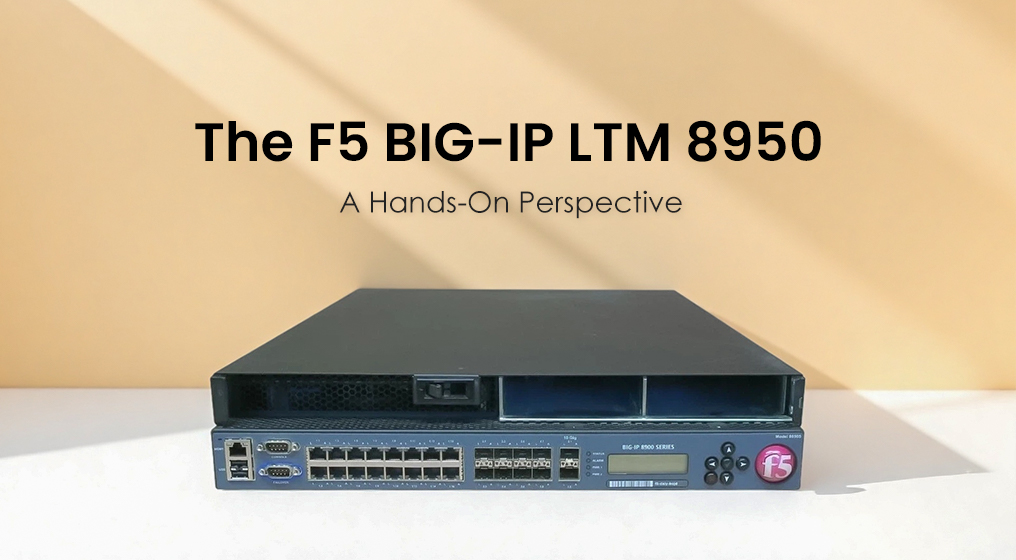
When you first rack the 8950, the build quality is immediately apparent. This is not a flimsy appliance; it is a dense, industrial piece of kit designed to withstand the rigors of a 24/7 data center environment. The front panel is dominated by a high density of connectivity options, which is one of its standout physical features. You are typically greeted by 16 Gigabit Ethernet copper ports, which provide immense flexibility for segmenting traffic without needing extra top-of-rack switches. Alongside these, you will find the SFP slots for fiber uplinks, ensuring that your backbone connectivity never becomes a bottleneck. The redundant power supplies on the rear add to the sense of durability, promising that this device will keep running even if your power distribution units hiccup.

Under the hood, the 8950 is built to handle serious throughput. While it is considered a legacy platform today, its specifications were top-tier in its prime. It relies on a dual-CPU architecture to separate the management plane from the data plane, ensuring that your configuration changes don't interrupt live traffic. The system typically comes equipped with 16GB of RAM and dual hard drives (usually configured in a RAID 1 mirror for safety), providing enough headroom to handle complex traffic shaping and logging tasks.
Here is a breakdown of the core specifications that define its performance envelope:
| Feature |
Specification |
| Processor Architecture |
Dual CPU (Multi-core) |
| System Memory |
16 GB |
| Storage |
2 x 300 GB HDD (Mirrored) |
| Layer 4 Throughput |
Up to 20 Gbps |
| SSL TPS |
Hardware acceleration capable of ~56,000 TPS |
| Connectivity |
16 x 1GbE Copper, 4 x 1GbE SFP (Fiber) |
| Compression |
Hardware-based acceleration |
The real magic of the 8950, however, lies in the software capabilities it unlocks. Running the TMOS (Traffic Management Operating System), it allows for granular control over your network traffic. The standout feature here is iRules, a scripting capability that allows administrators to inspect and manipulate traffic in real-time. You aren't just balancing loads; you are programmatically deciding where a packet goes based on its content, the user's browser, or the time of day. Furthermore, features like OneConnect and SSL Offloading are critical for user experience. By terminating SSL connections on the F5, you offload the heavy mathematical lifting from your web servers, allowing them to focus on serving the application. This results in faster page loads and a snappier experience for the end-user.
From a compatibility standpoint, the 8950 is a veteran. It plays nicely with almost any ecosystem, supporting standard routing protocols like BGP and OSPF, and integrating seamlessly with Active Directory and various logging tools. However, it is crucial to acknowledge the lifecycle status of this unit. The 8950 has reached End of Life (EOL). While it is a robust piece of hardware, it is no longer the bleeding edge. It is best suited for stable, established environments rather than cutting-edge cloud-native deployments that require the absolute latest software features.
When weighing the value proposition, you have to look at this through the lens of the secondary market. Since the unit is discontinued, you won't find it with a standard retail price tag. Its value lies in its reliability and capability at a fraction of the cost of new gear. For a lab environment, a testing sandbox, or a mid-sized enterprise that needs enterprise-grade traffic management on a budget, a refurbished 8950 is a steal.
However, the user experience does come with caveats. The "Pros" are obvious: rock-solid stability, deep traffic visibility, and massive port density. But the "Cons" are equally real. You are dealing with older silicon that consumes more power and generates more heat than modern appliances. The spinning hard drives are a potential point of failure compared to modern SSDs. If you are running a mission-critical banking application, the risk of running End-of-Life hardware might outweigh the cost savings. But for a DevOps team needing a powerful traffic manager to test configurations before pushing to the cloud, the 8950 remains a highly capable, robust tool that punches well above its weight class.