
Intellectual Property
Hot selling product recommendations
View More




















FortiGate FG-600D vs. FG-800D: A Practical Comparison for Network Architects
When evaluating Fortinet's FG-600D and FG-800D security appliances, the decision often hinges on the specific demands of your network environment. Both are formidable firewalls, but they cater to slightly different pressures and scales. The newer FG-800D generally builds upon the 600D's foundation with enhanced connectivity and potential performance gains, making the choice more about matching specs to your network's real-world traffic and growth plans. Let's break down the details beyond the marketing sheets.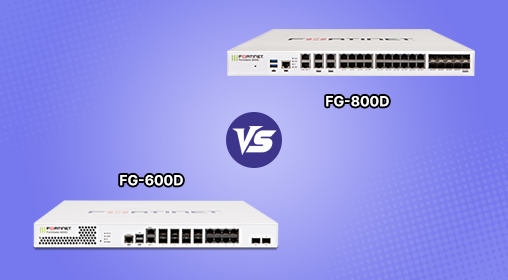
At the heart of the comparison are the core hardware specifications. The FG-800D pushes ahead with a more extensive port density. It boasts twenty hardware-accelerated GE RJ45 ports, which is a significant increase over the FG-600D's eight. Both units feature two 10 GE SFP+ slots for high-speed backbone connections, but the 800D further includes eight dedicated GE SFP slots, offering greater flexibility for fiber connections compared to its sibling. Both appliances are equipped with hardware acceleration chips (like the SPU NP6 and CP8) to offload demanding tasks, ensuring smooth performance under load. In terms of basic storage, the FG-800D comes with 240 GB of onboard SSD storage, while the FG-600D is listed with 120 GB, which can be a factor for logging and reporting purposes.
A side-by-side look at their key physical parameters reveals a family resemblance with subtle differences. They share the same compact 1 RU form factor, making them suitable for standard server racks. The FG-800D measures 1.77 x 17.0 x 16.4 inches (45 x 432 x 416 mm) and weighs 19.0 lbs (8.6 kg). Specific dimensions for the 600D are not detailed in the available information, but as a same-generation 1U appliance, it is expected to be similar. Both support optional redundant, hot-swappable power supplies, a critical feature for maintaining uptime. The operating temperature range for the FG-800D is specified as 32°F to 104°F (0°C to 40°C), ensuring reliability in typical data center conditions.
Functionally, both devices run Fortinet's FortiOS, providing a consistent suite of security services like IPS, application control, and VPN. However, the hardware differences dictate their operational sweet spots. The FG-800D, with its higher port count and interface variety, is explicitly designed for the connectivity needs of mid-sized to large enterprises and data center perimeters. Its four accelerated GE RJ45 bypass interfaces are a standout feature for critical network segments, allowing traffic to pass through uninterrupted even during a device failure or maintenance window. The FG-600D, with a more modest port configuration, is well-suited for smaller enterprise core networks or larger branch offices where the raw number of physical connections is a lower priority.
From a usability standpoint, the increased port density of the FG-800D translates directly to greater deployment flexibility. Network architects can dedicate ports to specific services or segments without immediately requiring additional switches. The inclusion of multiple SFP and SFP+ slots also makes it easier to adapt to mixed copper and fiber cabling plants. For administrators, the management experience is identical through FortiOS, but the FG-800D's hardware might provide more headroom, leading to a snappier interface when multiple features are enabled simultaneously. The peace of mind offered by the built-in bypass interfaces on the 800D is a significant advantage for scenarios where maximum availability is non-negotiable.
When it comes to stability and reliability, both models are built to enterprise standards. The option for redundant power supplies is a key contributor to stability, available for both. The FG-800D's bypass interfaces give it a tangible edge in high-availability scenarios, physically ensuring network continuity. The similar operating temperature and humidity specifications suggest comparable durability under environmental stress.
Weighing the pros and cons is essential. The FG-800D's key advantage is its superior connectivity: more RJ45 ports, additional SFP slots, and integrated bypass interfaces make it a more versatile and resilient unit. The larger onboard storage is also a plus. The potential drawback is that all this capability might be overkill for some environments, leading to unnecessary complexity and power consumption if the extra ports and features go unused. The FG-600D, on the other hand, presents a more focused package. Its main strength is covering the essential security needs for a certain scale of network in a cost-effective manner. Its limitation is clearly the lower port density and absence of specialized features like hardware bypass, which could limit its role in expanding or highly available networks.
Ultimately, the choice is straightforward. If your network requires a high number of physical connections, plans for a mixed media (copper/fiber) environment, or demands the highest level of redundancy through hardware bypass, the FG-800D is the more capable and future-proof investment. For smaller core networks or branch offices where the full spectrum of ports and advanced features like bypass are not required, the FG-600D remains a competent and reliable security appliance that can handle the core security workload effectively. The best choice aligns the appliance's physical and performance characteristics with the specific scale and criticality of your network.