
Intellectual Property
Hot selling product recommendations
View More




















FortiGate FG-501E vs. FG-600E: A Side-by-Side Look at Two Security Powerhouses
Choosing between Fortinet's FG-501E and FG-600E is more than just comparing spec sheets; it's about matching the appliance to the specific pressure points of your network. One is a nimble specialist for leaner operations, while the other is a robust workhorse built for heavier loads. The right choice hinges entirely on the scale of your digital terrain and the weight of the traffic you need to secure. Let's break down the details beyond the brochures.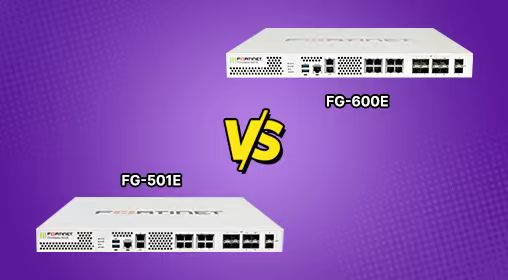
At their core, the difference is one of muscle. The FG-600E is clearly architected for a more demanding environment, featuring superior firewall throughput and VPN capacity. This translates to handling more users and more data simultaneously without breaking a sweat. While both are equipped with dedicated security processing units (SPUs) to accelerate demanding tasks like encryption and threat inspection, the FG-600E's more powerful hardware ensures consistent performance even when every security feature is turned on. The FG-501E, in contrast, delivers solid performance for its class, perfect for organizations where traffic volumes are more predictable and less intense.
A glance at their core specifications makes the performance delta clear.
|
Core Parameter |
FortiGate FG-501E |
FortiGate FG-600E |
|---|---|---|
|
Firewall Throughput |
Lower |
Significantly Higher
|
|
VPN Throughput |
Standard |
Higher Capacity
|
|
Interface Density |
Standard |
Higher port density and optional 10G SFP+ interfaces for high-speed backbone connections
|
|
SPU Acceleration |
Yes (CP/NP ASICs) |
Yes (More powerful CP/NP ASICs)
|
Physically, both units share the no-nonsense, rack-mountable design typical of enterprise hardware. The key differentiator often lies in expansion capabilities. The FG-600E typically offers greater flexibility, sometimes supporting additional hardware modules or boasting a higher default port density, including interfaces ready for 10-gigabit connectivity, which is a clear advantage for core network placements or data center perimeters. The FG-501E's form factor is more fixed, catering to setups where the network topology is simpler and less prone to change.
When it comes to the smarts—the security features and the operating system, FortiOS—the two models are largely identical. They run the same FortiOS version, which means you get access to the same unified threat prevention features, advanced networking capabilities like SD-WAN, and centralized management through FortiManager. The functional difference emerges under load. The FG-600E's hardware allows it to sustain high levels of deep packet inspection, SSL decryption, and intrusion prevention across a much larger volume of traffic. For a smaller network, the FG-501E handles these tasks competently, but pushing its limits with maximum inspection on a saturated connection could introduce latency.
The day-to-day management experience through the web GUI or CLI is consistent, thanks to the common FortiOS. However, user experience is also defined by performance. The FG-600E provides more headroom, which often results in a more responsive interface when generating reports or applying complex policy changes. Its higher capacity also means it's less likely to become a bottleneck, leading to a smoother network experience for end-users during peak usage. The FG-501E offers a perfectly fine management experience, though administrators in growing organizations need to be more vigilant about monitoring performance metrics to avoid overloading the device.
Assessing value isn't just about the initial price tag. The FG-501E represents a fantastic value for smaller offices, retail branches, or medium-sized businesses with straightforward security needs and moderate internet bandwidth. It delivers the full Fortinet security suite at an accessible point. The FG-600E, while a larger investment upfront, offers a better long-term value for organizations on a growth trajectory. Its performance reserves and expandability mean it won't need to be replaced as quickly, providing a more robust security posture and potentially a lower total cost of ownership over five years.
The FG-501E's primary strength is its focused efficiency. It does an excellent job of bringing enterprise-grade security to a more budget-conscious and space-constrained deployment. Its main limitation is its performance ceiling; it's a device you can potentially outgrow. The FG-600E's advantage is its power and scalability. It's built for the long haul, designed to handle complex policies, high-bandwidth links, and the integration of additional security services. The potential drawback is that all this capability would be overkill and an unnecessary expense for a network that will never demand it.
Both models are built for reliability, but the FG-600E often incorporates more robust hardware design with enhancements like optional redundant power supplies, a critical feature for maximizing uptime in core network roles. Its greater processing power also contributes to stability under sustained heavy load, whereas the FG-501E, while reliable, is best deployed within its specified performance envelope to maintain stability.
So, which one is for you? The decision is refreshingly straightforward. If your network is well-defined, with moderate user counts and internet bandwidth, and you need a cost-effective way to deploy comprehensive security, the FG-501E is a compelling and capable choice. However, if you're managing a larger enterprise, a busy data center edge, or anticipate significant growth, the FG-600E's additional performance, port flexibility, and expansion capabilities are not just nice-to-haves—they are essential for a secure and scalable network infrastructure.