
Intellectual Property
Hot selling product recommendations
View More



















Fortinet FG-1240B: A Closer Look at the Enterprise Firewall Workhorse
When it comes to securing a corporate network, you need a reliable sentinel, and the Fortinet FG-1240B positions itself as exactly that. This isn't a flashy, minimalist box; its substantial build and extensive port lineup immediately signal its purpose for serious business. We're going to peel back the layers on this piece of hardware to see what makes it a considered choice for many IT departments.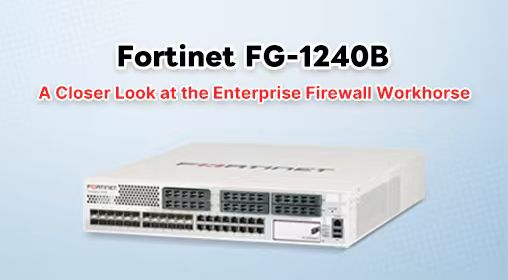
Right out of the gate, the physicality of the FG-1240B speaks to its role. It's a robust unit with a substantial footprint and weight, designed to fit neatly into a standard server rack. The front panel is where it gets interesting, densely packed with sixteen gigabit interfaces. The majority of these are hardware-accelerated, which is a key detail for maintaining performance when advanced security features are turned on. The inclusion of a hot-swappable redundant power supply is a thoughtful touch for critical environments, aiming to minimize downtime and make maintenance a breeze.
Digging into the core specifications reveals where this appliance shines. The numbers tell a story of capacity designed for demanding environments.
|
Parameter |
Specification |
|---|---|
|
Maximum Throughput |
40000 Mbps
|
|
Firewall Throughput |
100 Mbps
|
|
Concurrent Sessions |
2,000,000
|
|
IPS Throughput |
1.5 Gbps
|
|
Antivirus Throughput |
450 Mbps
|
|
New Sessions/Sec |
100,000
|
|
Power Consumption |
<342W
|
The heart of its operation is the proprietary FortiASIC network processor, a piece of silicon dedicated to offloading demanding tasks from the main CPU. This hardware-level integration is crucial for achieving the claimed throughput figures, especially for services like intrusion prevention and antivirus scanning. It’s this kind of engineering that allows the device to handle a massive number of simultaneous connections without breaking a sweat.
But raw power is nothing without smart capabilities. The FG-1240B is more than just a traffic cop; it's a security platform. It integrates a full suite of protections, including firewall, VPN, intrusion detection (IDS/IPS), and anti-DDoS capabilities. The ability to filter encrypted SSL traffic is a significant feature in today's web, adding a layer of visibility where many threats hide. For network managers, features like granular application control and bandwidth management are invaluable. Imagine being able to prioritize video conferencing traffic over file downloads or block unwanted peer-to-peer applications with precision. The system supports an extensive policy set, allowing for highly customized security rules tailored to the organization's needs.
So, what's the actual experience of deploying and managing one of these? Users often report that the initial setup is relatively straightforward thanks to the centralized management approach. The ability to define comprehensive security policies from a single console, instead of managing multiple point solutions, is a massive operational advantage. It simplifies the workflow for the IT team. The stability is another frequently highlighted plus; once configured, these units are known to run for years with minimal fuss, which is perhaps the highest compliment for enterprise infrastructure. The hardware redundancy features contribute directly to this sense of reliability.
When evaluating its worth, the conversation naturally turns to value. While specific pricing is dynamic, the FG-1240B's value proposition is clear: it consolidates multiple security functions into a single appliance. Instead of buying separate hardware for firewall, VPN, and IPS duties, you get an all-in-one solution. This consolidation potentially lowers the total cost of ownership, not just in hardware savings but also in reduced complexity and administrative overhead. For a growing business, this integrated approach can be a very smart financial and operational decision.
Of course, no product is perfect, and a balanced view is essential. Its strengths are notable: high throughput capacity, robust hardware build with redundancy, and a comprehensive, unified security feature set that simplifies the security stack. However, some might find the physical size a bit imposing for smaller infrastructure rooms, and the power consumption, while reasonable for its class, is something to factor into long-term operational costs. When placed next to some contemporary alternatives, its deep packet inspection throughput might be a consideration for networks that plan to heavily utilize all security features simultaneously at multi-gigabit speeds.
In conclusion, the Fortinet FG-1240B emerges as a solid, dependable workhorse. It may not be the newest model on the block, but its design philosophy—emphasizing hardware-accelerated performance, functional consolidation, and proven reliability—continues to make it a relevant and compelling option for businesses seeking to build a strong, manageable, and cost-effective network defense perimeter.