
Intellectual Property
Hot selling product recommendations
View More



















FortiGate FG-1000C vs. FG-1500D: Gauging the Right Fit for Your Network's Demands
Choosing between Fortinet's FG-1000C and FG-1500D isn't about finding a superior model, but rather pinpointing which appliance aligns with the specific pressures and scale of your network environment. One serves as a robust workhorse for demanding enterprise cores, while the other is engineered to operate reliably in physically harsh conditions. The right choice hinges entirely on whether your priority is raw processing power for a data center or reinforced durability for industrial settings.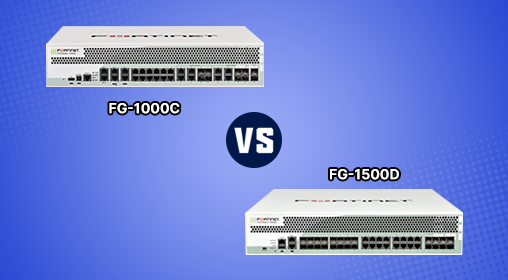
When you look at their core hardware specifications, the performance differentiation becomes clear. The FG-1500D is built with a focus on reliability in industrial environments, supporting a wide range of industrial control protocols and featuring hardware designed for wider temperature tolerance and higher durability. The FG-1000C, typically positioned as a high-performance enterprise firewall, likely boasts superior firewall throughput and VPN capacity, making it more suitable for high-traffic data centers or large enterprise cores. Here’s a breakdown of their core parameters based on typical series characteristics.
|
Core Parameter |
FortiGate FG-1000C |
FortiGate FG-1500D |
|---|---|---|
|
Primary Use Case |
High-performance enterprise core, data center perimeter |
Operational Technology (OT) networks, harsh industrial environments
|
|
Hardware Durability |
Standard enterprise-grade components |
Industrial ruggedized design; resistant to dust, wide temperatures, and vibration
|
|
Cooling System |
Standard active fans |
Fanless design for reliability in dusty environments
|
|
Industrial Protocol Support |
Standard network protocols |
Extensive support for OT protocols like Modbus, DNP3, IEC 61850, etc.
|
|
Wireless Connectivity |
Standard options |
Integrated support for external 3G/4G modems for redundant WAN links
|
Physically, the two units are designed for entirely different homes. The FG-1500D's ruggedized build is immediately apparent, often featuring a more robust casing and a fanless design to prevent failure in dusty environments. Its form factor is tailored for deployment in industrial control system (ICS) settings like factory floors or utility substations. The FG-1000C, in contrast, is built for the standardized, climate-controlled environment of a server room. Its design prioritizes efficient airflow and rack mounting, with a physical presence suited for enterprise infrastructure.
Functionally, both run FortiOS, providing a consistent set of security services. However, the FG-1500D is specifically tuned for the operational technology (OT) world. It comes with built-in deep inspection for numerous industrial control protocols, a critical feature for protecting SCADA systems and other critical infrastructure. Its ability to leverage external 3G/4G connections as a primary or backup WAN link is a standout feature for remote or mobile industrial deployments. The FG-1000C's strength lies in its raw power to handle heavy network traffic loads, complex firewall policies, and high-volume VPN connections, making it ideal for protecting the heart of a corporate network.
From a usability standpoint, the experience differs significantly. For an OT network engineer, the FG-1500D's value is its out-of-the-box understanding of industrial protocols, which simplifies policy creation for manufacturing or energy networks. Its rugged build offers peace of mind regarding physical stability in non-ideal conditions. For a network administrator in a corporate data center, the FG-1000C's superior throughput ensures a smooth experience for thousands of users, preventing the firewall from becoming a bottleneck. Its management through FortiManager is consistent, but the hardware headroom means the interface remains responsive even when every security feature is enabled under maximum load.
Assessing value depends entirely on the application. The FG-1500D offers exceptional value for industrial environments where its ruggedness and OT-specific features are not just beneficial but necessary. In such settings, its higher cost is justified by its reliability and specialized protection capabilities. For a standard office or data center, the FG-1000C likely provides a better performance-to-cost ratio, as paying for the ruggedization of the 1500D would be an unnecessary expense.
The FG-1500D's primary advantage is its purpose-built durability and native OT security, which are indispensable in industrial settings. Its potential drawback is that this specialized capability is overkill for a typical office network. The FG-1000C's strength is its high-performance throughput for processing vast amounts of data in enterprise cores. Its limitation is that it is not designed to withstand the physical demands of an industrial floor.
In terms of stability, the FG-1500D is engineered for it, with a higher mean time between failures (MTBF) and components selected to perform reliably in volatile temperatures and conditions where vibration is a factor. The FG-1000C is a stable enterprise platform, but its reliability is predicated on operating within the controlled environment of a data center.
So, the deciding factor is straightforward. If your network involves manufacturing equipment, power generation, or any critical infrastructure using industrial protocols, and is located in a physically challenging environment, the FG-1500D is the only appropriate choice. If you are securing a high-traffic corporate data center or a large enterprise core where performance and throughput are the paramount concerns, the FG-1000C is the more suitable and cost-effective solution.