When the Fans Spin Up but the Interfaces Stay Down: A Deep Dive into the Cisco FPR4150-NGFW-K9
There is a specific, heart-stopping moment that many network engineers who manage Cisco Firepower 4100 series appliances know all too well. You’ve just applied a major FXOS firmware update or swapped a network module on your
FPR4150-NGFW-K9, the system reboots, the fans spin up to a jet-engine roar, and then… silence on the data plane. The chassis manager says everything is green, but the logical Firepower Threat Defense (FTD) instance refuses to bring up its interfaces, or worse, it gets stuck in a "Initializing" loop for twenty minutes. This isn’t necessarily a broken box; it’s often the complex handshake between the underlying FXOS chassis and the logical security device that trips people up. The FPR4150 is a beast of a machine, but it demands a level of operational discipline that simpler, fixed-configuration firewalls simply don’t require. Understanding this friction point is the key to unlocking what is arguably one of the most capable mid-to-high-range security platforms on the market today.
At its heart, the
FPR4150-NGFW-K9 is designed for organizations that have outgrown the 2100 and 4110/4120 models but aren’t quite ready to jump into the modular chassis-based 9300 series. It serves as the workhorse for large enterprise campuses, data center edge deployments, and service provider environments where throughput requirements are massive, yet physical rack space is at a premium. Unlike entry-level appliances that act as simple gatekeepers, the 4150 is built to perform deep packet inspection at multi-gigabit speeds while running a full suite of next-generation security services. It’s the device you choose when your internet pipe is 10Gbps or 40Gbps, and you need to inspect every single byte for ransomware, command-and-control traffic, and data exfiltration without turning your network into a bottleneck. It bridges the gap between raw speed and intelligent security, acting as both a high-performance router and a sophisticated threat detection engine.
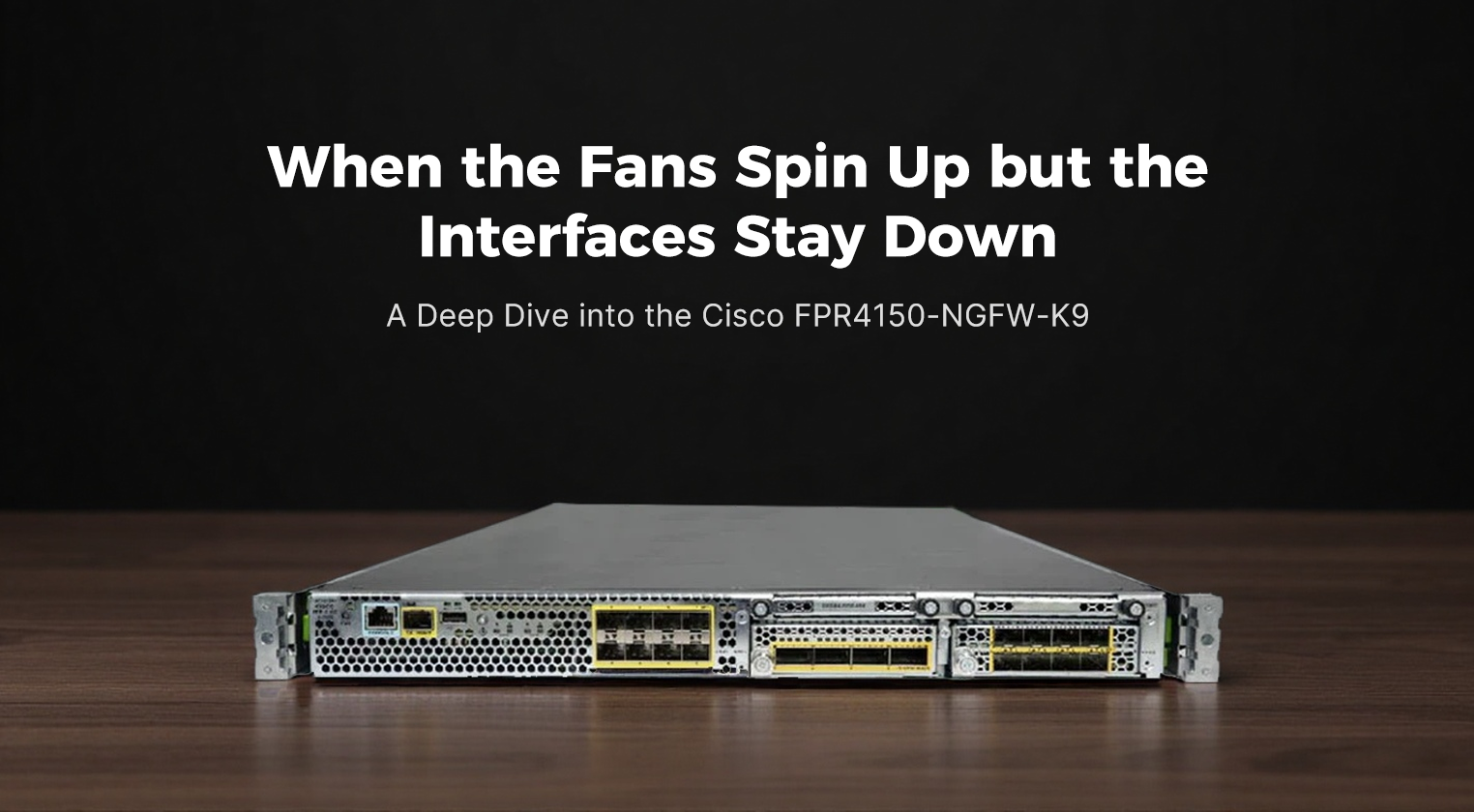
Visually, the FPR4150 cuts an imposing figure despite being a standard 1U unit. It feels denser and more industrial than the plastic-heavy feel of some competitors. The front bezel is dominated by two large network module bays, which are the soul of this device’s flexibility. Depending on how you ordered it, these bays could be housing a mix of 10G SFP+ ports or 40G QSFP+ interfaces, allowing you to tailor the physical connectivity to your exact core or aggregation layer needs. To the right of these bays sits a clean row of status LEDs, a USB port for local recovery or packet capture storage, and the ever-essential console port. The build quality is unmistakably Cisco—heavy gauge metal, precise tolerances, and a design that prioritizes airflow efficiency. The cooling system is robust, with fans that can ramp up aggressively during high-load scenarios or boot sequences, which is a necessary trade-off for keeping the powerful internals from thermal throttling. It’s not a device you’d want on your desk, but in a hot-aisle data center, it looks like it belongs there.
The performance metrics of the FPR4150 are where it truly separates itself from the pack. It leverages a multi-core Intel Xeon architecture paired with custom ASICs to handle traffic processing. When running with all security services disabled, it can push wire-speed throughput that rivals dedicated routers. However, the real test is always with the security stack enabled. With Intrusion Prevention Systems (IPS), SSL decryption, and Advanced Malware Protection (AMP) all turned on, the FPR4150 still delivers impressive sustained throughput, making it viable for encrypted traffic inspection at scale. The concurrency handling is equally robust, supporting millions of simultaneous sessions, which is critical for modern environments saturated with cloud applications and IoT devices.
Here are the core specifications that define the capabilities of this platform:
| Parameter |
Specification Details |
| Model |
Cisco Firepower 4150 (FPR4150-NGFW-K9) |
| Form Factor |
1U Rack Mount |
| Max Firewall Throughput |
Up to 60 Gbps |
| NGFW Throughput |
Approx. 20–25 Gbps (with full security services) |
| IPS Throughput |
Approx. 20 Gbps |
| Max Concurrent Connections |
Up to 40 Million |
| New Connections Per Second |
Up to 120,000 |
| Interface Flexibility |
2x Network Module Bays (Supports up to 24x 10G SFP+ or 8x 40G QSFP+) |
| Management Ports |
1x 1G RJ-45 Dedicated Mgmt, 1x RJ-45 Console, 1x USB 2.0 |
| Storage |
Dual SSDs (Hot-swappable, typically 400GB-800GB each) for redundancy |
| Memory |
64GB to 128GB DDR4 RAM (depending on configuration) |
| Processor |
Multi-core Intel Xeon E5 series |
| Power Supply |
Dual Redundant AC Power Supplies (Hot-swappable, 1+1 redundancy) |
| Operating System |
FXOS Chassis Manager + FTD or ASA Logical Device |
Functionally, the FPR4150 is a chameleon. Its ability to run different logical devices on the same hardware is a game-changer for IT strategy. You can deploy it as a Firepower Threat Defense (FTD) unit for cutting-edge threat intelligence and application visibility, or you can revert it to run classic ASA software if your team relies heavily on legacy configurations and specific ASA-only features. This duality protects your hardware investment against shifts in software strategy. Furthermore, the support for clustering allows multiple 4150 units to be grouped together, acting as a single logical firewall with massive scalability and seamless failover. If one unit goes down for maintenance or fails entirely, the cluster redistributes the load instantly, ensuring zero downtime for critical business applications. The integration with Cisco SecureX and the broader Talos intelligence network means the device doesn’t just block known bad IPs; it proactively identifies suspicious behaviors based on global threat data.
However, the user experience with the FPR4150 is a tale of two cities. For the seasoned engineer who understands the separation of duties between FXOS and FTD, it is a powerful and rewarding tool. The granularity of control is unmatched; you can tweak resource allocation, monitor individual core usage, and perform non-disruptive upgrades on the logical device while the chassis remains stable. But for the uninitiated, the learning curve is steep. The initial setup often confuses users who expect a single interface. Instead, they must configure the chassis network settings in FXOS, assign resources to the logical device, and then configure security policies in FTD. Misalignment here is the root cause of many "interfaces won't come up" issues. Additionally, the boot process is notoriously slow. Watching a progress bar crawl for 15 minutes after a reboot can induce anxiety, even if you know it’s normal. The dual-SSD setup provides great redundancy, but replacing a failed drive requires careful attention to RAID status and re-imaging procedures that aren’t always intuitive.
When evaluating the cost-benefit ratio, the FPR4150 sits in a very interesting spot. It is undoubtedly more expensive than fixed-port appliances, but the modular nature of the network modules means you don’t have to replace the whole box if your network speeds increase from 10G to 40G. You just swap the modules. This longevity significantly lowers the total cost of ownership over a five-year lifecycle. Compared to moving up to the 9300 series, the 4150 offers a substantial amount of power at a fraction of the complexity and price. For organizations that need high availability and massive throughput but don’t have the budget or staff for a chassis-based system, the 4150 represents the peak of value. It’s an investment that pays off in reduced downtime and extended hardware life.
The advantages of the FPR4150-NGFW-K9 are clear: exceptional throughput even with encryption, modular interface flexibility, dual-redundant storage and power, and the ability to cluster for massive scalability. It is a future-proof platform that can adapt to changing network topologies. However, the disadvantages are equally real. The complexity of the FXOS/FTD split creates a higher barrier to entry and increases the risk of configuration errors. The slow boot times can stretch maintenance windows, causing stress during critical updates. The licensing model for advanced features like URL filtering and premium threat intelligence can become costly if not managed carefully, and the fan noise under load is significant, ruling it out for any environment that isn’t a dedicated, sound-proofed server room. There have also been isolated reports of compatibility quirks between specific FXOS versions and FTD releases, requiring meticulous version checking before any upgrade.
Ultimately, the FPR4150 is not a device for everyone. It rewards expertise and punishes negligence. If you approach it expecting the simplicity of a home router, you will be frustrated by its layers of abstraction and strict operational requirements. But if you treat it with the respect due to a high-performance enterprise engine, understanding its quirks like the slow boot sequence or the dual-layer management, it becomes an indispensable asset. It stands as a testament to the idea that true power often comes with complexity. For the networks that demand nothing less than total visibility and uncompromising speed, the FPR4150-NGFW-K9 remains a top-tier choice, provided you are ready to master its intricacies rather than just plug it in and hope for the best.