The Quiet Workhorse: Why the Cisco FPR2130-NGFW-K9 Feels Like a Promotion for Overworked Admins
There is a distinct shift in atmosphere when you replace an aging, sputtering firewall with a Cisco
FPR2130-NGFW-K9. For many network administrators, this transition feels less like a hardware upgrade and more like a promotion. You stop spending your nights fighting false positives and struggling with clunky legacy interfaces, and start actually managing security posture. The FPR2130 doesn’t scream for attention with flashy lights or overly complex chassis configurations; instead, it settles into the rack with a quiet hum, offering a sense of stability that is often missing in the mid-range market. It is the device you choose when you are tired of "good enough" and ready for a system that handles the heavy lifting of modern threat detection without constantly demanding your intervention.
The specific purpose of the FPR2130 is to serve as the backbone for medium-sized enterprises, large branch offices, or distributed retail environments that have outgrown entry-level appliances but don't require the massive scale of the 4100 series. It is built to be a true Next-Generation Firewall (NGFW), meaning it looks beyond simple IP addresses and ports to understand applications, users, and content. Whether you are running it with Firepower Threat Defense (FTD) for deep inspection or sticking with the familiar ASA code for specific legacy needs, this box is designed to secure the perimeter against sophisticated ransomware, zero-day exploits, and data exfiltration attempts. It acts as the gatekeeper that doesn’t just check IDs but thoroughly searches every bag entering the building, all while keeping the line moving.
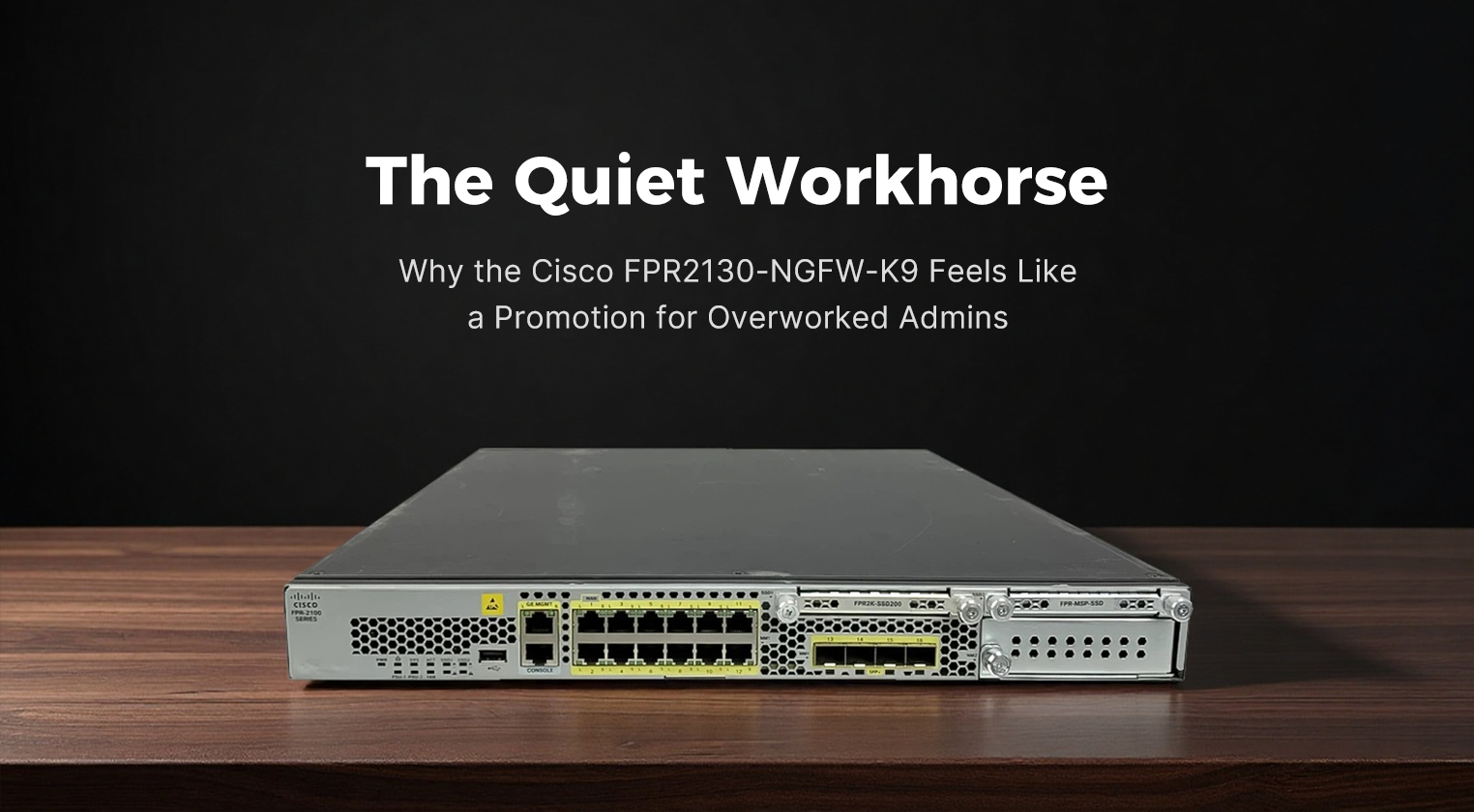
When you first pull the
FPR2130 from its packaging, the design strikes a balance between rugged utility and modern aesthetics. It is a sleek 1U rack-mountable unit that feels surprisingly solid, constructed from heavy-gauge steel that inspires confidence. The front panel is uncluttered, featuring a clear row of status LEDs that provide instant visual health checks—blue for healthy, amber for attention needed. To the side, you’ll find the console port and a USB slot, tucked away neatly to prevent accidental bumps. The rear panel is where the functionality shines, with a fixed configuration of high-density ports that typically includes a mix of 1G RJ-45 and 10G SFP+ interfaces. This layout eliminates the need for bulky transceivers on every port if you are sticking to copper, while still offering the fiber uplinks necessary for core connectivity. The airflow is strictly front-to-back, ensuring it plays nicely with standard data center cooling strategies, and the fan noise is remarkably subdued, making it one of the few enterprise firewalls you could theoretically tolerate in a quiet server closet without wincing.
Performance is where the user experience truly diverges from older generations. The FPR2130 is powered by a multi-core Intel processor architecture that handles concurrent connections with impressive ease. In real-world usage, admins notice that enabling resource-heavy features like SSL decryption or Intrusion Prevention System (IPS) no longer brings the network to its knees. While there is naturally a throughput cost when turning on full security services, the FPR2130 manages this trade-off gracefully, sustaining multi-gigabit speeds that keep video conferences crisp and cloud backups fast. It handles hundreds of thousands of simultaneous sessions without breaking a sweat, which is crucial in today’s environment where every employee has multiple devices and applications running in the background.
Here is a look at the core specifications that drive this performance:
| Parameter |
Specification Details |
| Model |
Cisco Firepower 2130 (FPR2130-NGFW-K9) |
| Form Factor |
1U Rack Mount |
| Max Firewall Throughput |
Up to 18 Gbps |
| NGFW Throughput |
Approx. 6–8 Gbps (with full security services enabled) |
| IPS Throughput |
Approx. 7 Gbps |
| Max Concurrent Connections |
Up to 2 Million |
| New Connections Per Second |
Up to 20,000 |
| Interface Configuration |
Fixed: 8x 1G RJ-45, 4x 1G/10G SFP+ (Shared ports) |
| Management |
1x 1G Dedicated Mgmt Port, 1x Console, 1x USB |
| Storage |
Single SSD (typically 240GB) for OS and Logging |
| Memory |
16GB or 32GB DDR4 RAM (depending on specific sub-model) |
| Processor |
Multi-core Intel Xeon D-series |
| Power Supply |
Single or Dual AC Power Supply options (Hot-swappable if dual) |
| OS Support |
FXOS Chassis Manager with FTD or ASA Logical Device |
The functional characteristics of the FPR2130 are deeply integrated into the Cisco security ecosystem, providing a user experience that feels cohesive rather than fragmented. One of the standout features is the application visibility and control (AVC), which allows admins to see exactly what applications are running on the network—whether it’s sanctioned Salesforce traffic or unsanctioned crypto-mining—and apply policies accordingly. The integration with Cisco Talos intelligence means the device receives real-time updates on emerging threats, automatically adjusting its defenses without manual rule creation. Furthermore, the ability to cluster two FPR2130 units for high availability provides peace of mind; if one unit fails, the other takes over seamlessly, ensuring business continuity. The management interface, whether through the on-box Firepower Device Manager (FDM) for smaller setups or the centralized Firepower Management Center (FMC) for larger deployments, offers intuitive dashboards that turn raw data into actionable insights.
From a user perspective, living with the FPR2130 is generally a positive experience, though it does come with a learning curve for those migrating from classic ASA firewalls. The initial setup requires understanding the dual-layer architecture: the underlying FXOS chassis and the logical FTD device. New users sometimes find themselves confused about which interface to use for certain tasks, but once this mental model clicks, the workflow becomes efficient. The boot times are reasonable, usually faster than the larger 4100 series, getting the network back online quickly after maintenance. The logging capabilities are robust, allowing admins to drill down into specific events without sifting through mountains of irrelevant data. However, the single SSD in the base configuration can be a point of anxiety for some; while reliable, the lack of local RAID redundancy means that a drive failure could complicate log retention or recovery, pushing users to rely more heavily on external syslog servers.
In terms of value, the FPR2130 hits a sweet spot that makes it a favorite for budget-conscious but security-aware organizations. It offers a significant step up in performance and feature set from the 2110 or 2120 models without the price jump associated with the 4100 series. The fixed port configuration simplifies ordering and reduces the risk of compatibility errors with network modules, lowering the total cost of ownership. For companies that need to comply with strict regulatory standards, the advanced reporting and threat intelligence features justify the investment, often replacing the need for additional standalone security tools. It represents a "buy once, cry once" scenario where the upfront cost is balanced by years of reliable service and reduced operational overhead.
The advantages of the
FPR2130-NGFW-K9 are numerous: it delivers strong performance for its class, offers a quiet and compact form factor, provides deep application visibility, and integrates seamlessly with the broader Cisco security portfolio. The fixed port design simplifies deployment, and the support for both FTD and ASA software offers flexibility. On the downside, the single SSD lacks the redundancy found in higher-end models, which could be a risk for local log storage. The licensing model for advanced features like URL filtering and premium malware protection can add up over time, requiring careful budget planning. Additionally, while the FDM interface is great for standalone use, scaling to manage dozens of these devices really requires the separate FMC appliance or virtual instance, adding another layer of complexity and cost for growing networks. Some users also note that the shared port architecture (where RJ-45 and SFP+ share the same logical interface) requires careful planning to avoid configuration conflicts.
Ultimately, the Cisco
FPR2130-NGFW-K9 is a device that earns the trust of its operators. It transforms the chaotic task of network security into a manageable, even strategic, function. It may not have the modular expandability of the 4100 series or the sheer brute force of the 9300, but for the vast majority of mid-sized networks, it offers exactly what is needed: robust protection, clear visibility, and a user experience that empowers rather than frustrates. It is the quiet workhorse that allows IT teams to focus on innovation rather than firefighting, proving that sometimes the best security tool is the one you barely notice because it just works.