
Intellectual Property
Hot selling product recommendations
View More




















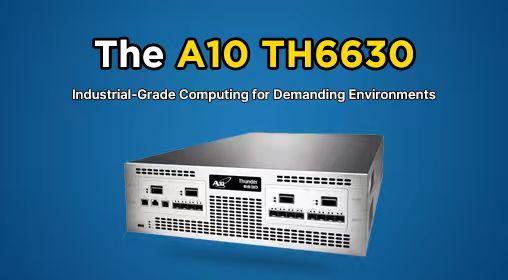
When it comes to application delivery controllers, A10 Networks' Thunder series holds a formidable reputation. Today, we're placing two distinct models from different tiers under the microscope: the high-end Thunder 6630 and the more accessible Thunder 3430. This isn't just about comparing specs on a sheet; it's about understanding which solution fits your specific network demands. The 6630 emerges as a powerhouse designed for massive data centers grappling with immense traffic, while the 3430 appears tailored for more constrained environments where balancing performance and cost is key.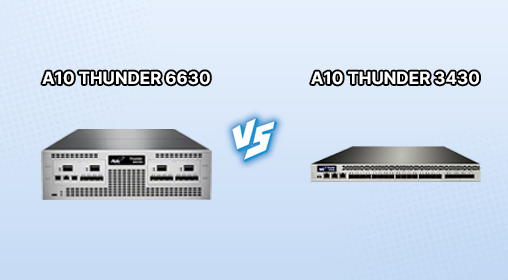
Diving straight into the core of the matter, the performance disparity between these two appliances is significant. The A10 Thunder 6630 is built around a robust 24-core Intel Xeon CPU architecture, supporting a staggering throughput of 150 Gbps and handling up to 7.1 million Layer 4 connections per second (CPS). It made waves as the industry's first ADC to incorporate four 100 Gigabit Ethernet (100GbE) interfaces, alongside twelve 10GbE ports, ready for the most demanding data center workloads. In contrast, the A10 Thunder 3430 positions itself in a different league. While detailed specs for the 3430 are less prominent in the available search results, insights can be drawn from its sibling model, the Thunder 4430. The 4430 is equipped with a 6-core Xeon CPU, 38 Gbps of throughput, and a capacity of 2.7 million L4 CPS. The 3430 is expected to offer performance figures lower than this, likely targeting a throughput range below 38 Gbps and fewer CPS, aligning with its role as an entry-level to mid-range solution.
Here's a quick overview of their core technical parameters:
| Feature | Thunder 6630 | Thunder 3430 (Inferred) |
|---|---|---|
| CPU Cores | 24-core Intel Xeon | Lower core count (e.g., 6-core or fewer based on 4430 data) |
| Total Throughput | 150 Gbps | Expected significantly lower (e.g., <38 Gbps) |
| L4 CPS | 7.1 million | Expected significantly lower (e.g., <2.7 million) |
| High-Speed Interfaces | 4 x 100GbE, 12 x 10GbE | Likely 1GbE and/or 10GbE ports |
| SSL Performance (S-Models) | High (e.g., 14,000 SSL CPS with 2048-bit key on 3030S) | Moderate |
| Typical Use Case | Large-scale data centers, cloud providers, carriers | Mid-sized enterprises, branch offices |
Beyond the raw numbers, the functional capabilities of each unit are shaped by their underlying hardware. Both platforms run on A10's Advanced Core Operating System (ACOS), a scalable architecture known for its efficiency. This means they share a common foundation for features like application delivery, server load balancing, and security modules such as a Web Application Firewall (WAF) and DDoS protection. However, the 6630's superior processing power and memory allow it to run these services at a much larger scale and with more advanced virtualized multi-tenant configurations. The "S" variants in both lineups integrate dedicated SSL security processors to handle encrypted traffic inspection, a critical feature for modern security postures.
Considering the user experience, the 6630 is a specialist's tool. Its value is fully unlocked in environments where managing colossal data flows from mobile devices, cloud applications, and big data analytics is the primary challenge. Its design prioritizes raw power and scale. The 3430, on the other hand, offers a more straightforward experience. It is the appliance for organizations that need to optimize and secure their application infrastructure without the complexity of a top-tier data center product. Its compact design and lower power consumption make it easier to integrate into existing server rooms.
A discussion of value and cost is inevitable. The Thunder 6630 represents a significant investment, justified by its class-leading performance and future-proof 100GbE interfaces. Its cost-per-connection might be remarkably low for its capacity, but the initial outlay is high. The Thunder 3430 shines in terms of affordability and operational efficiency. It consumes less power and requires less cooling, leading to a lower total cost of ownership. For organizations whose performance needs fall within its range, it presents a much more budget-friendly option.
When it comes to reliability and stability, both products benefit from the ACOS platform's design, which aims for maximum uptime through high-quality hardware components, features like solid-state drives (SSDs), and hot-swappable fans. The 6630, with its resources spread across more cores and higher-capacity interfaces, is engineered for carrier-grade environments where any downtime is unacceptable. The 3430 also provides a stable platform for its target market, with a hardware design focused on minimizing disruption for small to medium businesses.
So, which one is the right choice? The Thunder 6630 is an undeniable performance king, purpose-built for internet giants, large service providers, and any organization pushing the limits of network capacity. Its advantages are raw power, scalability, and future-ready interfaces. Its primary drawback is its overkill nature and high cost for more common business scenarios. The Thunder 3430 finds its strength in practicality. It is the ideal solution for mid-sized enterprises seeking to consolidate services, improve application performance, and enhance security without a massive capital expenditure. Its limitation is its defined performance ceiling, which cannot be expanded to meet the needs of a hyper-scale data center. Your final decision hinges entirely on the scale of your challenges and the breadth of your ambitions.