
Intellectual Property
Hot selling product recommendations
View More



















The QFX10002-72Q: Powering the Core of Modern Data Centers
In the high-stakes world where data center performance is non-negotiable, the Juniper QFX10002-72Q emerges as a formidable contender. This isn't your average top-of-rack switch; it's a high-density, high-throughput platform engineered for the core of demanding network environments. Think of it as the central nervous system for massive data flows, capable of handling the intense workload of cloud infrastructures, large-scale enterprise networks, and service provider backbones where speed, reliability, and scalability are paramount. Its design philosophy centers on delivering immense power without compromising on flexibility, making it a versatile solution for a variety of critical roles.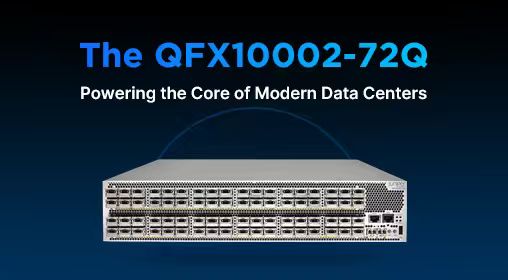
When you first encounter the QFX10002-72Q, its physical presence commands respect. Housed in a 2U chassis measuring 442 mm by 887 mm by 87 mm (width x depth x height) and weighing in at a substantial 31 kilograms, it's built for serious business within standard racks. The design is robust, featuring redundant, hot-swappable power supplies that ensure continuous operation even if one unit fails, a critical feature for maintaining uptime. The front panel is dominated by its impressive array of 72 QSFP28 ports, offering tremendous configuration flexibility. These ports can natively handle 40GbE connections, but their true potential is unlocked through breakout cables, allowing you to configure them as 24 ports of 100GbE or a high-density mix of lower-speed connections to suit your exact needs. This modularity in a fixed form factor is a key part of its appeal.
Diving beneath the surface reveals where this switch truly shines. It's powered by an Intel quad-core Ivy Bridge 2.5GHz CPU and is supported by 16GB of SDRAM, providing the necessary computational muscle for complex routing and management tasks. The performance specs are staggering: a massive 5.76 Tbps backplane bandwidth and a packet forwarding rate of 2 Billion packets per second (Bpps). This raw power ensures that even under extreme load, the switch moves data with minimal latency, preventing bottlenecks at the network core. A quick look at its core specs reveals the scale it operates on:
|
Core Parameter |
Specification |
|---|---|
|
Port Configuration |
72 x QSFP+ ports (configurable for 40GbE/100GbE) |
|
Backplane Bandwidth |
5.76 Tbps |
|
Packet Forwarding Rate |
2 Bpps |
|
MAC Address Table |
512,000 entries |
|
Maximum VLANs |
4,000 |
|
Maximum Jumbo Frame |
9,216 bytes |
The functional capabilities of the QFX10002-72Q are extensive. It operates as a full Layer 3 routing switch, supporting a comprehensive set of protocols including IPv4 and IPv6. For network resilience, it offers robust implementations of Multiple Spanning Tree Protocol (MSTP) and Rapid Spanning Tree Protocol (RSTP). Its support for Link Aggregation Groups (LAGs) and Multi-Chassis LAG (MC-LAG) enhances bandwidth and provides high availability. From a management perspective, it runs on Juniper's Junos OS, which is a significant benefit for network engineers. Junos offers a consistent, powerful command-line interface (CLI) and supports zero-touch provisioning (ZTP), streamlining large-scale deployments. Advanced features like flow telemetry provide deep visibility into network traffic, while integration with tools like Puppet, Chef, and Python allows for modern automation workflows, making the network programmable and responsive.
For the engineers who manage it, the QFX10002-72Q offers a blend of power and predictability. The familiarity of Junos OS drastically reduces the learning curve, allowing teams to apply their existing expertise to manage this high-end platform efficiently. The automation capabilities are a major time-saver, turning complex, repetitive configuration tasks into simple, automated scripts. This reliability and advanced feature set translate into a smooth operational experience, where the network feels like a solid foundation rather than a constant source of troubleshooting. However, this power comes with considerations. The switch's physical depth requires ensuring adequate rack space, and its power consumption, with a typical draw around 1050W, is a factor in data center power and cooling planning. While not the quietest device, its acoustic profile is in line with standard data center equipment and is designed for machine room environments, not office spaces.
Evaluating its strengths and weaknesses provides a clear picture. Its most significant advantage is its remarkable port density and scalability in a 2U form factor, offering exceptional value per rack unit. The proven stability and richness of Junos OS is another major benefit, providing a reliable and automatable operating system. Furthermore, its flexible port configuration via breakout cables future-proofs your investment. On the flip side, the relatively high power consumption is a key factor to consider for total cost of ownership. The substantial physical weight and depth necessitate careful planning during deployment. Finally, while highly capable, it is undoubtedly a premium solution whose advanced features may be overkill for smaller or less complex environments, representing a significant investment.
When it comes to value, the QFX10002-72Q isn't about being the cheapest option but about delivering maximum capability for the investment. Its density means you can serve more connections with fewer physical devices, saving on rack space and reducing network complexity. The combination of high performance, reliability, and comprehensive feature set in the Junos ecosystem makes it a compelling long-term asset for organizations where network performance is directly tied to business success. It's a platform built not just for today's demands but engineered to be a cornerstone of your data center for years to come.