
Intellectual Property
Hot selling product recommendations
View More




















The Port Powerhouse vs. The Fiber Specialist: Decoding MikroTik's CRS328 Switch Dilemma(CRS328-24P-4S+RM vs CRS328-4C-20S-4S+RM )
Choosing between MikroTik's CRS328 series switches feels like picking a specialty tool for a critical job. At first glance, the CRS328-24P-4S+RM and the CRS328-4C-20S-4S+RM might seem similar, but they're engineered for fundamentally different network environments. One is a power-delivering beast for device-dense setups, while the other is a speed-optimized maestro for fiber backbones. Let's break down this technical face-off.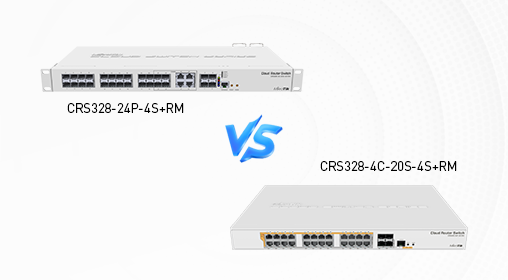
The most dramatic difference lies in their port philosophy. The CRS328-24P-4S+RM is a Power over Ethernet (PoE) monster. It comes with 24 Ethernet ports that can deliver power to a small army of devices like wireless access points, security cameras, and VoIP phones, eliminating the need for separate power adapters at the installation site. Alongside these, it offers 4 SFP+ ports for high-speed 10 Gigabit uplinks. In contrast, the CRS328-4C-20S-4S+RM is a fiber connectivity specialist. Its design prioritizes pure data throughput with 20 SFP ports (1 Gigabit) and 4 SFP+ ports (10 Gigabit), plus 4 combo ports that allow you to use either an RJ45 Ethernet or an SFP port, providing excellent flexibility for mixed media connections. The core mission is clear: one powers devices, the other connects fibers.
When we look under the hood, the similarities become more apparent. Both models are built on a robust shared foundation. They house the same 800 MHz Single-Core 32-bit ARM CPU and come with 512 MB of internal memory, ensuring a consistent management experience and processing power for advanced networking features. They both offer a switching capacity of 128 Gbit/s and a forwarding rate of 95.2 Mpps, which is more than adequate for handling wire-speed traffic on all ports simultaneously in their intended roles. Physically, they share the same 1U rack-mount form factor and a white enclosure, but differ in size; the CRS328-4C-20S-4S+RM measures 443 x 200 x 44 mm (W x D x H), while the PoE model requires a more substantial internal power supply, contributing to a different physical profile.
From a user experience standpoint, the choice is incredibly straightforward. You pick the CRS328-24P-4S+RM if you need to power a large number of devices directly from the switch. This dramatically simplifies cabling, reduces clutter, and makes installations much cleaner. It's the ultimate convenience tool for offices and security systems. The CRS328-4C-20S-4S+RM, however, offers a different kind of elegance for network purists or data center applications. Its high density of SFP/SFP+ ports is ideal for creating a fast, reliable, and clean fiber optic backbone. The combo ports add a layer of flexibility that is invaluable in evolving networks. Stability-wise, the fiber-focused model might have a slight edge in consistently controlled environments because it generates less heat than a switch actively powering 24 PoE devices. However, both are built to the same industrial standard with an operating temperature range of -20°C to 60°C, making them reliable workhorses.
The value proposition isn't about which switch is cheaper, but which one delivers more for your specific budget and needs. The CRS328-24P-4S+RM likely offers a lower total cost of ownership for PoE-heavy deployments. The built-in power supply means you avoid the significant expense of purchasing separate midspan PoE injectors for every device. The value of the CRS328-4C-20S-4S+RM is in its unparalleled scalability and performance for fiber connectivity. While the initial investment in SFP modules is a factor, it provides a future-proof backbone for high-speed data transfer.
Here is a quick overview of their core technical parameters for a direct comparison.
|
Core Parameter |
CRS328-24P-4S+RM |
CRS328-4C-20S-4S+RM |
|---|---|---|
|
Primary Port Focus |
24x RJ45 PoE Ports |
20x SFP ports, 4x SFP+ ports |
|
Combo Ports |
Information not specified in sources |
4x Combo (RJ45 or SFP)
|
|
Switching Capacity |
Information not specified in sources |
128 Gbit/s
|
|
Forwarding Rate |
Information not specified in sources |
95.2 Mpps
|
|
Power Supply |
500W internal power supply for PoE
|
Standard AC power supply (100-240V) included
|
|
Processor |
Information not specified in sources |
800 MHz Single-Core 32-bit ARM
|
|
Dimensions (B x D x H) |
Information not specified in sources |
443 x 200 x 44 mm
|
The Final Verdict
So, which switch wins? It completely depends on the language your network speaks.
Choose the CRS328-24P-4S+RM if: Your world is filled with devices that need power and data over a single cable. This is the undisputed champion for modern offices, surveillance systems, and WiFi deployments where convenience and clean installation are paramount.
Choose the CRS328-4C-20S-4S+RM if: You're building a high-speed network core, need to connect to multiple fiber links, or require the flexibility of combo ports. This is the tool for server rooms, ISPs, and anyone who values raw data throughput and fiber density above all else.
MikroTik hasn't created a winner and a loser here; they've created a specialist and a generalist for the high-density switch market. Your specific connectivity needs will tell you exactly which one is the right fit.