
Intellectual Property
Hot selling product recommendations
View More


















The Network Workhorses: Decoding F5's LTM-10000S and LTM-8950
Choosing between F5's LTM-10000S and LTM-8950 is like selecting the right engine for a ship. One is built for raw power and heavy seas, while the other is a incredibly capable workhorse for well-charted waters. The LTM-8950 carves out its space as a robust, high-performance box designed for substantial enterprise data centers, handling a solid 20 Gbps of throughput with a hardware SSL capability that supports up to 56,000 transactions and a maximum of 9.6 Gbps of encrypted data flow. It's the kind of device you install when you have predictable, high-volume traffic and need unwavering reliability for critical applications. Packed with 16 GB of memory, dual quad-core CPUs, and a versatile port configuration including 16 gigabit Ethernet interfaces and 2x 10-gigabit fiber ports, it's built to be a cornerstone of your network infrastructure.The LTM-10000S, while specific detailed specs are less readily available in the search results, logically positions itself as the next step up. It's engineered for environments where the LTM-8950's substantial capabilities might eventually be stretched. Think of massive data centers, telecommunications providers, or large financial institutions where traffic isn't just high-volume but also unpredictable and demanding the highest levels of scalability. The "S" in its model often hints at higher scalability or specialized performance enhancements, suggesting it is built to handle even greater connection counts, more complex application delivery policies, and heavier encryption loads without breaking a sweat. It's the platform you choose when your network's growth trajectory is steep and application availability is directly tied to business survival.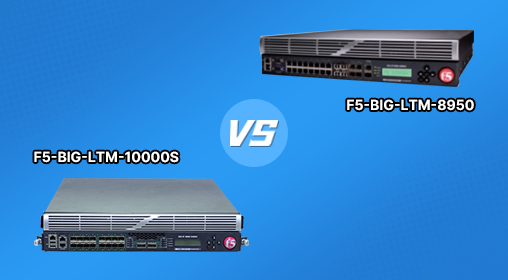
When you line up their core specifications, the difference in their design philosophy becomes clear. The following table outlines the key performance and hardware metrics available for the LTM-8950, with the LTM-10000S's positioning inferred towards higher-tier performance.
|
Feature / Specification |
F5 BIG-LTM-10000S (Inferred Position) |
F5 BIG-LTM-8950 (Documented) |
|---|---|---|
|
Performance & Capacity |
||
|
Target Deployment |
Large-scale data centers, high-demand core networks |
Substantial enterprise data centers
|
|
Throughput |
Higher overall capacity (inferred) |
20 Gbps
|
|
Hardware SSL |
Higher capacity for encrypted traffic (inferred) |
Default: 500 TPS, Max: 56,000 TPS, 9.6 Gbps bulk encryption
|
|
Data Compression |
Higher capacity (inferred) |
Default: 50 Mbps, Max: 8 Gbps
|
|
Hardware Design |
||
|
Chassis & Form Factor |
Larger physical footprint, greater expansion capacity (inferred) |
2U chassis
|
|
Memory |
Higher capacity (inferred) |
16 GB
|
|
Hard Drive |
Typically SSD for performance (inferred) |
2 x 320 GB (RAID 1)
|
|
Network Interfaces |
High-density 10G/40G ports (inferred) |
16 x Gigabit Ethernet, 8 x SFP, 2 x 10G Fiber
|
|
Power Supply |
High-wattage, redundant units (inferred) |
Standard dual 850W power supplies
|
Physically, these units are built for the data center rack. The LTM-8950 is a 2U system, making it relatively compact for its capabilities. The LTM-10000S, designed for an even greater workload, often requires a larger chassis—perhaps 4U or more—to accommodate additional processing blades, more powerful cooling systems, and a higher density of network interfaces. This isn't just about size; it's about scalability and redundancy. The LTM-10000S likely supports a modular design, allowing you to add specialized blades for tasks like advanced firewall protection or enhanced SSL offloading, a feature that extends the platform's lifespan and adaptability.
For the network engineer, the experience differs in terms of headroom and granular control. Managing the LTM-8950 is a solid, reliable experience. The F5 TMOS operating system provides a unified interface for configuring virtual servers, pools, monitors, and intricate traffic policies. You have deep visibility and control. However, working with the LTM-10000S offers a greater sense of scale. Its additional processing power means you can deploy more advanced features—like detailed behavioral analytics for the Advanced Web Application Firewall (AWAF) or sophisticated routing policies in the DNS module—without worrying about becoming the performance bottleneck. It provides the peace of mind that comes with knowing you have ample reserve capacity for future demands or unexpected traffic spikes.
The conversation about value is nuanced. The LTM-8950 presents a lower barrier to entry and is a phenomenally capable solution for organizations whose performance needs align with its specifications. It's a solid investment for today's high demands. However, for businesses on a rapid growth path or those operating in sectors where application performance is critical, the LTM-10000S's superior scalability and feature headroom often justify a higher initial investment. Its modular architecture can prevent a costly "forklift upgrade" in a few years, offering a better total cost of ownership over its operational life. You're paying for future-proofing and operational flexibility.
Of course, no piece of technology is without its trade-offs. The LTM-10000S's primary strength is its scale, which can be a drawback. Its larger physical footprint demands more data center real estate, and its advanced capabilities require a more skilled team to manage and fully utilize. The LTM-8950, while extremely powerful, has a defined performance ceiling. In the face of extreme, unanticipated growth, it could become a limitation where the LTM-10000S would continue to perform seamlessly. It's engineered for high performance but within a specific operational envelope.
In terms of raw stability, both platforms are built for mission-critical, 24/7 operation. The LTM-8950's redundant power and cooling designs ensure high availability for enterprise deployments. The LTM-10000S takes this a step further, with an architecture typically reinforced for the continuous, heavy loads expected in core network roles, often featuring more comprehensive redundancy in critical components. It's the difference between a very reliable system and one designed for what the industry calls "five-nines" availability.
Your final choice ultimately hinges on the weight of the traffic you need to carry and your anticipated growth. The F5 BIG-LTM-8950 is a powerful, dependable workhorse for demanding enterprise data centers that need robust application delivery and security today. The F5 BIG-LTM-10000S is the next-level solution, designed for the core of the network where traffic is heaviest, uptime is non-negotiable, and scalability is paramount. For proven, high-level performance, the 8950 is formidable. For ensuring application reliability at an even greater scale and for the long haul, the 10000S is the clear path forward.