
Intellectual Property
Hot selling product recommendations
View More




















The F5 VPR-LTM-C2400-AC: Powering Modern Data Centers
In the world of high-demand networking, where application performance and reliability are non-negotiable, the F5 VPR-LTM-C2400-AC establishes itself as a formidable player. This isn't your average piece of hardware; it's a modular chassis system designed for environments where traffic is measured in gigabits and connections in millions. Think of large enterprise data centers, telecommunications providers, and financial institutions—places where downtime is not an option and seamless scalability is a daily requirement. The "Viprion" in its name hints at its flexible nature, being a chassis that can host multiple blades, allowing organizations to scale their application delivery and security capabilities horizontally by adding more processing power as needed.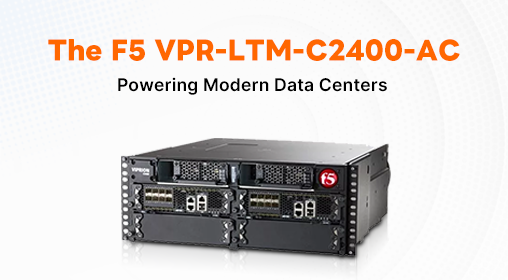
When you look at its core specifications, the C2400-AC is built for heavy lifting. It's a 4U chassis, giving it substantial real estate in a server rack for a reason: to house robust components. Inside, you'll an Intel quad-core Xeon processor and 32GB of memory, which work in tandem to handle massive network traffic loads. The system comes standard with eight multi-gigabit fiber ports, which can be expanded up to a total of 32, providing immense connectivity flexibility for diverse network architectures. Where it truly shines is in its performance metrics, which are best understood at a glance:
|
Parameter Category |
Specific Metric |
Performance Data |
|---|---|---|
|
Throughput Capacity |
Layer 4 (L4) |
40 Gbps
|
|
Layer 7 (L7) |
18 Gbps
|
|
|
Connection Handling |
L4 Connections per Second |
400,000
|
|
Maximum L4 Concurrent Connections |
24 Million
|
|
|
Advanced Function Performance |
L7 HTTP Requests per Second |
1 Million
|
|
Hardware SSL Transactions (TPS) |
4,000 per blade (up to 10,000)
|
|
|
Hardware DDoS Protection (SYN Cookies) |
40 Million per second
|
Beyond just shuffling traffic around, the C2400-AC is packed with features that make it an intelligent application delivery controller. Its core function includes sophisticated load balancing, intelligently distributing user requests across pools of servers to ensure no single server becomes a bottleneck. It also performs SSL/TLS offloading, taking the computationally expensive task of encryption and decryption away from the backend servers, thereby freeing them up to focus on delivering application logic. Furthermore, it offers protocol security for HTTP, FTP, and SMTP, and its built-in hardware-based DDoS protection helps mitigate flood attacks before they can impact service availability. The system runs on F5's TMOS operating system, which provides a unified platform for managing traffic, security, and application acceleration policies.
For network administrators, managing this device offers a sense of control and depth. The ability to implement granular traffic policies and gain deep visibility into application performance is a significant advantage. Configuration and monitoring can be done securely through various methods, including HTTPS, SSH, and a local console connection, catering to different operational preferences. The chassis is designed with redundancy in mind, featuring dual power supplies, which is a critical feature for maintaining uptime in mission-critical deployments. This design consideration provides peace of mind, knowing that the system can withstand component failures.
Evaluating its value proposition involves looking at the bigger picture. While the initial investment is substantial, the C2400-AC's modularity is a key factor in its long-term value. Instead of replacing the entire unit for a performance boost, you can often add or upgrade blades within the chassis. This scalability can lead to significant cost savings over time, extending the hardware's lifecycle and protecting the initial investment. It's a solution that prioritizes long-term operational efficiency and adaptability over a low upfront cost.
Of course, no technology is perfect. The primary strength of the C2400-AC—its high-end, modular chassis design—can also be seen as a drawback for some. Its 4U physical size demands considerable rack space, making it less suitable for organizations with severe space constraints. The sophisticated feature set and the powerful TMOS operating system have a learning curve, potentially requiring dedicated training for IT teams to fully leverage its capabilities. This is unequivocally a platform for environments that need its level of performance and flexibility; for smaller businesses with more modest needs, it would be overkill.
In conclusion, the F5 VPR-LTM-C2400-AC carves out a specific niche for itself. It's not for everyone, and it doesn't try to be. It's for the network architects who need to ensure that critical applications remain fast, secure, and always available under immense load. Its blend of raw performance, advanced features like SSL offloading and DDoS protection, and a scalable chassis design makes it a powerful asset for any large-scale operation where network performance is directly tied to business success.