
Intellectual Property
Hot selling product recommendations
View More




















The Engine Behind the Air: A Look at Cisco's C9800-40-K9 Wireless Controller
In the world of enterprise IT, where every millisecond of downtime translates to lost productivity, the unseen gears that keep everything running are often the most critical. Tucked away in server racks, the Cisco Catalyst C9800-40-K9 Wireless Controller is precisely one of those pieces of engineering marvel. This isn't a flashy consumer gadget, but a robust central nervous system designed to command and control a vast wireless empire, capable of managing up to 2,000 individual access points and supporting a staggering 32,000 connected clients simultaneously. It’s built for environments where wireless isn't just a convenience but the backbone of operations—think large campuses, corporate headquarters, or data-intensive facilities.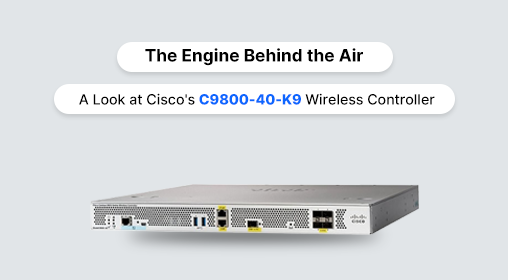
Diving into its core, the C9800-40-K9 is defined by some serious numbers that outline its capabilities. It’s not just about connectivity; it’s about high-performance, secure, and intelligent connectivity.
|
Core Parameter |
Specification |
|---|---|
|
Maximum Throughput |
40 Gbps
|
|
Supported Access Points |
Up to 2,000
|
|
Supported Clients |
32,000
|
|
Network Interfaces |
4 x 10G SFP+ and 1 x 1G SFP/SFP+ ports
|
|
Maximum WLANs/VLANs |
4096 each
|
|
Form Factor |
1RU (Rack Unit)
|
|
Power Supply |
AC with optional redundant AC power
|
What truly sets this controller apart is its foundation on Cisco's IOS XE operating system. This isn't just any software; it's the same battle-tested platform running on many of Cisco's core networking gears, bringing enterprise-grade reliability and a rich set of features to wireless management. The system supports the latest Wi-Fi security standards, including WPA3, creating a fortified shield against evolving cyber threats. For network administrators, the flexibility is a key advantage. The controller can be deployed in various modes—centralized, FlexConnect for branch offices, or as part of a software-defined access (SD-Access) fabric, making it adaptable to diverse architectural needs. Furthermore, it can be managed through the intuitive Cisco DNA Center, offering a centralized window into the entire network's health.
Physically, the C9800-40-K9 has a presence that speaks to its purpose. It's designed for a standard 19-inch server rack, occupying a single unit of space (1RU) with dimensions of 439.4mm in width, 495.3mm in depth, and a slender 13.7mm in height, weighing in at a substantial 10.34 kilograms. The front panel is dominated by its network ports, providing high-speed fiber connectivity for aggregating massive amounts of data from across the network. The design is purely functional, with a focus on efficient cooling and serviceability, ensuring it can operate reliably within a temperature range of 0° to 40°C.
From a user experience perspective, particularly for the network engineers who manage it, the C9800-40-K9 brings a sense of order to potential chaos. Imagine managing a wireless network for a large university. Instead of configuring thousands of access points individually, an administrator can define policies once on the controller and push them out everywhere. Features like seamless software updates with minimal disruption and high availability mean that the network can stay up and running even during maintenance, which is a massive win for user satisfaction and IT team sanity. The integration with Cisco's ecosystem, like Identity Services Engine (ISE) for advanced policy enforcement, allows for incredibly granular control, enabling scenarios where a guest, an employee, and an executive all connect to the same SSID but are granted dramatically different levels of network access automatically and securely.
When discussing value, the C9800-40-K9 isn't an entry-level purchase; it's a strategic investment for organizations where network performance, security, and scalability are non-negotiable. The value proposition lies in its immense scalability and the operational efficiencies it unlocks. The ability to manage thousands of access points as a single, cohesive system drastically reduces operational overhead. Its support for the latest Wi-Fi 6 standard (802.11ax) also future-proofs the investment, ensuring the network can handle the growing demands of modern devices and applications for years to come. For a large enterprise, the cost of network downtime or a security breach can far exceed the initial investment in a robust controller like this.
Of course, no piece of technology is without its trade-offs. The primary advantage of the C9800-40-K9 is also its main consideration: it's unequivocally overkill for a small or medium-sized business. Its power consumption of 381W is significant, and its full potential is only realized when integrated into a broader Cisco infrastructure. For a organization not already invested in the Cisco ecosystem, the learning curve and integration effort could be substantial. However, for its intended audience, its strengths are profound. The combination of massive scalability, robust security built on IOS XE, and deep integration with Cisco's management and security tools makes it a powerhouse. The main challenge lies in its complexity and the need for specialized skills to design, deploy, and manage it effectively. It's a tool for professionals, designed to build and maintain wireless networks that are not just fast, but also intelligent, secure, and resilient.