
Intellectual Property
Hot selling product recommendations
View More



















The 3030S vs 1030S Showdown: More Than Just a Number Game
When you're weighing up the A10 THUNDER 3030S against its sibling, the 1030S, it's easy to get lost in the spec sheets. But the real difference isn't just about bigger numbers; it's about how these machines are built for different battles in the world of application delivery and security. Picking one isn't about finding the "best" in a vacuum—it's about finding the perfect fit for your network's specific challenges and ambitions.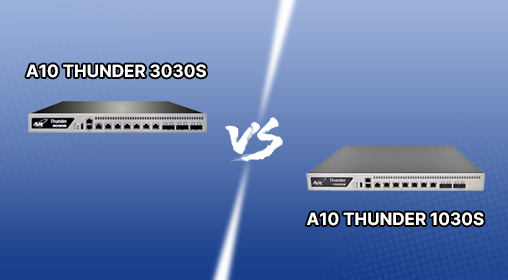
Let's talk about the engine room first. Think of the 1030Sas a reliable, fuel-efficient sedan. It's equipped with a solid foundation, handling Layer 4 throughput at a respectable 10 Gbps. It can manage up to 32 million concurrent sessions and process 450,000 connections per second (CPS). For many businesses, that's more than enough power for everyday traffic. Now, the 3030Sis the high-performance sports car built for the autobahn. While exact figures for the 3030S are not fully detailed in the search results, it is established as a newer and more powerful platform compared to the 1030S. It's designed for environments where traffic isn't just heavy; it's complex and unpredictable. The underlying architecture is more advanced, ready to handle modern application loads with greater efficiency and headroom for growth.
|
Core Parameter |
A10 THUNDER 1030S |
A10 THUNDER 3030S |
|---|---|---|
|
Platform Generation |
Established, proven platform |
Newer generation platform
|
|
Layer 4 Throughput |
10 Gbps
|
Higher than 1030S (specific value not detailed)
|
|
Concurrent Sessions |
32,000,000 (32 million)
|
Higher than 1030S (specific value not detailed)
|
|
Connections Per Second (CPS) |
450,000
|
Higher than 1030S (specific value not detailed)
|
|
Requests Per Second (RPS) |
480,000
|
Higher than 1030S (specific value not detailed)
|
|
DDoS Protection |
Yes, e.g., over 4 million SYN Flood/sec
|
Enhanced capabilities (specifics not detailed)
|
|
Core Feature Set |
Solid foundational features: SLB, GSLB, WAF, SSL Offload
|
Comprehensive & advanced feature set for modern application architectures
|
You can tell a lot about a device's purpose just by looking at it. Both units adhere to the standard 19-inch rackmount form factor, so they'll fit neatly into your data center cabinet. The 1030S has a straightforward, functional design—it's built to do a job without any fuss. The 3030S, however, often reflects a more modern industrial design. Its chassis might be engineered for better thermal efficiency in a denser package, hinting at the more powerful components inside. It’s the difference between a sturdy, reliable workhorse and a sleek, modern machine designed for a forward-looking infrastructure.
This is where the philosophical difference between the two models becomes crystal clear. The 1030S comes packed with a robust set of features that were top-tier for its time. It handles Server Load Balancing (SLB) with classic methods like Round Robin and Least Connection, offers solid Global Server Load Balancing (GSLB), and provides a Web Application Firewall (WAF) and SSL offloading. It's a capable all-rounder. The 3030S, however, is built for a cloud-native, automated world. Its feature set is not just expanded; it's more deeply integrated. Think advanced application security, sophisticated automation capabilities for DevOps-style CI/CD pipelines, and deeper analytics for application performance insight. It's the difference between a tool that directs traffic and a platform that provides intelligent, actionable control over your entire application delivery infrastructure.
For the network or security engineer, the day-to-day feel is distinct. The 1030S offers a sense of dependable familiarity. Its management interface is consistent, and its behavior is predictable for well-understood workloads. It's a reliable workhorse. The 3030S, in contrast, provides a more granular and insightful experience. The integration with modern management and analytics tools means you're not just putting out fires; you're gaining visibility into application performance and user experience, allowing for proactive optimizations. It’s the difference between driving a car with a basic dashboard and one with a full digital display showing real-time diagnostics and even predicting when you'll need maintenance.
Figuring out which model gives you more bang for your buck entirely depends on your timeline. The 1030S, likely available at a lower acquisition cost, represents excellent value for stabilizing predictable, core workloads. It's a smart capital expenditure for a known quantity. The 3030S is an investment in adaptability. Its potentially higher initial price is justified by the long-term savings from features that reduce operational overhead, such as advanced automation and more integrated security that might avoid the need for additional point solutions. For an organization focused on digital transformation, the 3030S's flexibility and future-proofing are its greatest value propositions.
When it comes to stability, both platforms are engineered for reliability. The 1030S has a long track record of stable operation within its performance envelope. The 3030S benefits from newer hardware and architectural improvements that likely contribute to stable performance under the heavy and complex loads it's designed to handle. Both support High Availability (HA) configurations to ensure service continuity.
The Final Tally: A Tale of Two Champions
A10 THUNDER 3030S Pros:Built for modern, distributed application architectures; superior scalability and performance; extensive and advanced security features; unparalleled flexibility for automation and cloud integration.
A10 THUNDER 3030S Cons:A steeper learning curve for teams accustomed to legacy systems and a higher initial investment that is best justified by forward-looking, complex requirements.
A10 THUNDER 1030S Pros:Proven stability for core workloads; lower upfront cost; and operational simplicity for teams with well-defined, traditional processes.
A10 THUNDER 1030S Cons:Lacks the advanced security, automation, and cloud-native features of its newer counterpart, which may limit its role in a rapidly evolving IT landscape.
So, which one is for you? The A10 THUNDER 1030S remains a solid, dependable choice for core network services that are not expected to change dramatically. It's the safe bet for today. The A10 THUNDER 3030S, however, is the clear path for anyone building a resilient, secure, and automated application delivery foundation ready for the challenges of the next decade. The choice isn't about which is better on paper, but which is the right partner for your organization's future.