
Intellectual Property
Hot selling product recommendations
View More




















MikroTik's Power Play: Choosing Between the CCR2004 and CCR2116
So you're setting up a serious network and you've narrowed it down to two solid contenders from MikroTik: the CCR2004-16G-2S+US and the CCR2116-12G-4S+US. This isn't a choice between a beginner model and a pro model; it's a choice between two professional-grade tools designed for slightly different jobs. One is like a powerful, efficient workhorse perfect for core routing duties, while the other is an absolute beast built to handle heavy computational loads without breaking a sweat. Let's get into the details to see which one fits your specific needs.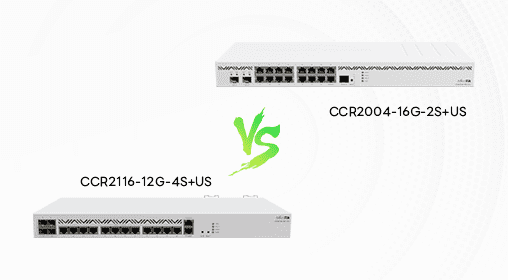
The heart of the difference lies in their processing power. The CCR2004 is equipped with a quad-core ARM Cortex-A57 CPU running at 1.7 GHz, which is known for its excellent single-core performance. This is crucial for tasks that rely on per-connection processing, like complex queue setups or firewall rules applied to individual connections. On the other hand, the CCR2116 is in another league, featuring a massive 16-core ARM CPU clocked at 2.0 GHz. This gives it a significant advantage in multi-threaded performance, making it at least 15% faster in single-core tasks and vastly more powerful for handling numerous simultaneous processes, such as managing extensive BGP tables or hundreds of IPsec tunnels. Both come with 4 GB of DDR4 RAM, but the CCR2116's raw core count is its defining characteristic.
When you look at the physical design, both units follow the classic MikroTik 1U rackmount form factor, but the port layouts tell a different story. The CCR2004 offers a high port density for Gigabit connections with 16x Gigabit Ethernet ports, plus two 10G SFP+ cages for high-speed uplinks or stacking. The CCR2116 takes a different approach, providing 12x Gigabit Ethernet ports and a more substantial four 10G SFP+ ports. This makes the CCR2116 more suited for environments where 10G connectivity is a priority. Both include features like dual redundant power supplies and active cooling, but the CCR2116, with its more powerful processor, likely has a more robust cooling solution to manage the higher thermal output.
|
Feature |
CCR2004-16G-2S+US |
CCR2116-12G-4S+US |
|---|---|---|
|
CPU |
Quad-core ARM Cortex-A57, 1.7 GHz
|
16-core ARM, 2.0 GHz
|
|
RAM |
4 GB DDR4
|
4 GB DDR4
|
|
Ethernet Ports |
16 x 1Gbps |
12 x 1Gbps
|
|
SFP+ Ports |
2 x 10Gbps
|
4 x 10Gbps
|
|
Key Differentiator |
Best single-core performance per watt
|
Layer 3 Hardware Offloading
|
Functionally, both run the full-featured RouterOS, giving you access to all the advanced routing protocols, firewall filters, queueing disciplines, and VPN support you'd expect. However, a critical differentiator for the CCR2116 is its support for Layer 3 Hardware Offloading. This means it can handle routing decisions for certain traffic directly in the switch chip, bypassing the CPU entirely for a massive speed boost and lower latency on those packets. The CCR2004 excels in raw CPU power for tasks that cannot be offloaded.
From a user experience perspective, the CCR2004 is often praised for being a "set it and forget it" device for many use cases. Its combination of strong single-core performance and efficiency makes it remarkably stable for core routing, bandwidth shaping, and running a moderate number of VPN tunnels. The CCR2116, by contrast, is what you turn to when you're pushing the limits. It's designed for large internet service providers or data centers that need to run complex BGP configurations, handle massive firewall rule sets, or process a huge volume of encrypted IPsec traffic. Its 16 cores ensure that the router remains responsive even under extreme load.
In terms of value, the CCR2004 typically represents an excellent balance of performance, port density, and cost for the majority of medium to large-sized businesses. Its efficiency also translates to lower long-term power costs. The CCR2116, while commanding a higher initial investment, is uniquely valuable for specific, demanding scenarios. If your network's requirements align with its strengths—such as needing extensive 10G connectivity and handling advanced dynamic routing at scale—the performance gains and stability it offers provide a compelling return on investment.
So, which one should you choose? It really boils down to your specific workload.
The CCR2004-16G-2S+US shines when:
Your primary need is robust and efficient gigabit-speed routing.
You have applications heavily reliant on strong single-core performance.
Your 10G connectivity needs are limited to a couple of uplinks.
Overall power efficiency and a lower total cost of ownership are important factors.
The CCR2116-12G-4S+US is the clear winner for:
Large-scale environments where multi-threaded performance is key (e.g., massive BGP tables).
Networks requiring multiple 10G interfaces for core distribution or server connectivity.
Scenarios where Layer 3 hardware offloading can be leveraged for specific traffic to reduce CPU load.
Future-proofing a network that is expected to see significant growth in complexity and traffic volume.
In the end, the CCR2004 is the dependable, high-performance workhorse, while the CCR2116 is the uncompromising powerhouse for the most demanding tasks. Your specific network demands will make the right choice clear