
Intellectual Property
Hot selling product recommendations
View More




















MikroTik Face-Off: CRS305-1G-4S+IN vs CRS310-1G-5S-4S+IN Compact 10G Power vs. Versatile Fiber Aggregation
When you're choosing between MikroTik's CRS305-1G-4S+IN and the CRS310-1G-5S-4S+IN, you're not just comparing two switches—you're deciding between two philosophies of network design. One is a ultra-compact 10G specialist, while the other is a flexible aggregation workhorse. Here’s a breakdown of where each one shines—and where it might leave you wanting more.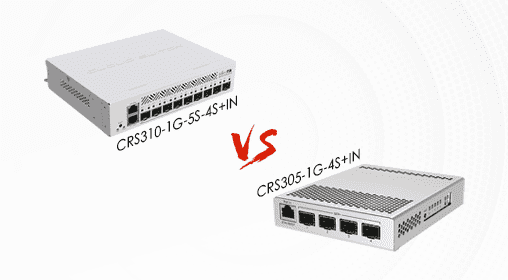
A quick look at their technical DNA reveals their divergent purposes immediately.
|
Parameter |
CRS305-1G-4S+IN |
CRS310-1G-5S-4S+IN |
|---|---|---|
|
Form Factor |
Desktop (Small enclosure) |
1U Rackmount |
|
SFP+ Ports |
4 x 10G SFP+ |
4 x 10G SFP+ |
|
Additional Ports |
1 x 1G RJ45 (management) |
5 x 1G SFP, 1 x 1G RJ45 (PoE-IN support) |
|
Switching Capacity |
40 Gbps |
92 Gbps |
|
CPU |
Unknown (passive cooling) |
ARM v7, 1 core @ 800 MHz |
|
RAM |
64 MB |
256 MB |
|
Power Options |
DC jack (passive) |
Dual DC inputs, PoE-IN (18-57V) |
|
Cooling |
Fanless |
Single fan (active) |
|
Ideal Use Case |
Desktop 10G lab, quiet environments |
Small office/ISP fiber aggregation |
Physical Design and Build Philosophy
The CRS305 is built for simplicity and silence. Its compact, desktop-friendly enclosure is fanless, making it ideal for home offices or labs where noise matters. Weighing under 500g, it’s the kind of device you tuck away and forget—until you need reliable 10G links between a NAS and workstation.
The CRS310, by contrast, demands attention. Its 1U rackmount steel chassis houses active cooling and a robust internal layout suited for comms rooms or ISP racks. The inclusion of dual power inputs (DC jack and PoE-IN) underscores its mission-critical role. But that fan isn’t subtle—under load, it’s audible, so keep it out of earshot.
Where They Excel: Features and Flexibility
The CRS305 is a purebred speed tool. Its four SFP+ ports deliver full 10G line-rate performance with minimal latency, thanks to hardware-offloaded switching. But that simplicity cuts both ways: beyond basic VLANs and L2 features, it lacks the muscle for advanced routing or PoE. It’s the switch you choose when you need 10G—and nothing else.
The CRS310 thrives on versatility. Those five 1G SFP ports transform it into a fiber aggregation point, perfect for linking remote cameras or access points. With PoE-IN support, it can be powered via Ethernet—handy for tricky installations. Its ARM CPU and 256MB RAM also enable lightweight L3 routing and QoS, though don’t expect full routerOS performance.
The Human Factor: User Experience
Both run RouterOS (or SwitchOS), but the CRS310’s extra RAM and CPU power make its WebFig/CLI interface noticeably snappier under load. For beginners, the CRS305 is easier to master: fewer ports, fewer features, less to misconfigure. But for power users, the CRS310’s scripting and automation capabilities—like scheduled scripts or complex firewall rules—add real value.
The CRS305’s fanless design is a win for peace and reliability; no moving parts mean fewer failure points. The CRS310’s fan is replaceable, but its mere existence introduces a potential point of failure—and noise. For labs, the CRS305 wins. For racks, the CRS310’s manageability shines.
Stability and Reliability Considerations
The CRS305’s passive cooling and minimalistic hardware make it exceptionally stable for light workloads. But push it hard with complex rules, and the lack of CPU headroom can cause hiccups. It’s built for simplicity, not stress.
The CRS310’s active cooling and robust power design let it handle sustained loads—think ISP uplinks or multi-tenant VLANs. The Marvell switch chip ensures hardware-offloaded L2 forwarding stays rock-solid, even if the CPU is busy. Just clean those air vents periodically.
The Value Proposition
The CRS305 delivers unbeatable value per 10G port for labs or media studios. If you need raw 10G speed on a budget—and silence is golden—it’s the obvious pick.
The CRS310 justifies its higher cost with flexibility. Those 1G SFP ports and PoE-IN support eliminate the need for separate media converters or power injectors. For small businesses or ISPs, it’s a consolidation play that saves rack space and complexity.
The Final Verdict
Choose the CRS305-1G-4S+IN if your world revolves around pure 10G connectivity in a quiet, compact setup. It’s the specialist’s tool for high-speed desktop workflows.
Choose the CRS310-1G-5S-4S+IN if you’re building a fiber-rich network that demands versatility—aggregating links, powering remote gear, or handling light routing duties. It’s the expandable backbone for growing infrastructure.
Neither switch is "better"—they’re just built for different corners of your network. Match the tool to the task, and you’ll be rewarded with years of silent service or scalable performance.