
Intellectual Property
Hot selling product recommendations
View More




















MikroTik CRS504 vs. CRS510: Choosing Your 100G Pathway
Deciding between the MikroTik CRS504-4XQ-IN and the CRS510-8XS-2XQ-IN is less about finding a "better" switch and more about aligning your choice with the specific demands of your network's present and future. One device is a focused powerhouse for pure 100G density, while the other offers a bridge between different speed tiers, emphasizing flexibility. Their design philosophies cater to distinctly different deployment scenarios.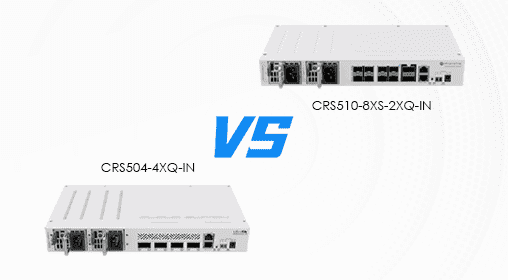
At the core of the CRS504 lies the Marvell Prestera 98DX4310 switch chip, a beast designed for high-throughput switching. It's equipped with a QCA9531 CPU running at 650 MHz, supported by 64 MB of RAM. Its key feature is four QSFP28 ports, each capable of 100 Gbps, giving the switch a total non-blocking switching capacity of 800 Gbps. These ports are incredibly versatile, supporting breakout cables to function as 4x25G or 4x10G links, effectively allowing up to 16 slower devices to connect to a single 100G port.
The CRS510 takes a different approach. While detailed specifications for its internal chipset were not available in the search results, its port configuration reveals its purpose: it features eight SFP+ ports (10 Gigabit) and two QSFP28 ports (100 Gigabit). This hybrid design is tailored for aggregation, allowing it to connect multiple 10G servers or access switches and uplink them efficiently into a 100G backbone. It’s the ideal tool for consolidating traffic from a high number of 10G sources and funneling it into a high-speed core.
A critical difference is programmability. The CRS504's switching capacity is primarily dedicated to Layer 2 and basic Layer 3 hardware offloading, making it a speed demon for straightforward switching. The CRS510, with its more varied port layout, is often perceived as offering a more balanced feature set suitable for environments requiring a mix of access and aggregation duties.
|
Core Parameter |
CRS504-4XQ-IN |
CRS510-8XS-2XQ-IN |
|---|---|---|
|
Primary Role |
High-Density 100G Core/Aggregation |
Hybrid 10G/100G Aggregation |
|
CPU |
QCA9531, 650 MHz, 1 core
|
(Specifics not detailed in search results) |
|
System Memory |
64 MB RAM
|
(Specifics not detailed in search results) |
|
Total Ports |
4 |
10 |
|
100G QSFP28 Ports |
4 |
2 |
|
10G SFP+ Ports |
0 |
8 |
|
1G/100M RJ45 Port |
1 (Management)
|
Likely 1 (Management) |
|
Switching Capacity |
800 Gbps
|
(Specifics not detailed in search results) |
|
Cooling |
2 fans
|
(Specifics not detailed in search results) |
|
Power Supply |
Internal, dual hot-swappable
|
(Specifics not detailed in search results) |
|
MTBF |
~200,000 hours
|
(Specifics not detailed in search results) |
The CRS504 is a study in minimalist, focused design. It's a compact, 1U high, rack-mountable unit with dimensions around 32.0 (W) x 18.5 (D) x 4.4 (H) cm and a net weight of approximately 1 kg. Its small footprint and relatively light weight make it easy to deploy in space-constrained data center environments. A key reliability feature is its support for dual, hot-swappable power supplies, a critical design element for core infrastructure where maximum uptime is required.
The CRS510, while also a 1U rack-mountable device, is physically larger to accommodate its greater number of ports. Its design reflects its role as a versatile aggregation switch, built to handle a broader mix of connections in a single unit. The build quality is consistent with MikroTik's industrial design, prioritizing function and durability.
Both devices run the powerful and versatile MikroTik RouterOS, but their hardware dictates their strengths. The CRS504 is a specialist. It excels at VLANs, ACL, MLAG, and handling Jumbo frames with hardware offloading for maximum performance. Its feature set is optimized for doing one thing exceptionally well: moving vast amounts of data between 100G links as efficiently as possible.
The CRS510 is a generalist. Its value lies in its port diversity. The eight SFP+ ports are perfect for connecting servers, storage, or lower-tier switches, while the two QSFP28 ports provide high-speed uplinks. This makes it ideal for scenarios where you need to future-proof a network, gradually introducing 100G capabilities while still supporting a large number of existing 10G devices. It's a consolidation play, reducing the need for multiple separate switches.
Setting up a CRS504 requires a solid understanding of RouterOS. Users on forums have noted that achieving optimal performance, especially when using breakout cables for 25G connections, sometimes requires manual interface speed adjustments instead of relying solely on auto-negotiation. For a network administrator comfortable with the CLI, it's a powerful tool, but there can be a learning curve to unlock its full potential.
The CRS510 offers a more familiar management experience for those accustomed to managing mixed-speed networks. The process of configuring VLANs across 10G and 100G ports is straightforward within the RouterOS interface. Its design is inherently more approachable for administrators managing a heterogeneous environment where simplicity and flexibility are valued over raw, single-purpose speed.
The CRS504's value is in its unbeatable cost per 100G port. For building a pure 100G backbone, it is incredibly difficult to match its price-to-performance ratio. Its low power consumption (around 25W without attachments) also contributes to a lower total cost of ownership over time for high-speed networks.
The CRS510's value is in consolidation and flexibility. While its per-port cost for 100G is higher, it eliminates the need for a separate 10G aggregation switch. For a network that is evolving, the ability to handle both 10G access and 100G uplinks in a single device can lead to savings in rack space, power, and overall complexity.
Choose the CRS504-4XQ-IN if:
You are building or upgrading a network core or aggregation layer that demands pure 100G connectivity.
Your primary goal is to create high-speed links between servers, storage, or other core switches.
You need the flexibility to break out 100G ports into multiple 25G or 10G connections for high-density server racks.
You are comfortable with RouterOS and potentially more involved configuration for non-standard setups.
Choose the CRS510-8XS-2XQ-IN if:
Your network requires a mix of 10G and 100G capabilities in a single device.
You need to aggregate traffic from many 10G servers or switches and uplink them efficiently into a 100G backbone.
You prefer a more straightforward setup for a mixed-speed environment and value connection flexibility over raw 100G port density.
You are looking for a cost-effective solution to bridge existing 10G infrastructure with future 100G investments.
The CRS504 is the specialist's tool, a scalpel for high-performance networking. The CRS510 is the versatile workhorse, built to handle the day-to-day mix of a growing enterprise network. Your current needs and future roadmap will clearly indicate which path is right for you.