
Intellectual Property
Hot selling product recommendations
View More




















Fiber Face-Off CRS326-24S+2Q+RM vs CRS326-4C+20G+2Q+RM : Unpacking MikroTik's 24 SFP+ vs. 20G Combo Port Switch
Choosing between MikroTik's CRS326 series switches can feel like picking a specialist tool for a complex job. On the surface, they're both powerful 10GbE fiber switches, but a closer look reveals they're engineered for distinctly different environments. Let's break down the CRS326-24S+2Q+RM and the CRS326-4C+20G+2Q+RM to see which one fits your network's blueprint.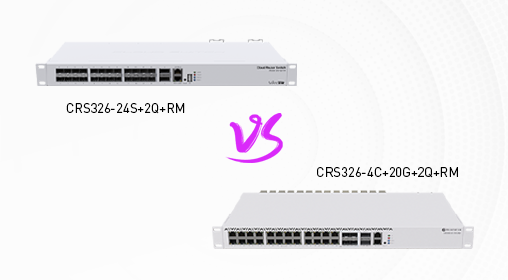
The most immediate difference is in their port architecture. The CRS326-24S+2Q+RM is a purist's dream for fiber connectivity, featuring a straightforward array of twenty-four 10 Gbps SFP+ ports and two 40 Gbps QSFP+ ports. This design is ideal for data centers or core network links where consistency and high-density 10G fiber connections are paramount. In contrast, the CRS326-4C+20G+2Q+RM takes a more flexible approach. It replaces some of the dedicated SFP+ ports with four 10G Combo ports (each offering an RJ45 and an SFP+ port, only one usable at a time) and sixteen 2.5 Gbps RJ45 Ethernet ports. This hybrid design is a perfect match for modern office deployments or access layers, seamlessly connecting everything from legacy 1G devices and WiFi 6/6E access points (which often have 2.5G uplinks) to 10G fiber backhaul links.
When we peek under the hood, the similarities become more apparent. Both models are built on the same robust hardware foundation. They share an identical MIPSBE CPU (QCA9531) running at 650 MHz, 64 MB of RAM, and 16 MB of storage for the dual-boot RouterOS/SwOS operating system. This means the core processing power and management experience are consistent across both switches. They also boast the same impressive non-blocking switching capacity of 640 Gbps and a layer 2 forwarding rate of 252 Mpps, ensuring wire-speed performance for your internal network traffic. Physically, they both come in a practical 1U rackmount form factor, though the 24S+ model is slightly narrower at 443mm wide compared to the 4C+20G+ model's 440mm width—a negligible difference for standard racks.
From a usability standpoint, the choice hinges on your day-to-day needs. The CRS326-4C+20G+2Q+RM offers unparalleled convenience for mixed-media environments. The ability to use either copper or fiber on the combo ports and the inclusion of 2.5GBase-T ports eliminates the need for external transceivers for many connections, simplifying cabling and potentially reducing costs. It's a "plug-and-play" solution for diverse device landscapes. The CRS326-24S+2Q+RM, however, is the definition of a dedicated workhorse. Its all-SFP+ design is optimized for pure fiber infrastructure, offering the highest density of 10G fiber links. This makes it potentially more stable and efficient in a controlled environment like a server room, as it generates less heat than switches with many high-speed copper ports and is built for a single, high-performance purpose.
So, which switch wins the value battle? It's not about which is cheaper, but which delivers more value for your specific budget and requirements. The CRS326-4C+20G+2Q+RM likely presents a lower total cost of ownership for environments with a significant number of copper-based devices. By having the right port types built-in, you save on the expense of additional media converters or SFP modules. The CRS326-24S+2Q+RM, while potentially having a higher initial investment due to the need for SFP modules for every connection, delivers uncompromising performance and scalability for all-fiber networks. Its value is in its simplicity, density, and focused design for high-throughput applications.
The Bottom Line
Here’s a quick guide to help you decide:
Choose the CRS326-24S+2Q+RM if: Your priority is maximizing the number of 10G fiber connections in a homogenous environment. You're building a core switch for a data center, a high-capacity link between routers, or a backbone for a virtualization cluster where consistency and fiber density are non-negotiable.
Choose the CRS326-4C+20G+2Q+RM if: Your network is a mix of old and new technology. You need the flexibility to connect a variety of devices—from 1G computers and 2.5G wireless access points to 10G servers—using the most convenient and cost-effective cabling available. It's the ultimate versatile solution for growing businesses and complex office networks.
In the end, MikroTik hasn't created a winner and a loser; they've created a specialist and a generalist. Your network's language will tell you which one is speaking it fluently.