
Intellectual Property
Hot selling product recommendations
View More


















F5 Showdown: When Your Network Growth Demands a Clear Choice Between I2600 and 4000S
Picking between the F5 BIG-LTM-I2600 and the 4000S isn't just about comparing specs on a sheet. It's a strategic decision that boils down to the expected heartbeat of your network traffic. One is a capable and efficient workhorse, while the other is a high-performance engine built for the data superhighway. The right choice depends entirely on whether you're building a reliable local road system or planning for eight-lane traffic.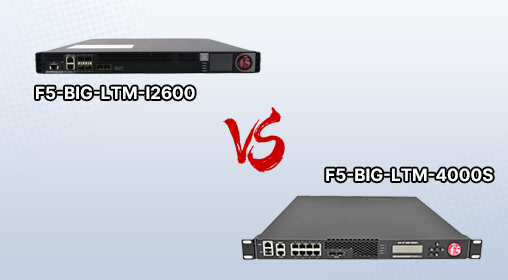
Let's get straight to the raw numbers, because they tell two very different stories. The I2600 is engineered for substantial but more predictable loads. It handles a solid 10 Gbps of throughput, managing 14 million concurrent connections and processing 350,000 Layer 7 requests per second. Its SSL offloading capabilities are respectable, handling RSA operations at 2,500 transactions per second. The 4000S, in contrast, operates in a different league altogether. It is designed for massive scale, with a throughput of 2.4 Tbps, support for up to 6 billion concurrent connections, and the ability to process a staggering 1.2 million TLS transactions every second. The difference in raw power is not just incremental; it's architectural.
|
Core Parameter |
F5 BIG-LTM-I2600 |
F5 BIG-LTM-4000S |
|---|---|---|
|
Max Throughput |
10 Gbps
|
2.4 Tbps
|
|
Concurrent Connections |
14 Million
|
6 Billion
|
|
L7 Requests/Sec |
350,000
|
Information not specified in search results |
|
TLS Transactions/Sec (RSA) |
2,500 TPS
|
1.2 Million TPS
|
|
Latency |
Information not specified in search results |
<0.5ms
|
|
Form Factor |
1U
|
2U
|
|
CPU / Memory |
Intel Dual-Core, 16GB DDR4
|
Information not specified in search results |
|
Advanced Features |
Core ADC features (SSL Offload, WAF, DDoS protection)
|
Multi-tenancy, Predictive Analytics, Edge Computing Support
|
The physical design of these units hints at their inner purpose. The I2600 sports a compact 1U chassis, a neat and efficient package for a standard rack. It's built with reliability in mind, often featuring a single power supply with options for redundancy. The 4000S demands more real estate with a 2U form factor, which is necessary to house its more powerful and redundant components, including advanced network interfaces and cooling systems designed for continuous high load. It's visibly a piece of core infrastructure, heavier and more substantial, reflecting its role in the data center.
When it comes to features, both cover the essential ADC grounds like SSL/TLS offloading, traffic management, and integrated security protections. The I2600 is a competent all-rounder for these foundational tasks. The 4000S, however, pushes into advanced territory. It offers granular multi-tenancy, which is a game-changer for service providers or large enterprises needing workload isolation. Its predictive analytics capabilities, likely driven by machine learning, provide a significant operational advantage by offering insights for proactive scaling. Furthermore, it has built-in support for modern edge computing architectures, making it a more forward-looking platform.
For the network engineer, the day-to-day experience differs. Managing the I2600 is straightforward via F5's intuitive GUI or CLI, perfect for environments where configurations are relatively stable. The 4000S enhances this experience with a stronger focus on automation and deep visibility. Its iControl REST API and Ansible integration cater to DevOps practices, while features like LiveDashboard provide real-time analytics that turn troubleshooting from a forensic task into an interactive session. The I2600 gives you control, but the 4000S gives you insight and automation.
The value question is interesting. The I2600 represents a solid, cost-effective entry point for core application delivery needs. Its lower acquisition cost makes sense for mid-sized enterprises or for specific, well-understood workloads. The 4000S commands a higher price, but it's an investment in headroom and sophistication. Its value is justified if you need extreme scalability, advanced features like multi-tenancy, or are planning for edge and hybrid cloud deployments within the next few years. It's about total cost of ownership for a decade rather than just the initial price tag.
In terms of stability, both are enterprise-grade hardware designed for reliability. The I2600 will run rock-solid within its performance envelope. The 4000S takes it further with comprehensive hardware redundancy and is engineered to remain stable under the immense, fluctuating loads of a large-scale network environment.
So, what's the final call? The F5 BIG-LTM-I2600is your champion if your needs are significant but bounded. It's the perfect fit for consolidating application traffic in a large enterprise or providing robust services in a substantial data center. Its pros are clear: a proven, cost-effective platform for core ADC functions. The con is its performance ceiling; it will eventually be outgrown by a rapidly expanding digital footprint.
The F5 BIG-LTM-4000Sis the undisputed choice for environments where scale, future-proofing, and advanced capabilities are non-negotiable. Its pros are immense power, advanced features like AI-driven analytics, and a architecture ready for the future of networking. The primary con is its higher initial investment, which is only justified if you truly need what it offers.
Your choice is simple: pick the I2600 for a powerful and reliable solution for today's known demands. Choose the 4000S when your network's future growth demands a platform that won't just keep up, but lead the way.