
Intellectual Property
Hot selling product recommendations
View More




















F5 i7820 vs i5800: Choosing the Right Engine for Your Network
When it comes to keeping critical applications running smoothly under heavy load, the F5 BIG-BT-I7820-DF and BIG-BT-I5800 represent two distinct tiers of solution. The choice between them isn't about finding a "better" device, but rather identifying the right tool for the specific scale and demands of your network infrastructure. The i5800 is a powerful workhorse designed for substantial enterprise data centers, while the i7820 steps up as a more robust option, likely catering to environments with even greater performance and scalability requirements, such as large-scale data centers or service providers.|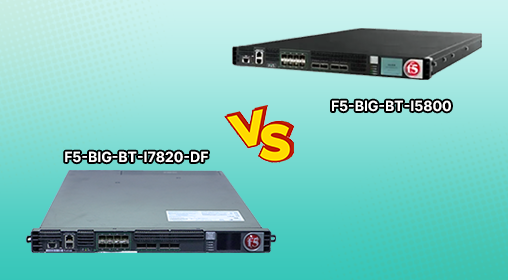
A look at their core specifications reveals a clear performance hierarchy. The i7820 generally supports a higher overall throughput capacity, designed to handle significantly more simultaneous connections and transactions per second. This is crucial for environments running high-traffic web services, large-scale databases, or extensive virtualized infrastructures. Its hardware-based acceleration for functions like SSL/TLS offloading and DDoS protection is typically more powerful, ensuring advanced security features can be enabled without creating a performance bottleneck. The i5800, while still highly capable, is built for strong performance at a relatively high level, but may not offer the same extensive headroom for future growth or massive, unexpected traffic spikes.
|
Feature / Specification |
F5 BIG-BT-I7820-DF |
F5 BIG-BT-I5800 |
|---|---|---|
|
Performance & Capacity |
||
|
Target Deployment |
Large-scale data centers, high-demand core networks |
Substantial enterprise data centers, regional hubs |
|
Total Throughput |
Higher overall capacity |
Strong, high-level capacity |
|
Connections per Second |
Higher threshold for new connections |
High threshold for new connections |
|
SSL/TPS (Transactions Per Second) |
Higher capacity for encrypted traffic |
Strong capacity for encrypted traffic |
|
Hardware Design |
||
|
Chassis & Expandability |
Larger physical footprint, greater expansion slot capacity |
Robust chassis with significant expansion capabilities |
|
Power Supply |
Higher wattage, often with redundant, hot-swappable units
|
Robust power design, may have configurable options |
|
Cooling System |
Advanced, multi-fan design for high heat dissipation
|
Efficient cooling system to maintain stability |
Physically, the i7820 often utilizes a larger chassis to accommodate its more powerful internal components and provide greater expansion capabilities for additional network modules or interface cards. This design prioritizes scalability and redundancy, frequently featuring multiple, hot-swappable power supplies and fans to ensure maximum uptime. The i5800, while also built to a high standard, might have a slightly more compact form factor, reflecting its positioning for environments where physical space or ultimate expandability may be secondary to raw performance within a defined scale. Both units are engineered for 24/7 operation, but the i7820's thermal and power design is typically reinforced for the sustained heavy loads expected in core network roles.
In terms of user experience, managing the i7820 provides a sense of commanding a top-tier infrastructure component. The interface offers deep granular control for complex traffic steering, advanced security policies, and detailed analytics, which is invaluable for large, complex networks. The i5800 runs the same intuitive F5 operating system (TMOS), providing a very similar management experience but for a slightly different set of scalability challenges. For engineers, the i7820's additional muscle translates to peace of mind when deploying resource-intensive features like advanced bot detection or full SSL inspection across massive traffic volumes, knowing the system won't become the bottleneck.
The value proposition of each unit hinges on forward-looking planning. The i5800 presents a powerful solution for organizations with predictable, high-volume needs. However, for businesses anticipating significant growth, dealing with unpredictable traffic bursts, or for whom application performance is directly tied to revenue, the i7820's superior headroom and expandability often justify the higher initial investment. Its ability to handle future demands without a hardware refresh can lead to a lower total cost of ownership over time. It's an investment in scalability and long-term infrastructure stability.
Of course, no technology is perfect. The i7820's primary strength is its scale, which can be a drawback for some. Its larger physical size demands more data center rack space, and its sophisticated feature set requires a skilled team to manage effectively. The i5800, while extremely powerful, might face limitations under extreme, unanticipated load scenarios where the i7820 would continue to perform seamlessly. It's engineered for high performance but within a certain operational envelope.
In conclusion, the decision is refreshingly clear-cut. The F5 BIG-BT-I5800 is an excellent choice for demanding enterprise data centers that need robust application delivery and security today and in the foreseeable future. The F5 BIG-BT-I7820-DF is the next step up, designed for the core of the network where traffic is heaviest and uptime is non-negotiable. Your choice ultimately depends on the weight of the traffic you need to carry and your growth trajectory. For proven, high-level performance, the i5800 is a formidable tool. For ensuring application reliability at an even larger scale, the i7820 is the clear path forward.