
Intellectual Property
Hot selling product recommendations
View More




















F5 i5800 vs i2800: A Real-World Performance Breakdown
When you're sizing up application delivery controllers, the comparison between F5's BIG-LTM-i5800 and i2800 is a classic study in matching the right tool to the job. It's not about one being universally better, but about which one fits the specific demands of your network traffic. The i2800 is a capable workhorse for regional offices or specific application tiers, while the i5800 is built to handle the core traffic of a sizable data center. The difference becomes obvious when you look under the hood. The i5800 is engineered for significantly heavier loads, featuring 48 GB of DDR4 memory and a solid-state drive, which contribute to its ability to handle a larger volume of concurrent tasks and faster data access. In contrast, the i2800 is equipped with 16 GB of DDR4 memory and a traditional hard disk drive, aligning with its role in less demanding environments.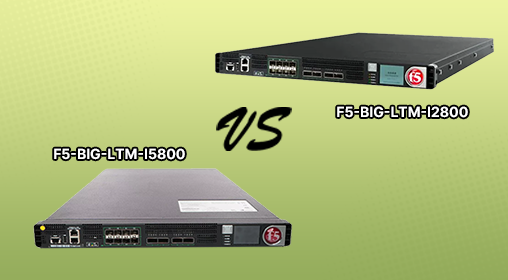
The performance gap is the most telling part of the story. Think of it in terms of highway lanes and vehicle capacity. The i5800 offers a massive 60 Gbps of Layer 4 throughput, and can process a staggering 12 million L4 HTTP requests per second. It also maintains a pool of up to 40 million concurrent connections. The i2800, on the other hand, is rated for 10 Gbps throughputand handles up to 1 million L4 HTTP requests per second, with a maximum of 14 million concurrent connections. For modern applications reliant on encryption, the i5800 also pulls ahead with superior SSL transaction performance, handling 35,000 TPS for RSA (2K keys) compared to the i2800's 4,300 TPS. Where the i5800 often includes dedicated hardware for compression and DDoS protection (e.g., 20 Gbps compression, 50M SYN cookies/sec), the i2800 typically relies on software-based solutions for these tasks, which can impact its overall performance under stress.
|
Feature / Specification |
F5 BIG-LTM-i5800 |
F5 BIG-LTM-i2800 |
|---|---|---|
|
Performance |
||
|
L4 Throughput |
60 Gbps
|
10 Gbps
|
|
L7 Throughput |
35 Gbps
|
10 Gbps
|
|
L4 HTTP Requests/sec |
12 Million RPS
|
1 Million RPS
|
|
Max L4 Concurrent Connections |
40 Million
|
14 Million
|
|
Hardware |
||
|
Memory |
48 GB DDR4
|
16 GB DDR4
|
|
Hard Drive |
480 GB SSD
|
500 GB HDD
|
|
Advanced Features |
||
|
SSL TPS (RSA 2K) |
35,000 TPS
|
4,300 TPS
|
|
Hardware Compression |
20 Gbps
|
Not Available
|
|
Hardware DDoS Protection |
50M SYN cookies/sec
|
Not Available
|
|
Physical & Design |
||
|
Dimensions (HxWxD) |
1.72" x 17.4" x 30.6"
|
1.72" x 17.4" x 22.5"
|
|
Typical Power Consumption |
265W
|
95W
|
|
10G SFP+ Ports |
8
|
2
|
|
40G QSFP+ Ports |
4
|
Not Available
|
Physically, both units occupy a standard 1U rack space, but the i5800 has a deeper chassis (30.6 inches vs. 22.5 inches for the i2800) to accommodate its more robust components. This extra hardware also translates to higher power draw, with the i5800 consuming around 265W compared to the i2800's 95W. The port density is another differentiator. The i5800 comes equipped with eight 10 Gbps SFP+ ports and four 40 Gbps QSFP+ ports, ready for high-speed data center interconnects. The i2800 offers a more modest setup with four 1 Gbps SFP ports and two 10 Gbps SFP+ ports, sufficient for edge deployments.
From an operational perspective, the i5800's additional muscle provides a different quality of experience. For network engineers, it means more headroom to deploy advanced features like hardware-accelerated compression and robust DDoS mitigation without becoming the bottleneck. Its support for more virtualized instances (up to 8 vCMP guests) allows for better consolidation of services. The i2800 offers a simpler, more straightforward management experience for environments that don't require such extensive segmentation or advanced feature offloading.
When discussing value, the i2800 presents a lower barrier to entry and is a sensible choice for targeted workloads where its performance ceiling is adequate. However, for organizations expecting growth or handling critical, high-traffic applications, the i5800's superior performance, hardware-offloaded features, and greater scalability offer a compelling long-term value, preventing the need for a premature upgrade.
In terms of stability, both platforms are built for reliability. The i5800's architecture is designed for the continuous operation required in core data centers. It often supports dual power supplies for redundancy, a critical feature for mission-critical deployments. The i2800, while also reliable, is tailored for the high availability expectations of a branch or medium-scale environment.
So, the choice ultimately hinges on the weight of the traffic you need to carry. The i2800 is an efficient and cost-effective solution for handling predictable, moderate traffic loads. The i5800 is the clear choice for ensuring application reliability, speed, and security in the heart of your network where demand is high and variability is a constant.