
Intellectual Property
Hot selling product recommendations
View More




















F5 3400 vs 3600: The Subtle Art of Application Delivery Tiering
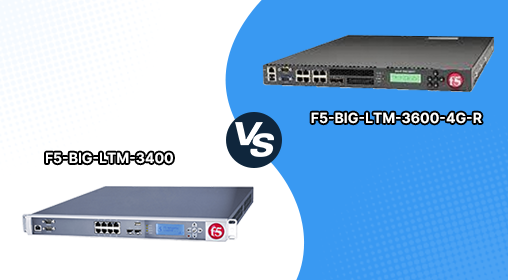
When you're weighing the F5 BIG-LTM-3400 against the BIG-LTM-3600-4G-R, you're not so much comparing a winner and a loser as you are distinguishing between a highly capable specialist and a more versatile workhorse. The choice ultimately boils down to the specific weight of the traffic and the complexity of the policies you need to enforce. The 3400 carves out its niche as a solid, power-efficient solution for branch offices or specific application tiers where demands are predictable and substantial but not overwhelming. It's the kind of device you set and forget, confident in its ability to handle a defined workload without fuss. The 3600-4G-R, suggested by its model number to be a step up, logically positions itself for more critical roles in medium-sized data centers or as a core component for businesses anticipating growth, where extra headroom is not a luxury but a necessity.The difference in their design philosophy becomes apparent under the hood. The 3400 is engineered for efficiency, often leveraging a specific processor and memory configuration to deliver its 8 Gbps throughput with a lower power draw. The 3600-4G-R, as a more robust model, would be built to sustain higher loads, likely featuring enhanced processing cores and increased memory to support a greater number of concurrent connections and more complex traffic inspection tasks. This isn't just about raw speed; it's about the capacity to maintain performance when advanced features like a robust Web Application Firewall or detailed iRules scripts are thrown into the mix.
|
Feature / Specification |
F5 BIG-LTM-3400 |
F5 BIG-LTM-3600-4G-R (Inferred) |
|---|---|---|
|
Performance & Capacity |
||
|
Target Deployment |
Mid-sized deployments, branch offices
|
More critical roles in medium-sized data centers, growth-oriented businesses
|
|
Throughput |
8 Gbps
|
Higher throughput capacity (inferred from model tier) |
|
SSL/TLS Performance |
4 Gbps
|
Better SSL inspection throughput (inferred) |
|
Maximum Connections |
500,000
|
Higher connection capacity (inferred) |
|
Hardware Design |
||
|
System Memory |
16 GB DDR4
|
Likely more than 16 GB (inferred) |
|
Storage |
240 GB SSD
|
Potentially larger/more robust storage (inferred) |
|
Power Consumption |
120W (typical)
|
Higher power draw (inferred) |
|
Network Interfaces |
4x 1G/10G ports
|
Likely higher port density or faster interfaces (inferred) |
Physically, both units understand they belong in a data center rack, but with different priorities. The 3400 often sports a 1U compact form factor, a design choice that prioritizes space savings and energy efficiency, making it suitable for environments where rack real estate and power budgets are carefully considered. The 3600-4G-R, tasked with a heavier burden, might utilize a similar 1U chassis but would need a more robust cooling solution to manage the heat from its higher-performance components. This difference in thermal design is a subtle but telling clue about the sustained workload each device is built to handle.
For the network administrator, the experience differs in terms of available headroom. Managing the 3400 is a straightforward affair; the F5 TMOS operating system provides a unified interface for configuring virtual servers, pools, and health monitors. It's a reliable tool for its intended scope. The 3600-4G-R runs the same intuitive software but offers a greater sense of flexibility. Its additional resources mean you can deploy more advanced features—like more detailed analytics, more complex traffic shaping rules, or more stringent security policies—without immediately worrying about pushing the device to its limits. It provides a cushion that can be crucial for troubleshooting or during unexpected traffic surges.
The value proposition of each model is clear-cut. The 3400 presents a lower upfront cost and is a sensible, economical choice for organizations with well-defined, moderate performance needs. However, for businesses on a growth trajectory or for whom application performance is critical, the 3600-4G-R's superior performance headroom and expanded capabilities often justify the higher initial investment. Its ability to handle future demands without a hardware refresh can lead to a better total cost of ownership over its operational life. You're investing in scalability and long-term infrastructure stability.
Of course, each has its trade-offs. The 3400's primary strength is its cost-effectiveness for specific tasks, which can be a limitation if your network's demands grow beyond its performance ceiling. The 3600-4G-R, while more powerful, represents a greater initial investment and may have higher operational costs due to increased power consumption. It's a more capable machine, but it demands a use case that truly requires its enhanced muscle.
In terms of stability, both platforms are built on F5's reliable architecture. The 3400 is a stable and solid performer for its designated role in branch offices or for specific application tiers. The 3600-4G-R's design is typically reinforced for the continuous, heavier loads expected in more critical network roles, often featuring more robust components to ensure maximum uptime.
Your final decision hinges on a realistic appraisal of your current and near-future needs. The F5 BIG-LTM-3400 is an excellent, efficient, and cost-effective solution for environments where its performance envelope is a perfect fit. The F5 BIG-LTM-3600-4G-R is the logical step up for networks that need more muscle, more headroom, and the confidence that comes with having extra capacity in reserve. For proven, solid performance at a lower entry point, the 3400 is a formidable tool. For ensuring application reliability under heavier loads and for the foreseeable future, the 3600-4G-R is the path of greater preparedness.