
Intellectual Property
Hot selling product recommendations
View More



















The Backbone of Modern Data Flow: Cisco's N9K-C9332C
In the heart of a contemporary data center, where every microsecond counts, the Cisco Nexus N9K-C9332C isn't just another piece of hardware; it's the central nervous system for high-stakes data traffic. This switch was engineered for a specific, critical role: to act as the spine of a large-scale network, a relentless mover of information that operates with both immense speed and unwavering reliability. It’s the kind of equipment that doesn't seek the spotlight but ensures that everything from cloud applications to real-time analytics platforms runs without a hitch .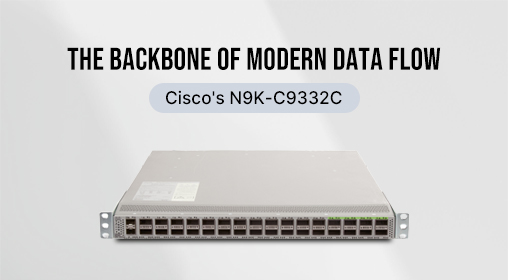
This device is a Layer 3 fiber switch, a sophisticated traffic controller designed for the core of the network. Its primary mission is to make intelligent decisions about data packet routing, ensuring they flow through the most efficient paths possible. This isn't a solution for a small office; it's built for the demanding environments of data center spines or high-capacity aggregation layers, where network performance and uptime are absolutely critical . The table below breaks down the raw numbers that give it this capability .
|
Core Parameter |
Specification |
|---|---|
|
Port Configuration |
32 x 40/100G QSFP28 ports + 2 x 10G SFP+ ports |
|
Backplane Bandwidth |
7.2 Tbps |
|
Forwarding Rate |
2.8 Bpps |
|
Form Factor |
1 Rack Unit (1RU) |
|
System Memory |
16 GB |
|
Power Supply |
700W (100-240V) |
|
Dimensions (HxWxD) |
44 x 439 x 581 mm |
|
Weight |
11.4 kg |
When you look at the N9K-C9332C, you see a device built for business, not for show. Its design is purely functional, adhering to a compact 1RU form factor that allows data center managers to pack a significant amount of networking power into a minimal vertical space. This density is a huge advantage when every rack unit counts. The front panel is dominated by the array of QSFP28 ports, ready for high-speed fiber connections, accompanied by a set of status indicators that provide a quick, visual health check of the entire system. Weighing in at 11.4 kilograms, it has a substantial feel that speaks to its robust internal construction .
Where this switch truly excels is in its functional intelligence. It operates on Cisco's NX-OS, a robust and highly programmable operating system built for data center resilience, offering advanced routing protocols and sophisticated traffic management. A key feature for modern, scalable networks is its programmability and support for automation, allowing it to be integrated into infrastructure-as-code practices. This is crucial for teams managing large, virtualized environments or private clouds, as it enables automated deployments and consistent configuration management, significantly reducing human error. Furthermore, its design supports modern data center architectures like VXLAN and EVPN, which are essential for creating flexible, large-scale overlay networks. The device can also operate in either traditional NX-OS mode or Cisco's Application Centric Infrastructure (ACI) mode, providing flexibility for software-defined networking deployments .
For the network engineer, the experience of working with the N9K-C9332C is defined by a sense of control and predictability. The massive throughput effectively eliminates concerns about network congestion, even during peak loads. The ability to automate repetitive tasks through NX-OS APIs is a significant quality-of-life improvement, freeing up time for more strategic work. However, this power comes with a learning curve. Mastering the full depth of NX-OS's capabilities requires dedication and specialized knowledge. For organizations without deep Cisco expertise, the initial setup and ongoing management of advanced features can be challenging. But for those who invest the time, the payoff is a network backbone that is both powerful and intelligently managed .
Evaluating its value proposition means looking beyond the initial sticker price. The N9K-C9332C sits in a category where the total cost of ownership over its operational life is the true metric. Its high port density and support for 40G and 100G speeds future-proof the investment, ensuring the network can handle growing data demands for years. The renowned reliability of Cisco's flagship hardware translates directly into reduced downtime, and in a data center, minutes of outage can cost far more than the switch itself. When you factor in the operational efficiencies gained through automation and the space savings of its 1RU design, the switch presents a compelling case for organizations where network performance is inextricably linked to business success .
No technology is a perfect fit for every scenario, and the N9K-C9332C is no exception. Its greatest strength is its raw, uncompromising performance and the rich, automated feature set of NX-OS, making it an ideal core for a demanding data center. Its stackability and integration into the broader Cisco ecosystem are major advantages. On the other hand, the complexity of its capabilities can be overwhelming for smaller teams without specialized expertise. The power and cooling requirements for a device of this caliber are not insignificant, and it is unequivocally over-engineered for any environment that doesn't genuinely need 100-gigabit speeds. It's a precision instrument for a specific, high-performance job .
In the final analysis, the Cisco Nexus N9K-C9332C is more than a collection of impressive specs; it's a commitment to building a network backbone that won't falter under pressure. It’s the right choice for those who need to move vast amounts of data with speed, reliability, and intelligent control, forming a solid foundation for the most demanding modern applications .