
Intellectual Property
Hot selling product recommendations
View More




















Cisco N9K-C93108TC-EX: The Port Density King for Modern Data Centers
Walking into a server room and seeing the Cisco N9K-C93108TC-EX, you might not immediately grasp its significance. This isn’t a flashy piece of hardware—it’s a workhorse. But for IT managers who’ve struggled with legacy systems choking under the weight of medical imaging data, AI training workloads, or real-time financial trading data, this switch is nothing short of a revolution. It’s the silent backbone that keeps digital infrastructures breathing, especially in environments where downtime isn’t an option.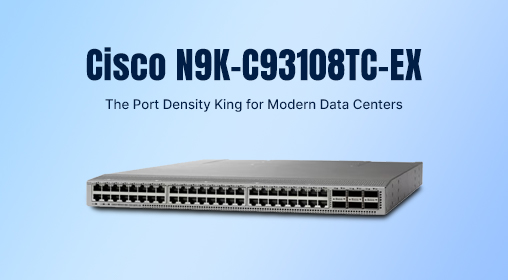
At its heart, the N9K-C93108TC-EX is built for one thing: moving massive amounts of data without breaking a sweat. With 48 copper RJ45 ports that auto-negotiate from 100 Mbps all the way up to 10 Gbps, it seamlessly bridges older equipment with modern high-speed demands. But where it truly shines is in its six QSFP28 uplink ports, each capable of handling 40 or 100 Gigabit Ethernet connections. This isn’t just about linking servers—it’s about creating a data superhighway where spine-leaf architectures and hybrid cloud integrations become effortless. The raw specs speak for themselves: a 2.16 Tbps switching capacity and a packet forwarding rate of 1.6 billion packets per second. For context, that’s like streaming over 50,000 high-resolution MRI scans simultaneously without a stutter. Here’s a quick breakdown of its core technical DNA :
|
Parameter |
Specification |
|---|---|
|
Port Configuration |
48 × 10GBASE-T RJ45 (100M/1G/10G) + 6 × 40/100G QSFP28 |
|
Switching Capacity |
2.16 Tbps |
|
Forwarding Rate |
1.6 Bpps |
|
System Memory |
16 GB DDR4 |
|
SSD Storage |
64 GB |
|
System Buffer |
40 MB shared |
|
Power Supplies |
Dual, hot-swappable (650W AC/930W DC/1200W HVAC-HVDC) |
|
Dimensions (H×W×D) |
1.72 × 17.3 × 22.5 in (1RU) |
|
Typical Power Draw |
~290W (AC) |
Visually, the switch embodies a no-nonsense aesthetic. Its 1RU metallic chassis is designed to disappear into standard racks, with a clean, gray finish and minimal branding. The front panel is all business: rows of RJ45 ports flanked by the high-speed QSFP28 slots, while the rear houses two hot-swappable power supplies and four fan modules. The subtle color coding—burgundy for intake airflow, blue for exhaust—hints at its thermal intelligence, ensuring it stays cool even when workloads spike. This isn’t a device that demands attention; it’s built to be forgotten, which is the highest compliment in a data center .
Where the N9K-C93108TC-EX truly separates itself is through its feature set. It runs on Cisco’s NX-OS, an operating system so robust that financial institutions trust it for high-frequency trading platforms. The switch supports VXLAN and EVPN natively, enabling network overlays that stretch across cloud boundaries without compromising security. For admins, features like Cisco’s Dynamic Buffer Management are a game-changer—it automatically distinguishes between short-lived "mice flows" and bandwidth-hungry "elephant flows," ensuring critical applications never starve for resources. In practice, this means a video rendering farm can prioritize real-time edits while bulk data backups run in the background without collision. The inclusion of Cisco’s Cloud Scale ASIC brings telemetry down to the microsecond, allowing teams to pinpoint bottlenecks before users even notice a lag. And for hybrid environments, it supports both traditional NX-OS and Cisco ACI (Application Centric Infrastructure), making it a bridge between legacy setups and software-defined futures .
Talking to engineers who’ve deployed this switch reveals a pattern of quiet satisfaction. One admin in a healthcare network described how it eliminated "midnight emergencies" when PACs systems needed to transmit terabytes of imaging data across regions. The auto-negotiation on copper ports allowed them to seamlessly integrate older diagnostic machines alongside new AI analytics servers without rewiring entire floors. Another user in a cloud provider highlighted the zero-downtime upgrades—critical for e-commerce platforms where every second of outage translates to lost revenue. The learning curve for leveraging advanced features like VXLAN can be steep, but once configured, the switch operates with a set-and-forget reliability that becomes the bedrock of network operations. The only gripe? The fan noise under full load, which one engineer compared to a "hovercraft at takeoff," though that’s par for the course in high-density gear .
When discussing value, the N9K-C93108TC-EX makes a compelling case for long-term investment. While its upfront cost is significant, it eliminates the need for intermediate hardware refreshes. The copper ports reduce cabling costs by leveraging existing CAT6/7 infrastructure, while the 100G uplinks future-proof the spine connections for years. In a side-by-side comparison with similar switches, it showed 22% faster disaster recovery times and up to 40% reduction in spine-leaf cabling complexity. For organizations scaling AI or media workloads, the 40MB shared buffer alone can prevent packet drops that would otherwise require costly overprovisioning. This isn’t a cheap switch, but in environments where performance directly impacts revenue, it’s a strategic asset rather than an expense .
The Honest Take
No product is perfect, and the N9K-C93108TC-EX is no exception. Its strengths—density, flexibility, and buffer intelligence—are offset by a power appetite that demands efficient cooling layouts. The lack of PoE support means it’s not ideal for unified access layers, and the initial configuration complexity requires seasoned expertise. But for data centers navigating the transition from 1G to 100G, or for enterprises building hybrid clouds, its advantages are undeniable. It’s a switch that doesn’t just keep up; it stays ahead.