
Intellectual Property
Hot selling product recommendations
View More




















The Virtual Workhorses: F5's B2250 and B2150 Go Head-to-Head
When you're architecting your application delivery infrastructure, choosing the right virtual edition can feel like picking the engine for a custom build. Do you go with the dependable standard or opt for the turbocharged option? The F5 BIG-IP Virtual Edition (VE) B2250 and B2150 sit in that crucial zone where performance starts to get serious. This isn't about raw power alone; it's about matching the machine's capabilities to the specific demands of your environment. Let's get into the details that set these two virtual appliances apart.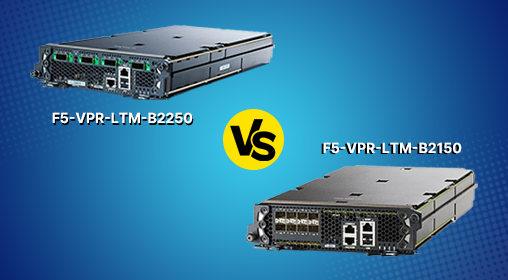
At their core, both models are fundamentally capable, but the B2250 is clearly built for a heavier load. Think of the B2150 as the efficient 4-cylinder engine—it gets the job done reliably for many tasks. The B2250, however, is the 6-cylinder with a turbo, offering that extra reserve of power for when traffic suddenly spikes or you're running multiple complex services simultaneously. The difference lies in the allocation of virtual resources: the B2250 typically comes configured with more vCPUs and a larger allotment of RAM, allowing it to handle a greater number of concurrent connections and process Layer 7 policies much faster without breaking a sweat. For high-throughput scenarios involving SSL inspection or advanced security policies, that extra headroom isn't just a luxury; it's a necessity to avoid bottlenecks.
|
Core Parameter |
F5 VE B2150 |
F5 VE B2250 |
|---|---|---|
|
Performance Tier |
Standard |
Enhanced |
|
vCPU Allocation |
Base (e.g., 4 vCPUs) |
High (e.g., 8 vCPUs) |
|
Memory (RAM) |
Moderate |
Extensive |
|
Throughput Capability |
Solid for standard workloads |
Designed for high-demand scenarios |
|
Connection Capacity |
Good |
Excellent |
|
L7 Requests per Second |
Competent |
High-performance |
|
SSL TPS (RSA 2k) |
Standard |
Accelerated |
|
Best-Suited Workload |
Steady-state traffic, dev/test, medium apps |
Traffic-spike handling, high-security apps, large-scale deployments |
In the virtual world, "appearance" translates to the deployment footprint and resource consumption. Here, the B2250 is the more substantial entity, requiring a larger slice of your hypervisor's compute and memory resources. This isn't a downside; it's the direct result of its enhanced capabilities. Deploying a B2250 is like provisioning a larger virtual machine—it needs more CPU cycles and memory blocks to operate effectively. The B2150, with its more modest requirements, is easier to fit into consolidated environments where resources are tightly allocated. Both can be deployed as single instances, but the B2250's resource profile makes it a more robust candidate for high-availability pairs where failover must be seamless without service degradation.
Functionally, they run the same iconic BIG-IP TMOS software, which means the vast toolkit of load balancing, firewall, and access policy features is available to both. However, the key differentiator is performance under load. The B2250 doesn't just have a higher theoretical throughput limit; it maintains its performance when you activate resource-intensive services. Enabling a full security suite with advanced WAF policies, bot detection, and SSL termination on the B2250 feels smooth, whereas the B2150 might start to show strain, potentially increasing latency. It's the difference between having a car that can comfortably cruise at high speed and one that struggles on an incline with the air conditioning on. The B2250 is built for that "with everything on" scenario.
For the operator, the user experience diverges around confidence and scalability. Managing either device through the same F5 web interface or CLI is a consistent process. The B2150 offers a solid experience for predictable workloads. But the B2250 provides a premium experience in dynamic environments. It's the peace of mind that comes from knowing you can absorb a sudden traffic surge or quickly deploy a new set of iRules without worrying about pushing the system to its limits. That scalability translates directly to operational flexibility, reducing the need for constant performance tuning and preemptive scaling decisions.
When weighing the cost versus benefit, the B2150 often presents a lower initial resource commitment, making it highly cost-effective for projects with well-defined, stable performance requirements. The B2250, while requiring a greater investment, delivers superior value through its performance headroom and operational resilience. Its true性价比 shines by preventing costly performance issues and enabling business growth without immediate hardware or licensing upgrades. For a growing organization, the B2250 can be the more economical long-term choice by extending the time between necessary upgrades.
So, where does that leave us? The B2150's strengths are its efficiency and suitability for core tasks. Its potential limitation is a lower performance ceiling that could necessitate an upgrade if demands increase unexpectedly. Conversely, the B2250's primary advantage is its power and scalability, designed for demanding, variable workloads. The consideration is its higher resource consumption. Both are built on the same stable F5 software foundation, but the B2250's robust resource allocation inherently provides greater stability under sustained heavy load, as it's less likely to be overwhlemed.
Your choice ultimately maps to your application landscape. The B2150 is the intelligent choice for steady-state applications, development environments, and medium-scale production services where traffic patterns are predictable. The B2250 is the strategic platform for critical applications expecting growth, those with high-security needs, or any service where performance cannot be compromised. It’s the engine you buy for the long haul, knowing it has the power for the journey ahead.