
Intellectual Property
Hot selling product recommendations
View More




















The Switch Duel: Campus Access Meets Data Center Muscle
When you line up the Cisco Catalyst C9200L-24T-4X-E against the Nexus N9K-C9372PX-E, you're not just comparing two pieces of networking hardware. It's a face-off between two different worlds within Cisco's ecosystem. One is the agile, versatile access layer specialist, while the other is a high-density data center workhorse. Picking the right one boils down to understanding which battlefield you're deploying them on.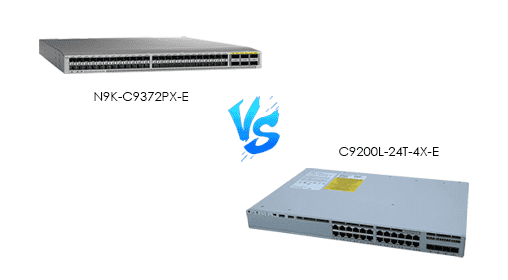
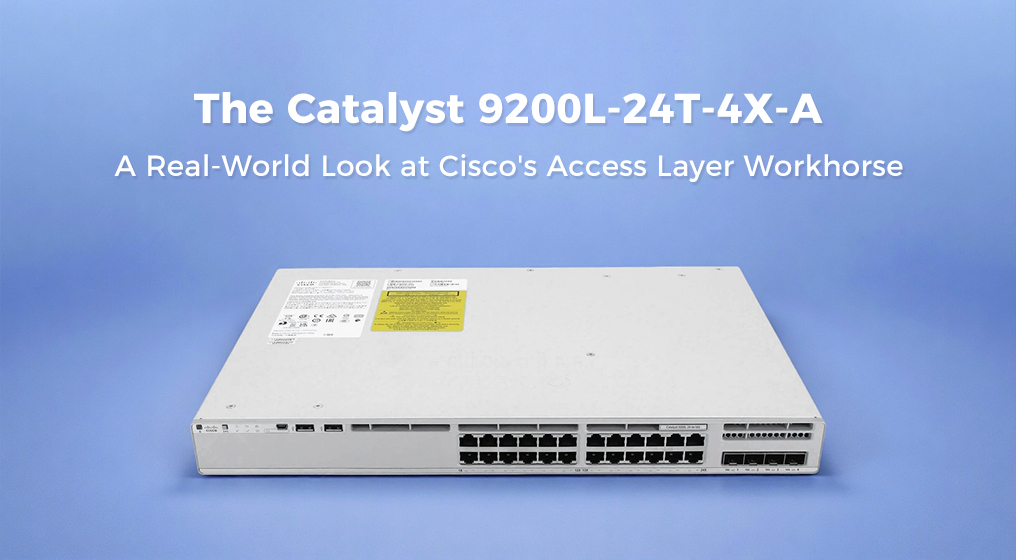
Let's get straight to their core technical DNA. The C9200L is built for the edge of the network. It offers 24 down-to-earth 1G copper ports for connecting your everyday devices, complemented by 4 x 10G SFP+ uplinks to efficiently trunk data back to your network core. Its switching capacity is robust for its class, around 128 Gbps, handling a packet forwarding rate of roughly 95 Mpps. In stark contrast, the Nexus 9372PX-E is in a different league. It's a top-of-rack titan designed for the heart of the data center, boasting 48 x 1/10G SFP+ fiber ports and 6 x 40G QSFP+ uplinks. Its capacity soars, with a massive switching fabric designed for handling immense server-to-server traffic without breaking a sweat. The N9K-C9372PX-E also packs a significant power punch with full PoE+ support across all its access ports, a feature the non-PoE C9200L-24T-4X-E explicitly lacks.
|
Core Parameter |
Cisco Catalyst C9200L-24T-4X-E |
Cisco Nexus N9K-C9372PX-E |
|---|---|---|
|
Port Configuration |
24 x 1G RJ45 + 4 x 10G SFP+
|
48 x 1/10G SFP+ + 6 x 40G QSFP+ |
|
Switching Capacity |
~128 Gbps
|
Multi-Terabit scale |
|
Power over Ethernet |
No (Non-PoE model)
|
Yes (Full PoE+ support) |
|
Primary Use Case |
Enterprise Access Layer, Campus Networking
|
Data Center Top-of-Rack |
|
Key Feature |
Cisco DNA Essentials, Layer 3 Lite
|
High-throughput, Low Latency |
Physically, they send a clear message. The Catalyst C9200L has a more compact, standard office-friendly form factor, designed to be mounted in a wiring closet without a fuss. The Nexus switch, true to its data center destiny, is a heavier beast built for a standard equipment rack, with port densities that scream performance and a need for serious cooling.
Functionally, the C9200L shines with features tailored for managed enterprise environments. It runs on the versatile Cisco IOS XE operating system and comes with the DNA Essentials license, which unlocks handy automated network management and security features like advanced threat protection. It's a capable Layer 3 switch, perfect for inter-VLAN routing within a building or campus. The Nexus, however, is all about raw speed and scale. It operates on Cisco's NX-OS, an operating system built from the ground up for stability and automation in data centers. Its world is one of VXLANs, high-throughput, and micro-second latency, optimized for server farms and storage area networks.
For the user experience, the difference is night and day. Managing a C9200L feels familiar to anyone with experience in Cisco's enterprise gear. The setup can be straightforward, and for day-to-day tasks, the web interface and DNA Center integration aim to make life simpler for a network admin. Deploying and managing a Nexus switch, especially in a complex data center fabric, requires a different skill set. It's the territory of engineers who live and breathe high-availability, automation scripts, and network orchestration tools. The stability proposition also differs. The C9200L offers excellent reliability for a campus setting, with features like redundant power and fan options for minimal downtime. The Nexus platform takes this to an extreme, engineered for "five nines" (99.999%) of uptime, with fully redundant and hot-swappable components because every second of outage in a data center has a real cost.
So, which one gives you more bang for your buck? The C9200L is the pragmatic choice for the vast majority of businesses looking to refresh their office network. It delivers a fantastic balance of performance, security, and manageability for its tier. The Nexus switch is a strategic investment. Its value isn't just in the ports per dollar; it's in the performance, density, and reliability it brings to a demanding data center environment. You're paying for the capability to handle massive workloads without flinching.
In a nutshell, the C9200L-24T-4X-E's strengths are its enterprise-friendly features, reasonable complexity, and solid all-around performance for connecting users and devices. Its weaknesses are the lack of PoE in this specific model and its unsuitability for high-density, high-speed data center workloads. Conversely, the N9K-C9372PX-E's strengths are its raw port density, blistering speed, and rock-solid data center pedigree. Its weaknesses are its higher cost of ownership, steeper learning curve, and sheer overkill for a typical office network.
There's no universal winner here. Deploying a C9200L in a data center would be a major bottleneck, just as using a Nexus switch to connect office desktops would be a colossal waste of resources. The right choice is the one that aligns with your network's terrain.