
Intellectual Property
Hot selling product recommendations
View More




















Walking into the heart of a modern business network, you'll find its pulse in the server room, where devices like the Cisco Catalyst C9200L-24P-4G-E operate with quiet determination. This isn't a flashy piece of hardware designed for the spotlight; it's the reliable engine in the background, ensuring the seamless flow of data that keeps companies running. As a core component of the Catalyst 9000 series, this switch is engineered for one primary purpose: to serve as a powerful, secure, and intelligent access layer switch for today's demanding enterprise environments. It's the cornerstone for connecting a wide array of devices—from employee computers and IP phones to wireless access points and security cameras—while providing the power and intelligence needed for a robust network infrastructure.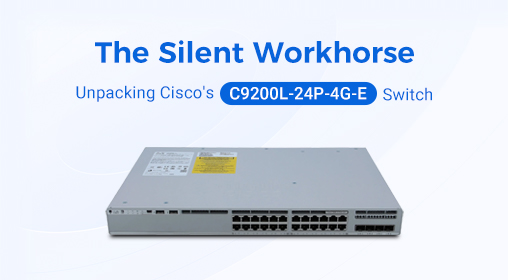
The first thing you notice is its straightforward, professional demeanor. Housed in a dark, resilient metal chassis, it's built for a standard 1U rack space, with dimensions of 440 x 445 x 288 mm (1.73 x 17.5 x 11.3 inches) and a weight of approximately 4.53 kg. The front panel presents a clean array of 24 RJ-45 Gigabit Ethernet ports, complemented by four dedicated 1G SFP uplink ports for flexible fiber or copper connectivity to the network core. A series of status LEDs provides a quick, visual health check. This is a device designed for function, not form, built to withstand the constant demands of a business environment while operating with a noise level that typically stays around 42 dB, making it suitable for office settings.
Beneath this unassuming exterior lies a serious performance core. The switch boasts a switching capacity of 56 Gbps and a forwarding rate of 41.66 Mpps, ensuring non-blocking performance across all ports even during peak traffic loads. The 370W PoE budget is a standout feature, allowing each of the 24 ports to deliver up to 30W of power to connected devices. This eliminates the need for separate power adapters for phones, cameras, and access points, significantly simplifying cabling and installation. The device is designed for longevity, with an impressive mean time between failures (MTBF) of 508,700 hours, reflecting its enterprise-grade build quality.
|
Parameter |
Specification |
|---|---|
|
Port Configuration |
24 x 10/100/1000BASE-T PoE+ ports, 4 x 1G SFP Uplinks |
|
PoE Capability |
IEEE 802.3at PoE+ (30W per port), 370W total budget |
|
Switching Capacity |
56 Gbps |
|
Forwarding Rate |
41.66 Mpps |
|
Backplane Bandwidth |
80 Gbps |
|
Power Supply |
370W AC |
|
Dimensions (HxWxD) |
440 x 445 x 288 mm |
|
Mean Time Between Failures (MTBF) |
508,700 hours |
Where this switch truly proves its worth is in its functional depth. It operates as a full Layer 3 device, supporting advanced routing protocols and enabling intelligent traffic management within the network. A key feature is its stacking capability through Cisco StackWise technology, which allows multiple physical switches to be managed as a single, logical entity. This simplifies configuration, provides high availability, and creates a resilient network fabric. For security, it offers a robust suite including access control lists (ACLs), intrusion detection systems (IDS), and 802.1X authentication to lock down network access. Features like Dynamic ARP Inspection and DHCP snooping help prevent common spoofing attacks, creating multiple layers of defense that protect the entire network ecosystem. The switch also supports advanced QoS to prioritize sensitive traffic like voice and video, ensuring a smooth user experience for critical applications.
From an administrator's perspective, the experience is a blend of enterprise power and manageable complexity. The initial setup can be streamlined using Zero-Touch Provisioning (ZTP), which is a blessing when deploying multiple switches. You have the flexibility of managing it through the familiar Command Line Interface (CLI) for veterans or a web-based GUI for simpler day-to-day tasks. The real-world benefit is stability. Users often report that once configured, it just runs. The solid construction and efficient cooling mean it operates reliably, becoming an invisible yet trusted component of the IT infrastructure. The ability to power devices directly from the switch ports is a significant practical advantage, reducing cable clutter and power outlet requirements for a cleaner, more organized installation.
Evaluating its value proposition, the C9200L-24P-4G-E sits in a strategic sweet spot. You're investing in the reliability, security, and feature set that Cisco is known for in the enterprise world. The stacking capability is a huge value-add, as it allows a network to grow without becoming exponentially more complex to manage. While the upfront investment might be higher than some basic alternatives, the total cost of ownership often proves favorable when you factor in years of reliable service, reduced downtime, and the operational efficiency gained from its advanced features. It’s a strategic choice for businesses that view their network as a critical utility rather than a mere expense.
However, a balanced view requires acknowledging its trade-offs. The 1G uplink ports, while sufficient for many current applications, may feel constraining for organizations planning a significant leap to multi-gigabit or 10-gigabit internal backbones. The 370W PoE budget, though substantial, must be carefully managed in deployments with many high-power devices like full-featured wireless access points, as it may not support powering all 24 ports at maximum capacity simultaneously. The management interface, while comprehensive, has a learning curve that might be steep for organizations without dedicated networking expertise.
In conclusion, the strengths of the Cisco Catalyst C9200L-24P-4G-E are its solid performance, extensive Layer 3 capabilities, advanced security, and exceptional flexibility through stacking and PoE. It is an ideal solution for businesses that need a reliable, scalable, and intelligent networking foundation. It's not the simplest switch on the market, but for those who need its specific blend of power, intelligence, and resilience, it becomes the silent, dependable cornerstone of the entire digital operation, proving that the most crucial technology is often the kind you can install, configure, and then almost forget about as it reliably does its job, day in and day out.