
Intellectual Property
Hot selling product recommendations
View More




















The Silent Workhorse: Cisco AIR-AP2802E-H-K9 in the Real World
Walk into a modern enterprise—maybe a busy office, a school campus, or a hospital—and you'll find the backbone of its wireless network often relies on unsung heroes like the Cisco AIR-AP2802E-H-K9. This isn't a flashy consumer gadget; it's a professional-grade, indoor wireless access point built for one thing: delivering rock-solid, dependable Wi-Fi where it absolutely cannot fail. You might not even notice it unless you actively look for the subtle, square-shaped device on the ceiling, which is precisely the point. It's designed to be invisible in its operation, quietly connecting dozens of users and their critical applications without a fuss.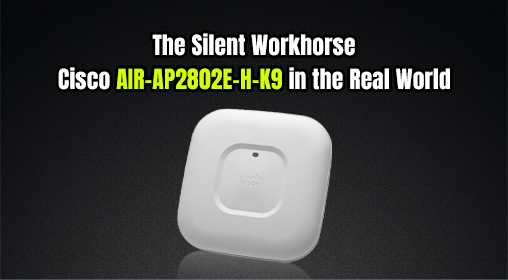
Crafted with a utilitarian elegance, its physical design is all about blending in and standing up to the task. The unit features a low-profile, square form factor that measures approximately 220 x 220 mm, with a clean, white finish meant to disappear against standard ceiling tiles. Weighing in at 2.09 kilograms, it has a substantial feel that hints at its robust internal construction. The front is minimalist, with only a few status LEDs, while the base houses the essential ports: two Gigabit Ethernet interfaces and a separate RJ-45 console port for management. This access point is typically powered through Power over Ethernet (PoE+ 802.3at), which dramatically simplifies installation by needing just a single cable run for both data and power.
Underneath that unassuming shell lies performance that has supported enterprise networks for years. As an 802.11ac Wave 2 access point, it operates simultaneously on both the 2.4 GHz and 5 GHz bands, providing the speed and capacity needed for a high-density environment full of devices. While specific maximum data rates can vary, its Wave 2 capabilities support multi-user MIMO, allowing it to communicate with multiple devices at once rather than taking turns, which significantly boosts overall network efficiency in crowded areas. The internal hardware is built for stability, featuring 1 GB of DRAM and 256 MB of flash memory to handle its operating system and configurations smoothly.
|
Feature |
Specification |
|---|---|
|
Model |
AIR-AP2802E-H-K9 |
|
Network Standards |
IEEE 802.11a/b/g/n/ac Wave 2
|
|
Frequency Bands |
Simultaneous Dual-Band (2.4 GHz & 5 GHz)
|
|
Interface |
2 x Gigabit Ethernet Ports, 1 x Console Port
|
|
Antenna |
External Antenna Type (Antennas typically sold separately)
|
|
Antenna Gain |
2.4 GHz: 3 dBi, 5 GHz: 5 dBi
|
|
Power Supply |
PoE+ (802.3at) or Local DC Power
|
|
Power Consumption |
22.5W (typical, USB off) to 26.5W (USB on)
|
|
Memory |
1 GB DRAM, 256 MB Flash
|
|
Operating Temperature |
-30 °C to 70 °C (-22 °F to 158 °F)
|
What truly sets this device apart in an IT manager's eyes is its operational flexibility. It can run in two distinct modes: as a standalone, self-sufficient controller (a "autonomous" or "fat" AP) or, more commonly in larger deployments, as a lightweight access point that is centrally managed by a Cisco wireless LAN controller. This "thin" mode allows for seamless roaming, automated RF management, and consistent policy enforcement across hundreds of access points from a single pane of glass. On the security front, it's equipped with enterprise-grade protocols including WPA, WPA2, 802.1X authentication, and AES encryption, creating a secure wireless boundary that goes far beyond a simple password.
From an end-user's perspective, a network built with these APs translates to a connection that's just... reliable. The Wi-Fi signal remains consistently strong as you move through a building, with minimal annoying drop-offs during video calls or file transfers. For the network administrators who deploy and manage them, the initial setup through a Cisco controller is straightforward. Once configured, these units are known for their set-and-forget reliability. They are built to operate in a wide range of environmental conditions, from chilly server rooms to warmer industrial settings, ensuring consistent performance. The power consumption, maxing out around 26.5 watts when all features are active, is reasonable for the performance level it delivers, contributing to a lower total cost of ownership over time.
Evaluating its value proposition reveals its enduring appeal. While it may not support the latest Wi-Fi 6 or Wi-Fi 6E standards, its strength lies in proven Cisco build quality, enterprise-grade reliability, and a rich feature set for network management and security. It's an investment in network stability. For organizations that prioritize a controllable, professional wireless infrastructure over consumer-grade hardware, the 2802E offers a compelling balance of performance, security, and manageability. Its durability and sustained performance in the secondary market are a testament to its inherent quality, making it a smart long-term investment for businesses prioritizing stability over cutting-edge speed.
No piece of technology is without its compromises, of course. The most significant drawback by today's standards is the lack of support for Wi-Fi 6. This means it misses out on higher efficiency in extremely dense device environments and the lower latency that newer standards offer. For a brand-new deployment focused on future-proofing for the next five to seven years, this could be a consideration. Some might also find the initial acquisition cost to be a consideration compared to some less feature-rich alternatives, though this is balanced against the brand's reputation and comprehensive feature set. Ultimately, the Cisco AIR-AP2802E-H-K9 may not be the newest player on the field, but it continues to be a profoundly competent and trusted one, delivering the solid, manageable, and dependable wireless foundation that businesses rely on every day.