The Mystery of C1117-4PLTELAWZ: Why Your Dell Monitor Stand Might Be the Real Hero
You know that sinking feeling when your pristine workspace setup suddenly feels off? Maybe your monitor wobbles slightly when you type too enthusiastically, or perhaps the tilt mechanism feels stiffer than it did on day one. For many Dell users, the culprit isn't the screen itself but an overlooked component hiding in plain sight: the stand. Specifically, a part often identified by the cryptic code
C1117-4PLTELAWZ. While most people focus on panel resolution or refresh rates, this unassuming piece of engineering is what keeps your view steady, ergonomic, and frustration-free. If you've ever wrestled with a loose base or a stand that refuses to click into place, you've already met this part, even if you didn't know its name.
At its core, this component is a replacement or specific variant of a monitor stand assembly designed for select Dell UltraSharp and P-series displays. Its primary job is deceptively simple yet critical: to provide a stable, adjustable foundation for your screen. Unlike generic third-party bases that often feel flimsy, this unit is engineered to match the exact weight distribution and VESA mounting specifications of compatible Dell monitors. It allows for the smooth height adjustments, tilts, and swivels that define a professional workspace. Without it, even the most expensive 4K panel becomes a static, neck-straining brick. It transforms a simple display into an ergonomic tool, letting you align the top of the screen with your eye level to reduce strain during those marathon coding sessions or endless spreadsheet marathons.
When we talk about performance in a monitor stand, we aren't discussing pixels or color gamut. Instead, the "performance" here is measured in stability, range of motion, and durability. The
C1117-4PLTELAWZ assembly typically supports a significant weight capacity, ensuring that larger 27-inch or even 32-inch screens don't tip forward when you adjust the tilt. The core parameters revolve around its mechanical precision. The hinge mechanisms are designed to hold their position without sagging over time, a common failure point in cheaper alternatives. It features a quick-release VESA mount interface, making it compatible with a specific range of Dell models without needing extra tools. The base footprint is optimized to provide a low center of gravity, preventing accidental knocks from sending your monitor crashing down.
| Core Parameter |
Specification Detail |
| Part Number |
C1117-4PLTELAWZ |
| Compatibility |
Select Dell UltraSharp & P-Series (e.g., U27xx, P27xx variants) |
| Mount Type |
Quick-Release VESA Interface |
| Adjustment Range |
Tilt, Swivel, Height Lift (varies by specific monitor model) |
| Material Composition |
High-density polymer base with reinforced steel internal framing |
| Load Capacity |
Engineered for monitors up to 32 inches / ~20 lbs (approx.) |
| Cable Management |
Integrated routing channels within the stem |
| Finish |
Matte black or silver (matching original OEM aesthetic) |
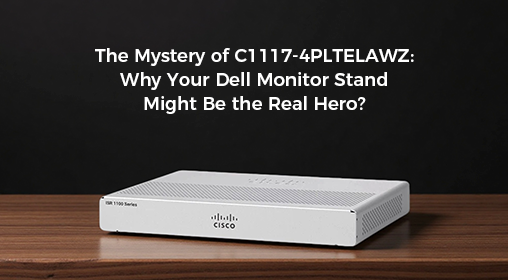
Visually, the unit exudes that signature Dell professional aesthetic. It's not flashy; it doesn't scream "gamer" with RGB lighting or aggressive angles. Instead, it features clean lines and a matte finish that resists fingerprints and dust. The base is usually a sleek, rounded rectangle or a subtle V-shape, designed to occupy minimal desk real estate while maximizing stability. The stem connecting the base to the monitor is slender but robust, often hiding the internal cabling that powers the USB hub or audio passthrough found on many UltraSharp models. The joints are tight, with no visible gaps or cheap plastic flashing, giving the impression of a solid, single-piece sculpture rather than an assembly of parts. When you run your hand over it, the texture is smooth and cool, indicative of high-quality molding.
Functionally, this stand is a powerhouse of subtle features. Beyond just holding the screen up, it integrates seamless cable management. You can route your power, DisplayPort, and USB cables through the stem, keeping your desk clutter-free—a feature that sounds minor until you try to clean around a tangled mess of wires. The ergonomic adjustments are smooth, requiring just a fingertip's pressure to lift, tilt, or swivel the monitor into the perfect viewing angle. Some versions of this assembly also include a dedicated slot for docking stations or allow for easy pass-through of thick connectors, ensuring you don't have to disconnect everything just to remove the monitor. The "click" when locking into a new height position is satisfyingly firm, providing tactile feedback that inspires confidence.
For the end user, the experience is one of effortless fluidity. Imagine sitting down to work and realizing you don't have to hunch over; a quick lift of the screen brings it to eye level instantly. There's no fighting against stiff screws or worrying that the monitor will slide down an hour later. The stability means that when you're typing vigorously or using a touch screen (if applicable), the display doesn't wobble annoyingly. It creates a sense of permanence and quality in your setup. Users who switch from a fixed stand or a wobbly aftermarket arm to this OEM unit often describe it as a "silent upgrade"—they didn't realize how much the instability was bothering them until it was gone. It turns the act of adjusting your monitor from a chore into a seamless part of your workflow.
In terms of value, while we won't quote specific prices, the cost-benefit analysis heavily favors the genuine part. Third-party stands might seem cheaper initially, but they often lack the precise fit, leading to compatibility headaches or reduced longevity. A mismatched stand can void warranties or, worse, damage the monitor's mounting points. The
C1117-4PLTELAWZ offers peace of mind. It's an investment in the lifespan of your entire display setup. Considering that a good monitor can last five to seven years, paying for a stand that guarantees ergonomic comfort and stability for that entire duration is a bargain. It preserves the resale value of the monitor too, as a complete unit with its original stand always fetches a better price than a panel alone.
However, no product is without its flaws. On the positive side, the build quality is exceptional, the fit is perfect for compatible models, and the aesthetic integration is flawless. The cable management is thoughtfully designed, and the adjustment mechanisms remain smooth even after years of use. On the downside, availability can sometimes be an issue; because it's a specific OEM part, finding it in stock might require checking specialized suppliers rather than general electronics stores. Additionally, while it fits a range of models, it is not universal—trying to force it onto an incompatible Dell monitor (or a different brand entirely) is impossible due to the proprietary quick-release mechanism. Some users might also find the base footprint slightly larger than ultra-slim aftermarket arms, which could be a constraint on very small desks. Finally, if the part number suffix (like "LAWZ") indicates a specific region or revision, ensuring you get the exact match for your monitor's generation is crucial, as slight variations in the locking tab can prevent installation.
Ultimately, the
C1117-4PLTELAWZ is a reminder that the best technology is often the kind you don't notice. It works so well that you forget it's there, allowing you to focus entirely on the content on your screen. Whether you're replacing a broken base or upgrading from a static stack of books, this component restores the intended experience of your Dell monitor. It's the unsung hero of the home office, proving that sometimes, the most important part of a high-tech device is the thing that simply holds it up.