
Intellectual Property
Hot selling product recommendations
View More




















The MikroTik CCR2004-1G-2XS-PCIe: A Full-Fledged Router on a Card
Ever thought about ditching that bulky standalone router and squeezing all its power directly into your server? That’s exactly what the MikroTik CCR2004-1G-2XS-PCIe brings to the table. It’s not your typical network card—it’s a complete cloud core router cleverly built into a PCIe adapter form factor. Imagine having the brains of a high-end router sitting right inside your server chassis, saving you precious rack space and simplifying your entire network setup.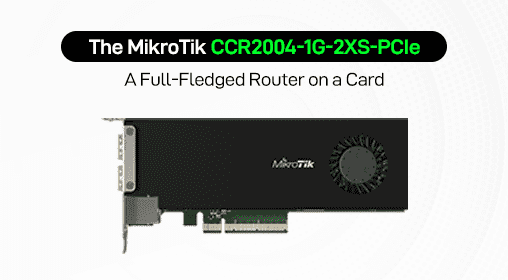
This little card is built around a quad-core ARM 64-bit CPU (the AL32400 or AL52400, depending on the source) humming along at 1.5 to 2 GHz. It’s paired with a healthy 4 GB of DDR4 RAM and 128 MB of NAND storage, all dedicated to running the full version of MikroTik’s powerful RouterOS (License Level 6). The real magic lies in its ports: you get two 25 Gbps SFP28 cages for blazing-fast network connections and a single Gigabit Ethernet port, which is super handy for out-of-band management.
|
Feature |
Specification |
|---|---|
|
CPU |
Quad-core ARM 64-bit (AL32400/AL52400), 1.5-2 GHz
|
|
RAM |
4 GB DDR4
|
|
Storage |
128 MB NAND
|
|
Network Ports |
2 x 25G SFP28, 1 x 1G Gigabit Ethernet
|
|
Form Factor |
Low-profile PCIe 3.0 x8 card
|
|
Max Power Consumption |
~25-29 W
|
|
Operating System |
MikroTik RouterOS (Level 6)
|
Physically, the card is designed for efficiency. It’s a low-profile PCIe card measuring about 170 x 69 x 18 mm, so it can fit even in a snug 2U server chassis. A small integrated fan keeps things cool, and the build is all business—this is a piece of professional gear. On the bracket, you’ll find the two SFP28 ports for your high-speed fiber links and the RJ-45 port for management, making for a clean and compact layout.
So, what can it actually do? Well, everything a full-sized MikroTik router can. Since it runs the full RouterOS, you can configure sophisticated firewall rules, manage traffic with complex queueing, set up VPNs (it has IPsec hardware acceleration), and control user access. Its default setup is clever: the PCIe interface presents itself to the host server as four virtual Ethernet interfaces. Two are in a passthrough mode directly to the 25G SFP28 ports, while the other two are bridged to the Gigabit port for management, giving you a lot of flexibility.
From a user's perspective, the appeal is all about integration and space-saving. If you're building a home lab or a compact server setup, consolidating your router and server into one box can be a game-changer for cable management and reducing clutter. The performance is serious; it's capable of handling wire-speed routing at 25 Gbps, making it suitable for data center applications or hosting powerful media servers. However, it’s not without its quirks. This card has its own boot process. If your host server boots up faster than the CCR2004 card finishes initializing, the card might not be recognized. You’ll likely need to tweak your server's BIOS to add a delay for PCIe device initialization or manually rescan the PCIe bus from the host OS after boot. It’s a small but important detail for a smooth experience.
When it comes to value, the CCR2004-1G-2XS-PCIe sits in a interesting spot. You're essentially getting the power of a high-end router without needing a separate device, power supply, and the associated space in your rack. For the right user, this consolidation is where the real value lies. It’s a fantastic solution for tech-savvy individuals, small businesses, or data centers looking to maximize efficiency in a compact footprint. You get the robust and feature-rich RouterOS environment, which is a huge plus for those already invested in the MikroTik ecosystem.
Let’s break down the good and the not-so-good.
What’s to love?
The space-saving design is its biggest win, integrating a full router directly into your server. The 25G throughput is more than enough for most demanding applications, and having the full RouterOS feature set at your disposal is incredibly powerful. The power consumption is also relatively low for the performance it offers.
What to keep in mind?
The boot-time dependency is the main quirk. You have to manage the boot sequence between the card and the host server to avoid detection issues. Also, while powerful, its performance is based on a general-purpose CPU. For pure routing at the highest speeds, it's fantastic, but it won't match the raw, specialized processing power (ASICs) of top-tier standalone routers for every possible task.
All in all, the MikroTik CCR2004-1G-2XS-PCIe is a brilliantly innovative product. It’s not for everyone, but if your goal is to build a clean, integrated, and powerful network setup without sacrificing an entire U of rack space, this router-on-a-card is a compelling and smart choice.