
Intellectual Property
Hot selling product recommendations
View More




















The Cisco WS-C4948-E, often referred to as the Catalyst 4948, is a fixed-configuration, 1-rack-unit (1RU) switch that carved out a significant niche for itself in server cluster and data center environments during its prime. Built on the mature architecture of the Cisco Catalyst 4500 series, this switch was engineered to deliver optimized performance for low-density, high-performance server and workstation aggregation. Its design focuses on providing line-rate, low-latency switching from Layer 2 through Layer 4, making it a reliable component for data-intensive applications.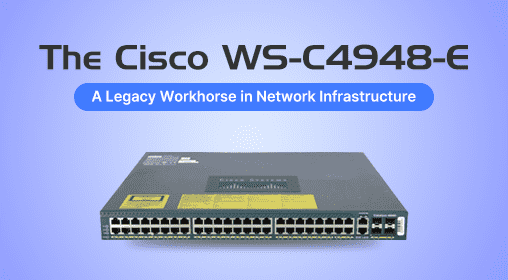
This switch was designed with a clear purpose: to be a dependable, high-performance access layer switch. Its primary habitat was the server rack, where it acted as a centralized connection point for groups of servers, ensuring fast and reliable communication within the cluster. The "E" in its model name often signified enhanced features, and in this case, it brought robust reliability options to the table. It was particularly well-suited for environments where performance predictability and redundancy were critical, such as in financial institutions, large enterprise server rooms, and even government agencies, as evidenced by its use in complex IT environments like the Zhongshan City Tax Bureau's network infrastructure.
When it comes to raw performance, the WS-C4948-E was no slouch for its era. Its core specifications are a testament to its capability to handle demanding workloads without breaking a sweat.
|
Core Parameter |
Specification |
|---|---|
|
Backplane Bandwidth |
96 Gbps
|
|
Packet Forwarding Rate |
72 Mpps (Million packets per second)
|
|
Switching Method |
Store-and-Forward
|
|
MAC Address Table |
32,000 entries
|
|
Processor |
266 MHz CPU
|
The 96 Gbps switching fabric and 72 Mpps forwarding rate, handled in hardware, guaranteed that performance remained consistent regardless of the number of active routing entries or enabled Layer 3 and Layer 4 services. This hardware-based Cisco Express Forwarding routing architecture was key to its scalable performance.
Physically, the switch sports a sleek but utilitarian design typical of enterprise-grade hardware. It fits neatly into a standard 19-inch rack, occupying just a single unit of vertical space (1RU). Its dimensions are 409.9 mm (width) x 439.1 mm (depth) x 44.5 mm (height), and it weighs in at 7.48 kg, giving it a substantial, robust feel. The front panel is where the action is, presenting a clean array of ports. It boasts a total of 52 physical ports, but with a twist: you can actively use up to 48 of them at any given time. The standard configuration includes 48 dedicated 10/100/1000 Mbps RJ-45 Ethernet ports, accompanied by 4 additional Gigabit Ethernet SFP (Small Form-factor Pluggable) slots for fiber optic connections, offering flexibility in connectivity options.
The functional palette of the Catalyst 4948 is extensive. It's a full-fledged Layer 3 switch, meaning it can handle routing between VLANs and IP subnets with ease. It supports a comprehensive set of networking standards like IEEE 802.1Q for VLAN tagging, 802.3ad for link aggregation (allowing you to bundle ports for more bandwidth), and 802.1x for network access control, which enhances security by requiring authentication before granting network access. Quality of Service (QoS) features ensure that critical applications get the priority they need, while management is primarily done through a detailed command-line interface (CLI), offering precise control for network administrators.
For those who deployed these switches, the experience was largely defined by reliability and predictable performance. Network engineers appreciated its rock-solid stability once configured. The learning curve for the Cisco IOS CLI could be steep for newcomers, but for those familiar with it, the switch was highly manageable. Its redundancy features were a significant benefit for uptime-sensitive deployments. The availability of 1:1 redundant hot-swappable power supplies was a major plus. This meant you could install two power supplies connected to different electrical circuits; if one failed, the switch would seamlessly continue operating on the other without any interruption. Furthermore, the hot-swappable fan tray with four redundant fans meant that a failing fan could be replaced without powering down the entire switch, a crucial feature for maintaining service availability.
Assessing its value proposition requires viewing it through a historical lens. When new, it represented a premium investment for Cisco's level of performance and reliability. Today, its value is largely tied to the secondary market and specific use cases. For lab environments, legacy system support, or non-critical network segments, a used WS-C4948-E can offer a great deal of capability for a fraction of its original cost, providing an opportunity to work with enterprise-grade features without an enterprise-grade budget. However, its value diminishes rapidly in modern contexts where energy efficiency, 10-gigabit connectivity, and advanced software-defined networking features are required.
Like any piece of technology, the WS-C4948-E has its strengths and weaknesses, which have become more pronounced over time.
On the positive side, its rock-solid reliability is legendary. The hardware is built to last, and the software is stable. The comprehensive Layer 3 feature set covers almost every need for a classic network design. The hardware-based redundancy for both power and cooling provides excellent fault tolerance, which is a core reason for its long service life in many organizations.
On the downside, the most glaring limitation from a modern perspective is the lack of 10-gigabit uplink ports. The four SFP ports are limited to standard Gigabit Ethernet, which can become a serious bottleneck in today's high-speed environments. It's also a power and space inefficiency champion compared to modern switches; newer devices can deliver significantly more ports and features in the same 1RU space while consuming far less electricity—think 300W for the 4948 versus 45W for a more modern 24-port switch. Furthermore, as an older model, it has likely reached end-of-life (EoL), meaning no more software updates or security patches from Cisco, posing a potential risk if still deployed on networks exposed to modern threats.
In summary, the Cisco WS-C4948-E is a testament to an era of networking where brute-force performance and unwavering reliability were paramount. It served as a backbone for countless server racks, earning a reputation as a workhorse. While it has been rightfully superseded by more efficient and capable technology, its legacy endures in labs and legacy installations, a capable piece of engineering that reliably did its job for many years.