
Intellectual Property
Hot selling product recommendations
View More




















In the bustling ecosystem of enterprise networking, where performance and reliability are non-negotiable, the Cisco C6800-48P-TX-XL emerges as a robust and versatile workhorse. This isn't a flashy, cutting-edge piece of hardware for the AI data center; it's a foundational component designed for the core of your network, where consistent, high-density Gigabit Ethernet connectivity forms the backbone of daily business operations. Picture it as the dependable engine room of a large ship, ensuring every department—from finance to customer service—remains powered and connected without a hitch. It’s the kind of hardware that network administrators come to rely on for its sheer dependability in handling the relentless data flow of a modern organization.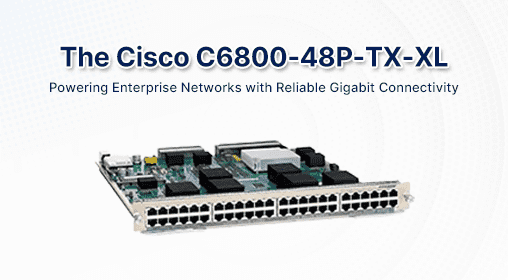
As a 48-port Gigabit Ethernet module for the Catalyst 6800-series chassis, this card is built for scale . Its physical design is straightforward and purposeful: a modular line card that slides neatly into a Catalyst 6807-XL chassis slot . The front panel is clean and functional, presenting 48 standard RJ-45 ports for copper connectivity, making it compatible with the vast installed base of Category 5e and 6 cabling found in most enterprises . This isn't a product that shouts for attention with blinking lights; its value is in its unassuming presence and the critical role it plays in keeping the network running. The integration of a DFC4 daughter card is a key internal feature, enhancing its ability to handle data forwarding efficiently .
When it comes to performance, the C6800-48P-TX-XL is architected for demanding environments. It's not just about having many ports; it's about what happens when all those ports are active and pushing data. The integrated Dual DFC4 (Distributed Forwarding Card) is the card's internal brain, enabling high-speed, distributed forwarding decisions to ensure that performance remains consistent even under heavy load . This design is crucial in a chassis system, as it prevents the central supervisor engine from becoming a bottleneck.
Here is a breakdown of its core technical parameters:
| Parameter | Specification |
|---|---|
| Product Type | Modular Line Card (Switch Module) |
| Port Configuration | 48 x 10/100/1000 Mbps RJ-45 Ethernet Ports |
| Fabric Integration | Fabric-enabled for chassis backplane connectivity |
| Forwarding Card | Integrated DFC4 Daughter Card |
| Deployment Context | Designed for Cisco Catalyst 6807-XL chassis |
The "fabric-enabled" nature of this module means it is designed to fully utilize the high-bandwidth capacity of the Catalyst 6800-series chassis backplane . In a practical setup, this translates to seamless, non-blocking communication between different modules within the same chassis. A common and powerful deployment scenario involves using this card within a Virtual Switching System (VSS) . In a VSS, two physical Catalyst 6807 chassis are clustered to act as a single logical switch. This is where users experience significant benefits. From a network administrator's perspective, VSS simplifies the topology, cutting down the number of routing peers and creating a loop-free Layer 2 network, which makes management and troubleshooting far less complex . For the end-user in the office, this setup means higher availability; if one chassis or a critical link fails, the network can recover almost instantly, minimizing disruptive downtime.
The card's role is often mission-critical, anchoring the wired connectivity for an entire floor or a large department. It can reliably handle a mix of data, voice, and video traffic, providing the necessary Quality of Service (QoS) features to prioritize latency-sensitive applications like VoIP. The inclusion of the DFC4 is a testament to its purpose, delivering the dedicated processing power needed to maintain line-rate performance on all 48 ports simultaneously .
On the positive side, the C6800-48P-TX-XL's primary strength is its proven reliability and high port density within the Catalyst 6800 ecosystem. For organizations already invested in this chassis platform, adding this module is a straightforward path to expanding Gigabit Ethernet connectivity. The integrated DFC4 card is a major advantage, ensuring that local forwarding decisions are made swiftly without overburdening the central supervisor engine, leading to more predictable and stable performance . Furthermore, its capability to operate in a VSS pair dramatically enhances network resilience and simplifies operational management, a huge plus for any team concerned with business continuity .
However, the card is not without its limitations. Its most significant constraint is that it is not a standalone device; it is entirely dependent on a compatible Catalyst 6800-series chassis, such as the 6807-XL . This makes it a non-starter for organizations that use fixed-configuration switches or a different chassis family. Additionally, in an era where multi-gigabit and 10-gigabit speeds are becoming increasingly common to the desktop, this card is limited to standard 1 Gigabit per port, which might not meet the future needs of power users or high-speed storage networks. Finally, as part of a larger, enterprise-grade system, the total cost of ownership—including the chassis, power supplies, and supervisor engine—can be substantial, making it a solution primarily suited for medium to large enterprises.
From an operator's viewpoint, working with the C6800-48P-TX-XL within a well-configured VSS environment is a study in streamlined efficiency. The complexity of managing two core switches is abstracted away, presenting a single management interface. This translates to less time spent on routine configuration and more time for strategic projects. For the employees relying on the network it supports, the experience is one of uninterrupted connectivity. The card facilitates a fast and responsive network, allowing them to access cloud applications, share large files, and participate in video conferences without a second thought about the underlying infrastructure. This invisibility is the card's ultimate success—it just works.
In terms of value, the C6800-48P-TX-XL's Cost-effectivenessis best evaluated through the lens of total cost of ownership and reliability. While the initial investment in a Catalyst 6800 system is significant, the platform's robustness and the card's specific focus on high-density Gigabit Ethernet deliver long-term value. It helps avoid the hidden costs of frequent hardware failures or network downtime. By providing 48 ports of reliable, wire-speed Gigabit Ethernet in a single module, it maximizes the ROI of the chassis slot it occupies. For a growing enterprise that needs to connect a large number of users and devices without compromise, this card represents a solid, dependable investment in the network's core, even if it doesn't boast the latest speed tiers found on newer, more specialized hardware.