
Intellectual Property
Hot selling product recommendations
View More




















The Brains Behind the Operation: Getting to Know Cisco's N9K-SUP-A Supervisory Engine
So, you're dealing with a hefty Cisco Nexus 9000 series switch, right? Think of a massive chassis like the Nexus 9508—it's a real beast. But even the most powerful hardware needs a brain to run the show. That's precisely where the N9K-SUP-A, a supervisory engine module, comes into play. It's the component that turns a box full of potential into a smart, functioning network powerhouse.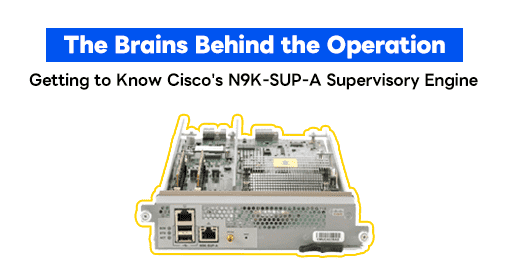
This module is essentially the command center for your switch chassis. Its main job is to handle the system's control plane functions. This includes managing the overall device operations, running the network operating system (like NX-OS), and ensuring all the different line cards—the ones that actually have the network ports—work together in harmony. It doesn't forward your data traffic itself (that's handled by the network forwarding engines on the line cards), but it makes all the critical decisions about howand wherethat traffic should go. It's the central nervous system, keeping everything coordinated and communicating smoothly.
Let's break down its core components. Cisco packed this module with some serious hardware to ensure it can handle demanding data center environments.
|
Feature |
Specification |
|---|---|
|
Processor |
Quad-core Intel Sandy Bridge, 1.8 GHz
|
|
System Memory (RAM) |
16 GB (upgradable to 48 GB)
|
|
Internal Storage |
64 GB SSD
|
|
Management Interfaces |
1 x 10/100/1000 Ethernet (RJ-45), 1 x RS-232 Console (RJ-45), 2 x USB 2.0
|
Physically, the N9K-SUP-A is designed as a half-width module to be installed into a dedicated slot within the Nexus 9500 series chassis. On its front face, you'll find the various management ports—the console and Ethernet ports for out-of-band management are essential for initial setup and troubleshooting. The module is built with redundancy in mind; high-availability setups typically use two of these supervisors in a chassis, with one acting as the active unit and the other standing by as a hot backup to take over instantly if the primary fails, which is absolutely critical for maintaining uptime in a data center.
Functionally, it's a powerhouse. It's responsible for booting up the NX-OS software and providing the core intelligence for advanced features. This includes managing complex routing protocols, enabling automation and programmability through APIs, and supporting modern overlay technologies like VXLAN, which is fundamental for building scalable multi-tenant data center networks. The decent amount of RAM and processing power allows it to manage large routing tables and support a significant number of connected devices without breaking a sweat.
From a user's perspective, especially for a network engineer, working with a system powered by this supervisor is about stability and capability. The experience is defined by the robustness of the NX-OS operating system it runs. You get a full-featured CLI that will be familiar to anyone who has worked with Cisco devices, which greatly simplifies daily operations. The module's design supports high availability (HA) with stateful failover. This means that if a problem occurs with the active supervisor, the switchover to the standby unit is so seamless that it often doesn't even disrupt established network sessions—a huge plus for mission-critical applications. Furthermore, the programmability features mean you're not stuck with just a command line; you can automate repetitive tasks and integrate the switch into larger orchestration systems, which is a massive time-saver for managing large-scale environments.
When it comes to the value proposition, the N9K-SUP-A isn't a product you buy on its own; its value is intrinsically linked to the Nexus 9000 switch chassis it operates in. For the investment, you're getting a highly reliable, feature-rich supervisory engine from a established networking vendor. Its true "value for money" shines in environments that demand high availability, advanced feature sets, and deep integration into the broader Cisco ecosystem. The hardware redundancy, the mature NX-OS software, and the strong vendor support are the key benefits that justify its position in the market. For a large enterprise or cloud data center where network stability is non-negotiable, the reliability offered by this supervisor module is worth the cost. However, for a small business or a simple lab setting that doesn't need such advanced features or redundancy, the overall solution might be overkill and not the most budget-conscious choice.
Here’s a quick look at its main strengths and weaknesses:
The Good:
Proven Reliability: It's built on a stable, time-tested platform designed for 24/7 data center operation.
High Availability: The support for stateful failover with a redundant supervisor is a cornerstone for building fault-tolerant networks.
Rich Feature Set: It unlocks the full potential of the Nexus 9000 series, supporting everything from traditional routing to modern overlays like VXLAN.
Strong Ecosystem: It benefits from seamless integration with other Cisco products and a wealth of knowledge and support available.
The Not-So-Good:
Aging Architecture: Being based on an older Intel Sandy Bridge processor, it may not match the raw performance or power efficiency of newer supervisory modules in terms of modern programmatic workloads.
Context-Dependent Value: As discussed, the overall solution's cost might be difficult to justify for smaller or less complex network needs.
Platform Specific: It is designed specifically for certain Nexus 9500 chassis models and is not a universal component.
All in all, the Cisco N9K-SUP-A is a competent, reliable workhorse. It might not have the very latest silicon, but it provides a solid, trustworthy foundation for powering one of Cisco's flagship data center switching platforms, especially when network stability and a comprehensive feature set are the top priorities