
Intellectual Property
Hot selling product recommendations
View More




















The Brain of the Beast: Getting to Know Cisco's 8800-RP Route Processor
Ever wonder what really drives the internet's backbone? I'm talking about the massive routers that quietly shuffle petabits of data behind the scenes. Well, if those routers are the brawn, then the route processor is the brains. And Cisco's 8800-RP? It's a seriously smart piece of hardware. This isn't a flashy consumer gadget; it's a workhorse engineered for networks where downtime isn't an option. Having seen these in action, let me break down what makes the 8800-RP tick.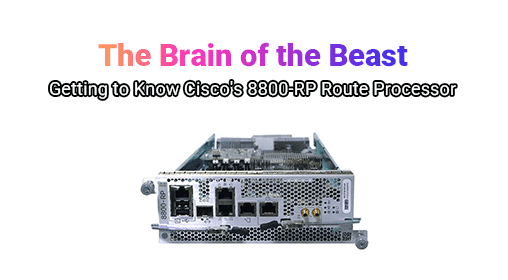
First off, let's talk about its job. The 8800-RP is the central nervous system for Cisco's 8800 Series Modular Routers, which come in various sizes to handle everything from data center interconnects to the core of the internet itself. Think of it as the master conductor. While the line cards do the heavy lifting of forwarding packets, the RP is in charge. It runs the Cisco IOS XR network operating system, manages the entire chassis, processes routing protocols, and makes sure all the line cards know where to send traffic. Its most critical role might be in high availability: you can have two RPs in a system, where one sits in hot standby mode, ready to take over in a split second if the active one fails, ensuring service continuity with what's known as a graceful failover.Now, onto the raw specs. This is where you see the capability. The original 8800-RP is built around a 2.4 GHz quad-core processor, paired with 32 GB of DRAM and a 128 GB SSD for storage. For connectivity, it's got the essentials: an RJ-45 management port, a SFP+ port (1/10G), a couple of USB 2.0 ports, and an RS-232 serial port for legacy console access. It also handles precise timing with support for SyncE and 1588. For a quick, scannable look, here are the core parameters:
|
Component |
Specification for 8800-RP |
|---|---|
|
Processor |
Quad-core, 2.4 GHz
|
|
System Memory |
32 GB DRAM
|
|
Storage |
128 GB SSD
|
|
Management Ports |
1x RJ-45 + 1x SFP+ (1/10G)
|
|
Redundancy |
Supports 1+1 active/standby failover
|
|
Dimensions (HxWxD) |
2.61 x 22.37 x 8.05 in. (66.3 x 56.8 x 20.4 cm)
|
|
Weight |
6 lb (2.72 kg)
|
Physically, the 8800-RP is all business. It's a heavy (6-pound) module designed to slide into the front of an 8800 series chassis. The front panel is utilitarian, featuring status LEDs and the necessary ports for management and debugging. It's built for a life in a data center rack—rugged, hot-swappable, and focused entirely on function over aesthetics.
The feature set is where the 8800-RP truly shines for network operators. It's the cornerstone of the system's reliability. The 1+1 redundancy is a killer feature for any mission-critical environment; a standby RP can take over control functions without dropping a packet if the active RP fails. Security is baked in deep, starting with a hardware-anchored root of trust (via a Cisco Trust Anchor Module) to ensure the system boots only valid software, establishing integrity from the ground up. It's also designed for the long haul, offering backward compatibility with previous-generation line cards, which is a huge plus for protecting investments and simplifying upgrades.
So, what's it like to live with an 8800-RP? If you're a network engineer, the setup involves the powerful but robust Cisco IOS XR CLI. There's a learning curve if you're new to it, but the payoff is immense control and flexibility. Once it's up and running, the thing just hums. The peace of mind that comes with knowing the redundant RP has your back is priceless. You're not babysitting the device. Plus, the telemetry features in IOS XR let you stream real-time analytics, so you can spot potential issues before they become outages.
When we talk about value for money, the 8800-RP sits in the premium segment, but for good reason. You're not just buying hardware; you're buying resilience. The ability to prevent costly network outages through its seamless failover capabilities directly translates to saving money and protecting revenue. Its role in supporting massive scale—up to 28.8 Tbps per slot with the latest line cards—means you can grow your network without needing to rip and replace the core brains of the operation. This future-proofing, combined with energy-efficient design features like dynamic fan control, contributes to a lower total cost of ownership over time, making it a smart investment for large-scale deployments.
Let's break down the good and the not-so-good.
The Upsides:
Rock-Solid Reliability: The graceful RP failover is a lifesaver for critical operations, ensuring near-zero downtime.
Strong Security Foundation: The hardware root of trust provides a robust security baseline, validating the system's integrity from boot-up.
Investment Protection: Its backward compatibility means you can integrate it with your existing gear, avoiding a full-scale, expensive upgrade.
The Downsides:
Steep Learning Curve: The IOS XR operating system is powerful but can be complex for those unfamiliar with it.
Hefty Build: At 6 pounds, it's a substantial piece of hardware, but that's the trade-off for its durable, enterprise-grade construction.
The bottom line? The Cisco 8800-RP isn't for everyone. It's overkill for a small business. But if you're operating a network that demands relentless reliability, massive scale, and ironclad security—like a service provider, a large cloud operator, or a financial institution—this route processor is the intelligent, dependable heart that keeps everything else running smart and fast.