
Intellectual Property
Hot selling product recommendations
View More




















The Backbone of Bandwidth: Cisco's A9K-MPA-20X10GE Deep Dive
Popping a Cisco A9K-MPA-20X10GE module into an ASR 9000 Series router feels like unlocking a new level of network density. This isn’t just another line card; it’s a high-density 10 Gigabit Ethernet powerhouse designed for service providers and large enterprises drowning in traffic. With twenty ports packed into a single slot, it tackles the critical need for aggregating multiple high-speed links without eating up valuable chassis real estate. Think of it as the ultimate traffic conductor for modern data centers and network cores, where space efficiency and raw throughput are non-negotiable.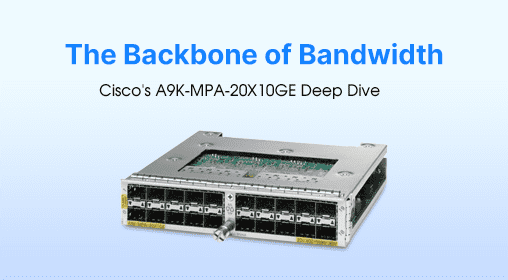
The card’s raison d'être is straightforward: consolidate connectivity. It seamlessly integrates into the ASR 9000 ecosystem, acting as a modular port adapter that transforms the router into a high-capacity aggregation point. Engineers typically deploy it to handle traffic from downstream access switches or to manage multiple 10G uplinks, ensuring smooth data flow between network layers. Its design prioritizes flexibility, allowing it to support a mix of SFP+ transceivers for fiber connections, which is a godsend for future-proofing network infrastructure without requiring a complete overhaul.
When it comes to performance, the A9K-MPA-20X10GE is built to handle relentless data loads. It leverages Cisco’s extensive experience in packet processing to maintain low latency and high throughput, which is absolutely critical for real-time applications like video streaming or financial transactions. The card’s architecture ensures that even with all twenty ports active, packet loss is minimized and jitter is kept on a tight leash. Here’s a quick breakdown of its core specifications:
|
Feature |
Specification |
|---|---|
|
Port Configuration |
20 × 10 Gigabit Ethernet |
|
Form Factor |
Modular Port Adapter (MPA) |
|
Compatibility |
Cisco ASR 9000 Series routers |
|
Transceiver Support |
SFP+ |
|
Typical Use Case |
Network aggregation, high-density uplinks |
Physically, the module follows Cisco’s robust design language. It sports a sturdy, metallic casing that promises durability under continuous operation. The twenty SFP+ cages are neatly aligned, facilitating straightforward cable management—a small but vital detail for technicians working in cramped data center aisles. Despite the high port count, the layout avoids feeling cluttered. The card relies on the chassis’s cooling system, but its efficient power design ensures it doesn’t run excessively hot, contributing to the overall stability of the system.
Functionally, this adapter shines in its simplicity and reliability. It doesn’t pretend to be a Swiss Army knife; instead, it excels at doing one thing very well: moving massive amounts of data. It supports essential features like advanced QoS policies, allowing network administrators to prioritize critical traffic across the ports. However, it’s worth noting that as a dedicated Ethernet module, it lacks integrated routing or advanced security functions—those are handled by the router’s central processor. This separation of duties is actually a strength, keeping the card focused and efficient.
From a user’s perspective, the installation process is typically plug-and-play for anyone familiar with Cisco’s IOS-XR. The real joy comes from watching the chassis recognize the module and bring all twenty ports online without a hitch. One network operator mentioned that after deployment, the card just hummed along for years, requiring no unscheduled maintenance—a testament to its build quality. The learning curve is minimal for seasoned engineers, though newcomers might need time to master the CLI for fine-tuning port parameters. The shared reliance on the router’s resources can be a double-edged sword; while it simplifies design, a high load on other modules could theoretically impact overall performance, but in practice, the ASR 9000 chassis handles it gracefully.
Evaluating its pros and cons reveals a product that knows its audience. The advantages are compelling: exceptional port density, proven reliability, and seamless integration into a mature ecosystem. It’s a workhorse that network teams can depend on. On the downside, the card’s specific focus on 10G Ethernet means it can’t be upgraded to support faster 25G or 100G interfaces, which might limit its appeal for future-proofing in all-new deployments. Its power consumption, while reasonable for its class, is higher than that of newer, more efficient generations of hardware.
In terms of value, the A9K-MPA-20X10GE sits in a sweet spot for organizations that have already invested in the ASR 9000 platform. It delivers a high port-per-slot ratio without the premium cost of a full chassis upgrade. For networks built around 10G connectivity, it remains a supremely cost-effective way to scale. It might not be the flashiest piece of gear, but for those who need reliable, high-density 10G aggregation, it’s a cornerstone that quietly gets the job done, day in and day out.