
Intellectual Property
Hot selling product recommendations
View More




















The Backbone Booster: Unpacking Cisco's C9300-NM-8X Network Module
In the architecture of a modern enterprise network, the real magic often happens not just in the core switch itself, but in the components you add to it. The Cisco C9300-NM-8X is precisely one of those force multipliers. This isn't a standalone device but a high-density network module engineered to slot into the Catalyst 9300 series switches, instantly transforming them into powerhouses capable of handling the massive data flows demanded by today's Wi-Fi 6/6E access points, bandwidth-intensive applications, and converged data centers. Think of it as a turbocharger for your network backbone, adding eight dedicated 10-Gigabit Ethernet uplinks to ensure that the connection between your access layer and the core never becomes a bottleneck.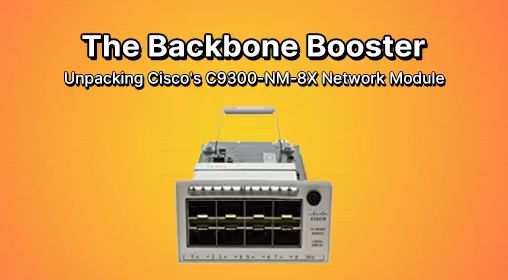
For network administrators, the arrival of this module signifies a pivotal moment. It's the solution deployed when you need to future-proof a wiring closet, ensuring that the aggregation switch can handle a growing fleet of multi-gigabit wireless access points and a surge in IoT devices without breaking a sweat. Its purpose is singular yet critical: to provide massive, high-speed uplink capacity in a compact, hot-swappable form factor that integrates seamlessly into an existing Cisco ecosystem powered by the IOS XE operating system.
When we talk about its raw capabilities, the module's specifications tell a clear story of a component built for speed and density.
|
Core Parameter |
Specification |
|---|---|
|
Port Configuration |
8 x 10 Gigabit Ethernet ports
|
|
Form Factor |
Plug-in network module for Catalyst 9300 series switches
|
|
Compatibility |
Cisco Catalyst 9300 Series Switches
|
|
Key Technology Support |
Designed for high-density Wi-Fi 6 and 802.11ac Wave 2
|
Physically, the module is the epitome of functional design. It's built to occupy a single module slot on a compatible Catalyst 9300 switch. The front panel is dominated by the eight high-speed ports, typically SFP+ cages for fiber optic connections, which are essential for maintaining signal integrity over longer distances within a campus or building. The build is robust, with a metal casing that aids in heat dissipation, ensuring stable operation even when all eight ports are pushing data at full tilt. The design prioritizes serviceability—it's built to be inserted and removed without needing to power down the entire switch chassis, a feature that network teams deeply appreciate during upgrades or troubleshooting.
What truly sets the C9300-NM-8X apart are the advanced features it unlocks within the broader Catalyst 9300 platform. This isn't just about adding ports; it's about enabling the switch to participate fully in software-defined architectures like Cisco's SD-Access. The module works in concert with the switch's powerful UADP ASIC, supporting advanced capabilities like Cisco's Encrypted Traffic Analysis (ETA), which can intelligently detect threats hidden within encrypted data streams without the performance hit of decryption. Furthermore, it provides the flexible, high-bandwidth uplinks necessary for sophisticated network segmentation and quality-of-service (QoS) policies, ensuring that critical applications like voice and video get the priority they need across the network backbone.
From the perspective of a network engineer, integrating the C9300-NM-8X is a straightforward process that yields immediate, tangible benefits. The experience is one of relieved pressure. Before its installation, the team might be constantly monitoring uplink utilization, fearing congestion during peak hours. Afterward, there's a sense of headroom and confidence. The clear, consistent labeling of the ports simplifies cable management, and the integration with Cisco DNA Center means the new capacity is instantly recognized and can be managed through a centralized, intuitive interface. This translates directly into reduced anxiety about network performance during company-wide video trainings or when deploying new, data-hungry applications. The module just works, silently providing the plumbing for a modern digital business.
Assessing its value is interesting because the module itself is an component whose value is tied to the Catalyst 9300 switch. The investment is justified by the significant enhancement in uplink capacity and future-proofing it provides. For an organization facing a network upgrade, adding this module to a new switch is often a more cost-effective and elegant solution than deploying an entirely separate aggregation device. It maximizes the return on investment in the Catalyst 9300 platform by extending its usable lifespan and capabilities, effectively delaying the need for a more expensive core network overhaul. The value proposition lies in its ability to consolidate functionality and provide massive bandwidth density in a simple, manageable package.
Of course, no technology is a perfect fit for every scenario. The primary strength of the C9300-NM-8X—its role as a specialized expansion module—is also its main limitation. It is exclusively designed for the Catalyst 9300 series and offers no value to users of other switch brands or models. For a very small business with only gigabit needs, this module would be a massive overkill. However, for its intended enterprise and campus environment audience, its advantages are profound. The combination of high-density 10G uplinks, seamless integration with the Cisco security and management ecosystem, and the reliability of the platform makes it an indispensable upgrade. The main consideration isn't a flaw in the module itself, but rather the need to ensure that the rest of the network infrastructure—like the core switch and the fiber cabling—is ready to handle the increased throughput it delivers. It's a key that unlocks higher performance, but only when used in the right lock.