
Intellectual Property
Hot selling product recommendations
View More




















The A9K-4X100GE-TR: Where Density Meets Simplicity in Network Design
Let’s be real—scaling a network is often a messy affair. It usually means wrestling with complex hardware additions, reconfiguring half your system, and hoping you don’t create a new bottleneck while solving an old one. The A9K-4X100GE-TR feels like a direct answer to that chaos. This isn't just another interface module; it's a purpose-built key that unlocks a cleaner, more streamlined path to massive bandwidth. Imagine needing to add a significant number of 100 Gigabit Ethernet ports to your core infrastructure without turning it into a weekend-long crisis. That's the specific problem this module is designed to solve with almost surgical precision. It slots into compatible chassis and instantly provides a high-density aggregation point for networks that are straining under the weight of modern data flows, like in large enterprise data centers or at the core of a service provider's network . It’s the difference between patching a leak and reinforcing the entire pipeline.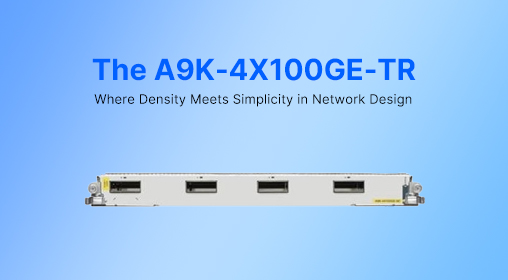
The heart of its appeal lies in its raw, uncompromising performance. We're talking about four individual 100-Gigabit Ethernet ports on a single module. That’s a total theoretical throughput of 400 Gbps, which is the kind of muscle needed for backbone connections, data center interlinks, and handling traffic from high-demand applications like real-time analytics, high-performance computing clusters, and massive storage arrays. The technology behind these ports, often adhering to standards like 100GBase-LR4 or ER4, allows for reliable data transmission over long distances on single-mode fiber, making it just as effective for connecting buildings across a campus as it is for linking data centers across a city . This isn’t just about speed for speed’s sake; it’s about moving enormous volumes of data with the low latency and high reliability that keep everything else running smoothly.
|
Feature |
Specification |
|---|---|
|
Interface Technology |
100-Gigabit Ethernet (100GE) |
|
Port Density |
4 ports per module |
|
Key Supported Standards |
100GBase-LR4, 100GBase-ER4 (typical for long-haul optics) |
|
Typical Application |
High-density aggregation in core networks and data centers |
|
Physical Medium |
Single-mode fiber (for long-distance transmission) |
What truly sets it apart are the intelligent features that lie beneath the impressive specs. This module is built for stability, minimizing the jitter and packet loss that can cripple high-speed connections. It’s designed for seamless integration into sophisticated network management systems, allowing for detailed traffic monitoring, quality of service (QoS) policies, and proactive diagnostics. This means the network can intelligently prioritize critical traffic, ensuring that your most important applications never get stuck in a digital traffic jam. The design prioritizes not just moving data, but managing it intelligently .
From a user's perspective, deploying the A9K-4X100GE-TR is a game-changer for operational sanity. For a network engineer, it translates to fewer late-night pages about bandwidth issues. The constant struggle of managing multiple lower-speed links to achieve a high aggregate bandwidth is eliminated. Consolidating connections with this module simplifies the network topology, making it easier to manage and troubleshoot. There's a tangible sense of relief knowing that the network core has so much headroom; it allows teams to focus on innovation and new services rather than constantly fighting capacity fires. The module’s design for hot-swapping also means upgrades or replacements can be done with minimal to no disruption to the live network, a critical feature for any environment where uptime is measured in dollars and cents.
Of course, no piece of hardware is perfect for every scenario, and it's important to weigh its strengths against its requirements.
The advantages are significant: exceptional port density that saves valuable chassis slots, tremendous bandwidth capacity that future-proofs the network for years, and the proven reliability required for mission-critical operations.
On the other side, the considerations are straightforward. This is unequivocally an enterprise and service provider-grade component. The investment is substantial and is justified in environments where network performance is directly tied to business outcomes. Its full potential is only realized within a compatible high-end chassis ecosystem, and leveraging its advanced capabilities requires a certain level of networking expertise. It would be overkill and not cost-effective for a small or medium-sized business.
When it comes to value, the A9K-4X100GE-TR is a clear case of investing in precision. For an organization where network performance, reliability, and scalability are non-negotiable, its value proposition is strong. The cost is an investment in reducing operational complexity, avoiding future costly upgrades, and ensuring business continuity. It eliminates the hidden costs of a fragile network—downtime, lost productivity, and the constant re-engineering of bottlenecks. For the right organization, this module isn't an expense; it's a strategic asset that pays for itself by providing a rock-solid, high-capacity foundation for everything else.