
Intellectual Property
Hot selling product recommendations
View More




















The A9K-24X10GE-SE: When Port Density Truly Matters
Let’s be honest—nobody gets excited about adding more hardware to an already cramped data center rack. The real thrill comes from deploying a single piece of gear that effortlessly multiplies your network's capabilities without multiplying the management headaches. That’s the space where the Cisco A9K-24X10GE-SE truly shines. This isn't just a line card; it's a high-density powerhouse engineered for the core of modern networks, specifically for the Cisco ASR 9000 Series routers. It answers a very direct challenge: how to dramatically scale bandwidth for services like IPTV, cloud edge routing, and 5G mobile aggregation without constantly wrestling with physical space constraints or complex configurations . It’s the kind of solution that turns network bottlenecks into distant memories.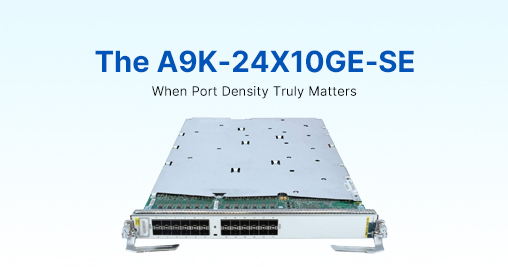
The raw performance of this module is immediately apparent from its core specification: twenty-four independent 10 Gigabit Ethernet ports. That’s a total aggregate throughput of 240 Gbps, with each port capable of delivering line-rate performance . This kind of density is a game-changer for service providers and large enterprises that need to terminate a massive number of high-speed links in a single slot. The flexibility is another key advantage; these SFP+ ports can often be configured to support not just 10GE but also 1GE or OTU2e modes, allowing network architects to adapt to different connection requirements without changing hardware . This programmability makes the card a versatile tool for evolving network landscapes.
Core Performance Parameters
|
Feature |
Specification |
|---|---|
|
Port Density |
24 x 10 Gigabit Ethernet ports |
|
Interface Type |
SFP+ (supporting 10GE/1GE/OTU2e) |
|
Total Throughput |
Up to 240 Gbps aggregate |
|
Form Factor |
Plug-in line card for Cisco ASR 9000 Series |
|
Key Feature Set |
Service Edge (SE) optimized with enhanced QoS |
|
Reliability |
Supports online insertion and removal (OIR) |
Physically, the card embodies the robust, no-nonsense design you'd expect for core network infrastructure. It's built to a substantial scale, with dimensions around 14 inches in height and a weight of approximately 14 pounds, engineered to fit into the various chassis sizes of the ASR 9000 family . The front panel is all business—a clean array of 24 SFP+ cages, with typical status LEDs providing clear visual feedback on link and activity for each port. Its air-cooled design ensures efficient heat dissipation, which is critical for maintaining stability under full load in a 24/7 operational environment .
Beyond the impressive numbers, the "SE" or Service Edge optimization is where its intelligence lies. This designation unlocks carrier-class features essential for modern, scalable networks. We're talking about advanced traffic management with hierarchical Quality of Service (QoS) that can prioritize latency-sensitive traffic like voice or financial data to under 5 milliseconds . It provides the foundation for technologies like MPLS-TE and EVPN, which are fundamental for building scalable and profitable WAN services. For network resilience, it supports features like 1:1 redundancy and hitless software upgrades, allowing for critical maintenance without causing service outages .
From an operator's perspective, deploying this line card translates to tangible operational benefits. The high port density means one card can do the job of multiple lower-density cards, simplifying the network topology, reducing the number of components to manage, and saving valuable chassis slots for future expansion. The programmability of the ports offers incredible flexibility; an engineer mentioned that being able to software-configure a port for 1GE or 10GE meant they could quickly adapt to a customer's changing bandwidth needs without a truck roll. The advanced QoS and deep buffer architecture have been credited in real-world deployments for reducing packet loss during peak traffic hours by as much as 90%, which directly translates to a more reliable experience for end-users .
When evaluating its value, the A9K-24X10GE-SE is a clear case of strategic investment over mere cost. The initial acquisition price is positioned for organizations where network performance and scalability are directly tied to revenue.
The advantages are compelling: exceptional port density that maximizes rack space, proven reliability for mission-critical environments, and the advanced feature set of Service Edge licensing that prepares the network for future service demands .
The considerations are equally pragmatic. This is enterprise and service provider-grade hardware, representing a significant investment that is justified in environments requiring high bandwidth and advanced features. Its full potential is realized within the Cisco ASR 9000 ecosystem, and leveraging its capabilities effectively requires corresponding networking expertise . The power consumption, while efficient for its class, is still substantial and must be factored into data center power and cooling plans .
In essence, the A9K-24X10GE-SE isn't for everyone. But for a service provider or a large enterprise building a robust, scalable, and feature-rich network core, its value proposition is strong. It eliminates the hidden costs of insufficient infrastructure—downtime, complex multi-card solutions, and inability to meet service level agreements. It's an investment in simplicity, capacity, and future-proofing, paying for itself by being a rock-solid foundation for the next generation of high-bandwidth services .