
Intellectual Property
Hot selling product recommendations
View More




















Switch Duel: C9300-24T-A vs. WS-C4500X-16SFP+ The Modern Workhorse Meets the Specialized Powerhouse
When you're building or upgrading a network backbone, the choice of core switches is a critical decision that ripples through performance, manageability, and total cost of ownership. Today we're putting two compelling options from Cisco's extensive lineup under the microscope: the Catalyst 9300-24T-A and the older but robust WS-C4500X-16SFP+. They emerge from different eras and design philosophies, making this less about a straightforward winner and more about identifying the perfect fit for your environment. The 9300 feels like a versatile all-terrain vehicle, packed with modern tech for a flexible journey, while the 4500X is more like a specialized tank, built for raw power in a specific domain. Let's get into the details.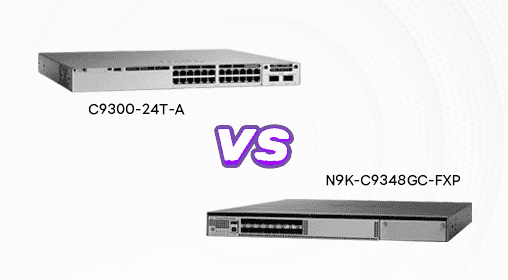
Peeking Under the Hood: A Core Parameter Breakdown
First up, a quick glance at the raw specs is essential. The difference in their fundamental architecture is apparent right from the start.
|
Feature |
Cisco Catalyst 9300-24T-A |
Cisco WS-C4500X-16SFP+ |
|---|---|---|
|
Port Configuration |
24 x 1G Copper RJ45
|
16 x 1G/10G SFP+ Fiber
|
|
Forwarding Rate |
154.76 Mpps
|
800 Gbps (Switching Capacity)
|
|
Power Supply |
Integrated 350W AC
|
Field-Replaceable (Sold Separately)
|
|
Form Factor (HxWxD) |
44 x 445 x 445 mm
|
44 x 438 x 533 mm
|
|
Weight |
7.27 kg
|
16.29 kg (Chassis Weight)
|
Looking at this table, the narrative begins to form. The 9300 offers a high density of common gigabit copper ports, ideal for connecting a large number of desktop phones, computers, and access points. Its 208 Gbps backplane bandwidth and forwarding rate are solid for an access layer switch. The 4500X, on the other hand, is a different beast. Its 16 ports are all SFP+, meaning they can handle either 1 Gigabit or 10 Gigabit connections using optical fiber or DAC cables, and its massive 800 Gbps switching capacity points to a role as a core or aggregation switch designed for blistering speed.
Physical Presence and Design Philosophy
The physical differences between these two switches are impossible to ignore once you have them in a rack. The Catalyst 9300-24T-A sports a compact and standardized form factor. It's relatively lightweight, which makes installation and handling a one-person job. This design aligns with its nature as a building block for stackable, scalable access layers.The WS-C4500X-16SFP+ feels substantially more substantial. It's deeper and, at over 16 kilograms, significantly heavier, hinting at a more robust internal construction. It's worth noting that the power supply and fan modules are field-replaceable components in the 4500X, a feature common in chassis designed for high availability in data centers or core network locations. The 9300, with its integrated power supply, follows a more simplified, fixed-configuration approach.
Functionality and Forward-Looking Features
This is where the generational gap becomes most evident. The Catalyst 9300 is a cornerstone of Cisco's Software-Defined Access (SD-Access) architecture. It's built not just to switch packets but to handle security, IoT integration, and cloud management. Think of it as a smart, programmable device ready for modern network automation and policy enforcement. Its ability to be stacked with other 9300s to create a single, logical switch with a unified management plane is a major operational advantage.
The 4500X is a classic workhorse. Its strength lies in pure, high-speed Layer 3 switching. It was built for reliability and performance in the core of a network, aggregating traffic from multiple access switches. While it can be managed effectively, it doesn't have the native programmability or the SD-Access integration of the 9300 series. It's a powerful tool, but one from an era before network automation became as pervasive as it is today.
Stability and Daily User Experience
Both platforms have a reputation for rock-solid stability, a hallmark of Cisco enterprise gear. The 9300 series boasts a Mean Time Between Failures (MTBF) of over 300,000 hours, which translates to decades of reliable operation. For a network engineer, the 9300's day-to-day experience is defined by the modern Cisco IOS XE operating system. It offers a cleaner CLI, better REST API support, and a more intuitive path for automation with tools like Ansible or Python scripts.
The 4500X is also incredibly stable, but the user experience is more traditional. Management is done through the classic Cisco IOS CLI. While incredibly powerful and well-documented, it lacks the modern API-driven approach that simplifies large-scale automation. For someone managing a few core switches, this is perfectly fine. For a team trying to automate a network of thousands of devices, the 9300 provides a more future-proof path.
The Value Proposition: Weighing the Investment
Discussing pure price is tricky without context, but we can talk about value and application. The Catalyst 9300-24T-A presents its value in operational efficiency and future readiness. You're investing in a platform that simplifies expansion through stacking, reduces the touchpoints for management, and is ready for the next decade of networking trends like IoT and network segmentation. It's a cost-effective solution for the access layer that avoids future upgrade pains.
The value of the WS-C4500X-16SFP+ is in its raw port speed and density for fiber connections. If your primary need is to link other switches or servers with 10-gigabit fiber links and you need a rock-solid, proven core, the 4500X offers tremendous performance. However, it's crucial to factor in the additional costs; the power supplies are not included, which adds to the initial investment. Its value is highest in scenarios where its specific capabilities are fully utilized.
The Final Tally: Strengths and Shortcomings
So, which one is for you? Let's break down their personalities.
The Cisco Catalyst 9300-24T-A is the modernizer. Its strengths are clear: high density of common copper ports, seamless stackability for easy growth, a modern operating system primed for automation, and a central role in next-generation architectures like SD-Access. Its potential drawbacks are its lack of native 10G ports without an additional uplink module and a design more focused on the access layer than the network core.
The Cisco WS-C4500X-16SFP+ is the specialist. Its undeniable advantage is its sixteen native 10-gigabit SFP+ ports, offering serious speed for fiber connections, and a chassis-built for core-level resilience with redundant, hot-swappable components. Its limitations are its age—lacking modern programmability features, its higher physical footprint and weight, and a requirement for additional component purchases.
In the end, the choice is straightforward. If your world revolves around connecting end-users, wireless access points, and IP phones, and you want a network that's easy to manage and ready for the future, the Catalyst 9300-24T-A is the undeniable choice. But if your mission is to build a blazingly fast core for a network that relies heavily on fiber and 10-gigabit connectivity, and you need proven, chassis-like reliability, the WS-C4500X-16SFP+ still has a powerful role to play. It all comes down to the problem you need to solve today and the network you want to run tomorrow.