
Intellectual Property
Hot selling product recommendations
View More




















Port Density vs. Power: The MikroTik CRS354 and CRS418 Switch Breakdown
Choosing between MikroTik's Cloud Router Switch series often feels like picking between a Swiss Army knife and a specialized tool. The CRS354-48G-4S+2Q+RM and the CRS418-8P-8G-2S+RM sit in the same family but are engineered for completely different missions. One is a high-density aggregator for core networks, while the other is a compact power source for edge deployments. Let's get into the details.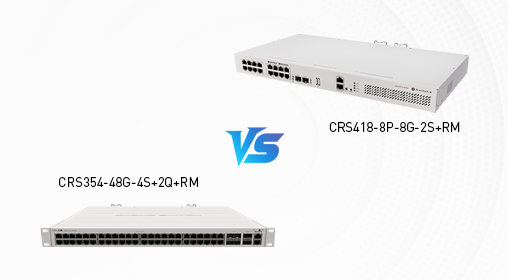
The most striking difference is their fundamental design philosophy. The CRS354-48G-4S+2Q+RM is a port density king. It’s built for the core of a network, boasting a massive 48 x 1GbE RJ45 ports, supplemented by 4 x 10G SFP+ ports and 2 x 40G QSFP+ uplinks. This design is ideal for aggregating traffic from a large number of devices, like in an office or data center, and connecting them to a high-speed backbone. In contrast, the CRS418-8P-8G-2S+RM is a Power over Ethernet (PoE) specialist. Its port configuration is more modest—8 x 1GbE RJ45 ports and 2 x 10G SFP+ ports—but its superpower is that all 8 RJ45 ports deliver PoE. This makes it perfect for powering and connecting a cluster of devices like wireless access points, security cameras, and VoIP phones directly from the switch, eliminating the need for separate power adapters.
When we look at the raw performance, the differences become even clearer. The CRS354 is built for non-blocking, high-capacity switching with a total switching capacity of 336 Gbps and a forwarding rate of 235 Mpps. Under the hood, it relies on a Qualcomm Atheros QCA9531 CPU and a Marvell 98DX3257 switch chip to handle this workload. The CRS418, while still powerful, is optimized for a different set of tasks where its PoE budget is the critical metric. Physically, both are 1U rackmount devices, but the CRS354 is substantially wider at 443mm to accommodate its extensive port array, while the CRS418 features a more compact design.
For user experience, the choice is straightforward. The CRS418-8P-8G-2S+RM offers incredible convenience for edge deployments. You can mount it on a ceiling or in a telecom closet and run a single cable to each device for both data and power, dramatically simplifying installations. It’s a "set it and forget it" solution for distributed environments. The CRS354-48G-4S+2Q+RM, however, is a core network workhorse. Its value is in its flexibility and density. It’s the central connecting point for an entire floor or a small data center, allowing you to connect everything from desktop computers to servers with high-speed fiber uplinks. You manage it more as the brain of your operation.
The value proposition isn't about which switch is cheaper, but which one solves your specific problem more effectively. The CRS354-48G-4S+2Q+RM delivers unparalleled value per port for pure data connectivity. If you need to connect 40+ devices at gigabit speeds and have a path for 10G/40G uplinks, its price-to-port ratio is tough to beat. The value of the CRS418-8P-8G-2S+RM is in its integrated power delivery. For PoE-heavy setups, the built-in power supply means you avoid the significant expense and clutter of purchasing and managing dozens of external PoE injectors, leading to a cleaner and potentially lower total cost of ownership.
Here’s a quick overview of their core technical parameters for a direct comparison.
|
Core Parameter |
CRS354-48G-4S+2Q+RM |
CRS418-8P-8G-2S+RM |
|---|---|---|
|
Core Function |
High-Density Data Switch |
PoE Power & Data Switch |
|
Copper Ports |
48 x 1G RJ45
|
8 x 1G RJ45 (all PoE-capable)
|
|
SFP+ Ports |
4 x 10G
|
2 x 10G
|
|
QSFP+ Ports |
2 x 40G
|
Information not specified in sources |
|
Switching Capacity |
336 Gbps
|
Information not specified in sources |
|
Key Differentiator |
40G Uplinks, 48-port density |
Integrated PoE on all RJ45 ports |
The Final Decision
So, which switch should you choose? Your network's specific needs will point the way.
Choose the CRS354-48G-4S+2Q+RM if: Your priority is connecting a very large number of devices in a wiring closet or using it as a core switch. You need the flexibility of high-speed 40G uplinks for aggregation and future growth. Your focus is purely on data throughput and port density.
Choose the CRS418-8P-8G-2S+RM if: You are deploying a network where powered devices are the norm. You need to run wireless access points, security cameras, or access control systems and want the simplicity of a single-cable solution for both data and power. It's the ultimate tool for clean, modern edge deployments.
In the end, MikroTik offers a specialist for power and a generalist for ports. Your specific connectivity and power requirements will tell you exactly which tool is the right one for the job.