
Intellectual Property
Hot selling product recommendations
View More



















Nexus 9396PX: The Data Center Workhorse That Refuses to Retire
When you first encounter the Cisco Nexus 9396PX in a data center rack, its design screams practicality. This isn’t a flashy piece of hardware—it’s a 2RU workhorse built for business. With 48 fixed SFP+ ports lining the front panel, it handles 1G or 10G connections to servers and storage, while the right side hosts 12 QSFP+ uplinks capable of 40G each. The chassis is stout, measuring 3.5 inches tall and 17.5 inches wide, and it tips the scales at around 22.5 pounds without modules. What stands out are the color-coded fan trays and power supplies: blue for port-side exhaust, burgundy for intake. It’s a visual cue that simplifies maintenance in a cramped rack environment. The build is industrial-grade steel, designed to run 24/7 in conditions ranging from freezing cold to 104°F (40°C), and it operates reliably at altitudes up to 13,000 feet. This switch doesn’t ask for pampering.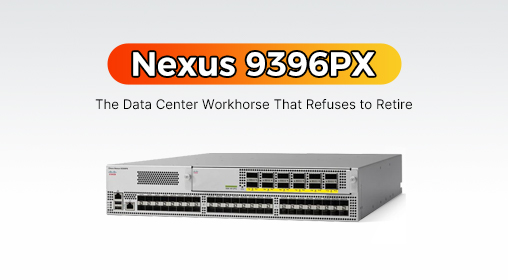
Under the hood, the 9396PX packs a serious punch. It delivers a non-blocking switching capacity of 1.92 Tbps, pushing up to 1.5 billion packets per second with latency kept under 3 microseconds. The MAC address table holds 96,000 entries, ensuring efficient traffic forwarding in large Layer 2 domains. Here’s a breakdown of its core specs:
|
Parameter |
Specification |
|---|---|
|
Port Configuration |
48 x 1/10G SFP+ downlinks, 12 x 40G QSFP+ uplinks |
|
Switching Capacity |
1.92 Tbps |
|
Forwarding Rate |
1500 Mpps |
|
Typical Power Draw |
232W AC |
|
Max Power Consumption |
455W AC |
|
Operating Temperature |
32°F to 104°F (0°C to 40°C) |
|
Acoustics |
68.3 dBA (40% fan speed) to 84.5 dBA (100% fan speed) |
|
Memory & Storage |
32GB DDR4 RAM (expandable to 64GB), 120GB SSD for OS/logs |
The uplink modules are field-replaceable, letting you choose between 4-port 100G (M4PC), 6-port 40G (M6PQ), or 12-port 40G (M12PQ) configurations. This flexibility means you can adapt the switch to everything from legacy 10G server farms to high-speed spine-leaf architectures without replacing the entire chassis.
Where the 9396PX truly shines is in its functional depth. It supports dual-mode operation—traditional NX-OS for network admins who prefer a CLI reminiscent of Cisco IOS, or ACI mode for software-defined networking. Features like VXLAN and EVPN allow for network segmentation across Layer 3 boundaries, a must-have for multi-tenant data centers. The switch also hardware-accelerates IPsec encryption at 100G line rate, a boon for securing east-west traffic. Automation is baked in: Ansible playbooks or Python scripts can handle zero-touch provisioning, cutting configuration time by up to 40% in managed environments. For security, it offers RADIUS/TACACS+ authentication, ACLs, and port security to lock down access.
Engineers who’ve operated the 9396PX describe it as "familiar yet powerful." The CLI feels like an old friend to anyone with Cisco experience, reducing the learning curve. One network admin noted, "We migrated from Catalyst 6500s and had the basics configured in under an hour." The trade-off is that advanced features like telemetry streaming or granular QoS policies require deeper expertise. In a real-world case, a financial firm used its virtual PortChannel (vPC) capability to slash VM migration times by 70%, thanks to multi-chassis link aggregation that prevented bottlenecks. The fans, while effective, can hit 84.5 dBA under full load—audible enough that you’ll want this switch in a dedicated server room.
From a cost perspective, the 9396PX occupies a sweet spot. Since it’s been discontinued (end-of-sale announced in 2020), new units are scarce, but refurbished models are widely available. This puts a fully tested unit with a one-year warranty within reach of budgets that can’t stretch to newer 100G switches. The real savings come from operational efficiency: it sips just 232W typically, earning an 80Plus Platinum efficiency rating, and its 5-year total cost of ownership can be 28% lower than comparable platforms like Arista 7050X. For organizations with stable 10G/40G requirements, it’s a capital-efficient way to deploy high-density aggregation without betting on the latest silicon.
The Verdict: Strengths and Limitations
Why it still earns a place in racks:The 9396PX’s port density remains compelling—48 10G ports plus 12 40G uplinks in 2RU is still respectable. Its modular uplinks let you tailor connectivity without overbuying. Reliability is proven; many units have logged years of service with minimal downtime. For teams steeped in Cisco ecosystems, the NX-OS consistency reduces operational risk.
Where it shows its age:The 40G uplinks feel dated in a 100G/400G world. It lacks native support for modern telemetry and segment routing, and its buffer space is smaller than in newer models. While refurbished units are affordable, long-term software support is finite—NX-OS updates are guaranteed only until 2030. It’s also not the pick for latency-sensitive applications; newer switches cut latency to under 1 microsecond.
The Cisco Nexus 9396PX is like a dependable truck: it might not have the latest autonomous features, but it hauls heavy loads day in and day out. It’s best suited for enterprises with existing 10G server infrastructure, budget-conscious cloud providers, or as an access-layer switch in a tiered data center. If you need future-proofed 100G/400G or ultra-low latency, look elsewhere. But for pure, reliable density at a reasonable cost, this switch still delivers.