
Intellectual Property
Hot selling product recommendations
View More




















MikroTik CRS326 vs. CRS354: Choosing Between a Compact Workhorse and a Powerhouse
Selecting between the MikroTik CRS326-24G-2S+IN and the CRS354-48P-4S+2Q+RM is less about finding a "better" switch and more about matching the right tool to your network's specific demands. One is a compact, energy-efficient access layer solution, while the other is a high-port-density, PoE-enabled core distribution beast. Their design philosophies cater to entirely different segments of the market.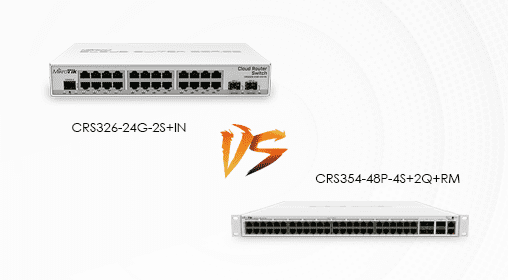
At the heart of the CRS326 lies a Marvell Prestera 98DX3236 chip clocked at 800 MHz, supported by 512 MB of RAM. Its switching capacity is a solid 88 Gbps, handling a packet forwarding rate of 65.476 Mpps. This hardware is well-suited for its primary role: connecting end-users and providing basic routing at the network's edge.
The CRS354, in contrast, is built for significantly heavier lifting. With 48 Gigabit Ethernet ports (all supporting PoE/PoE+), it immediately offers double the access layer capacity. Its uplink capabilities are also far superior, featuring four SFP+ ports (10 Gbps) and, critically, two QSFP+ ports (40 Gbps) for high-speed aggregation or backbone connections. While specific processor details for the CRS354 are not in the provided search results, its expanded port count and features imply a more powerful internal architecture to manage the increased throughput and PoE budget. The sheer number of high-speed interfaces suggests its switching capacity vastly exceeds that of the CRS326.
A defining difference is Power over Ethernet. The CRS354-48P-4S+2Q+RM comes with a robust built-in power supply to deliver PoE/PoE+ to all 48 of its ports, making it ideal for powering access points, IP cameras, and phones directly. The CRS326, on the other hand, relies on passive PoE input (10-30V), meaning it can be powered via PoE but cannot supply PoE to other devices without an additional injector or module.
|
Core Parameter |
CRS326-24G-2S+IN |
CRS354-48P-4S+2Q+RM |
|---|---|---|
|
Form Factor |
Compact, Desktop |
Rack-mountable (1U) |
|
Gigabit RJ45 Ports |
24x |
48x (all with PoE/PoE+) |
|
SFP+ Ports (10G) |
2x |
4x |
|
QSFP+ Ports (40G) |
None |
2x |
|
Switching Capacity |
88 Gbps
|
Significantly Higher |
|
Packet Forwarding Rate |
65.476 Mpps
|
Higher |
|
PoE Capability |
Passive PoE In (10-30V)
|
Yes, PoE/PoE+ Out on all 48 ports |
|
Power Supply |
External Adapter |
Internal, Redundant (Hot-swappable) |
|
Operating Temperature |
-40°C to 60°C
|
Standard Commercial Range |
The CRS326 sports a minimalist, compact design with dimensions of 285 x 144 x 44 mm, making it ideal for small offices or where space is limited. It's a lightweight unit at 1.32 kg, designed for simplicity.The CRS354 presents a completely different physical profile. It's a full-sized, rack-mountable (1U) unit designed for installation in a server cabinet or networking closet. A key feature is its support for redundant, hot-swappable power supplies, a critical design element for environments where maximum uptime is required. This robust build reflects its role as a central, reliable piece of network infrastructure, contrasting with the CRS326's more utilitarian and portable nature.
Both devices run the versatile MikroTik RouterOS and SwOS, but their hardware unlocks different feature sets. The CRS326 is a fantastic L3-capable switch for basic routing and VLAN management, perfect for segmenting a small network. Its two SFP+ ports allow for creating a fast 10 Gbps backbone link between two switches or to a server.
The CRS354 is a feature powerhouse in comparison. Its 48 PoE ports with a substantial power budget allow it to act as a centralized power and data source for an entire office or building. The two 40G QSFP+ ports are a game-changer, enabling incredibly high-speed connections to the network core or storage systems, making the switch suitable for data-intensive applications and future-proofing. The support for redundant power supplies directly enhances its reliability feature set.
Managing a CRS326 is straightforward, especially with MikroTik's Quick Set feature for rapid deployment. It can be configured via WinBox, WebFig, or the command line. For a technician familiar with MikroTik, it's a quick setup.
The CRS354 offers the same software experience but demands a more considered approach due to its complexity. Configuring PoE settings for dozens of devices, managing traffic across 40G links, and setting up power supply redundancy require a deeper understanding of network design and MikroTik's ecosystem. It's the tool of choice for network administrators managing a more complex environment.
The CRS326's value is in its exceptional affordability and low power consumption (around 21W) for a 24-port Gigabit switch with 10G uplinks. It delivers core functionality at a very accessible point, making it perfect for budget-conscious projects.
The CRS354's value is in its total cost of ownership and consolidation. While the initial investment is higher, it replaces the need for separate PoE injectors and potentially additional aggregation switches. The redundant power supply feature can prevent costly downtime. For a business building a scalable, reliable network infrastructure, the CRS354 represents a strategic investment.
Choose the CRS326-24G-2S+IN if:
Your network is a small to medium-sized office or a remote branch with up to 24 wired connections.
You need a cost-effective switch with basic routing and 10G uplink capabilities for a small office or home lab.
PoE is not a requirement, or you only need to power a very few devices via separate injectors.
Physical space is limited, and a compact, desktop-sized device is preferable.
Invest in the CRS354-48P-4S+2Q+RM if:
You are outfitting a medium to large office, school, or facility that requires a high density of wired and PoE-powered devices.
You need to future-proof your network with 40G capable uplinks for high-speed servers, storage, or backbone connections.
Network uptime is critical, and features like redundant, hot-swappable power supplies are non-negotiable.
You want to centralize power and data for a large number of IP phones, wireless access points, and security cameras.
The CRS326 is the pragmatic, efficient choice for the network edge. The CRS354-48P-4S+2Q+RM is the robust, scalable foundation for a growing business. Your specific needs for port density, power, and speed will clearly point to the right solution.