
Intellectual Property
Hot selling product recommendations
View More




















When a Data Center Titan Meets an Office Workhorse
Let me paint you a picture of the strangest matchup in networking gear. Imagine putting a Formula 1 car next to a reliable family SUV and asking which is "better." That's essentially what happens when you compare Juniper's QFX10002-36Q with Cisco's C9200L-24T-4G-E. They're both switches, but they inhabit completely different universes.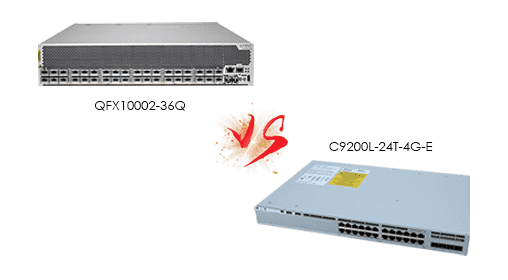
I've seen both of these in action, and the contrast is almost amusing. The Juniper is that silent, imposing beast humming away in a temperature-controlled data center, while the Cisco is the unassuming workhorse tucked neatly into an office wiring closet. Choosing between them isn't about finding a "winner" – it's about matching the tool to the job.
Let's start with what really matters – the raw specifications. I've put together the essentials that actually make a difference in real-world deployments:
| Core Parameters | Juniper QFX10002-36Q | Cisco C9200L-24T-4G-E |
|---|---|---|
| Form Factor | 2U chassis | Compact desktop/rack mount |
| Port Configuration | 36× QSFP+ (supporting 10G/40G/100G) | 24× 1G RJ45 + 4× 1G SFP |
| Switching Capacity | 2.88 Tbps | 80 Gbps |
| Forwarding Rate | 1 Bpps | 41.66 Mpps |
| Power Supply | Dual, hot-swappable | Fixed with optional redundancy |
| Cooling System | Multiple hot-swappable fans | Fixed fans with smart control |
The numbers tell a clear story – we're dealing with entirely different classes of equipment. The Juniper's switching capacity alone could handle traffic from dozens of the Cisco units simultaneously.
When you first lay eyes on the QFX10002-36Q, you know you're dealing with serious hardware. It's built like a tank with that distinctive Juniper industrial design – all business, no flash. The front panel is dominated by those 36 QSFP+ ports, while the rear houses the redundant power supplies and cooling modules. At around 2U and significantly heavier than the Cisco, this isn't something you'll be casually moving around once it's racked.
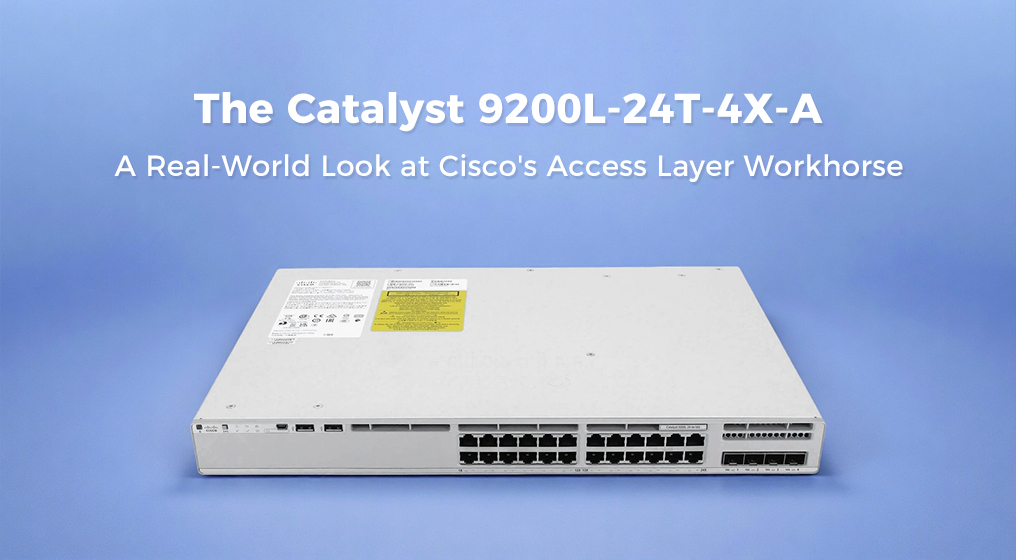
The C9200L-24T-4G-E couldn't be more different in appearance. It's sleek, compact, and designed to blend into office environments. The familiar Cisco styling with its clean lines and informative status LEDs makes it instantly recognizable. What it lacks in imposing presence, it makes up for in practical design that fits standard office racks without drawing attention.
Where these two really separate is in their functional capabilities. The Juniper is built for the core of modern data centers – we're talking massive scalability, support for technologies like EVPN-VXLAN, and the ability to handle spine roles in fabric architectures. I've seen these devices effortlessly manage traffic flows that would make lesser equipment buckle.
The Cisco plays a completely different game. It's all about connecting end-user devices, providing access layer intelligence, and integrating seamlessly into Cisco's DNA Center ecosystem. The 24 Gigabit Ethernet ports are perfect for desktop connections, while the 4 SFP uplinks handle connectivity to distribution switches. It's the definition of a reliable access layer workhorse.
Living with these devices day-to-day reveals their true characters. The Juniper demands expertise – its Junos OS has a learning curve, and configuring advanced features requires real skill. But once it's set up properly, it just runs. I've watched these handle years of continuous operation without so much as a hiccup.
The Cisco feels much more approachable. The IOS XE operating system will be familiar to anyone who's worked with Cisco gear, and the web interface makes basic management accessible to less experienced staff. It's the kind of switch you can deploy quickly and then mostly forget about – which is exactly what you want from access layer gear.
Now, let's talk value – because this is where context becomes everything. The Juniper represents a significant investment, but for organizations that need its capabilities, every dollar is justified. When you're building out a data center that needs terabit-scale throughput and advanced features, there are no shortcuts.
The Cisco offers tremendous value for what it does. For typical office environments, campus networks, or branch offices, it delivers enterprise-grade features at a reasonable cost point. The optional PoE capabilities (on other models in the series), stacking functionality, and DNA Center integration make it a smart long-term investment for access layer needs.
If I had to sum up the strengths and weaknesses:
The Juniper QFX10002-36Q brings incredible power, scalability, and data-center-ready features. It's built for the long haul and can handle whatever you throw at it. The trade-off is the higher cost, power consumption, and complexity that requires skilled engineers to manage properly.
The Cisco C9200L-24T-4G-E offers simplicity, ease of use, and cost-effectiveness for its intended role. It fits beautifully into Cisco ecosystems and requires less specialized knowledge to operate. The limitations come in scale – this isn't a device you'd use for data center core or even distribution layers.
At the end of the day, your choice comes down to a simple question: what problem are you trying to solve? If you're building a data center backbone or need massive port density for high-speed connectivity, the Juniper is your only real option here. If you're connecting users in an office or campus environment, the Cisco will serve you perfectly while being easier on both your budget and your technical staff.
The funny thing about comparing these two is that in a well-designed enterprise network, you might actually find both working together – the Juniper handling the heavy lifting in the data center while dozens of Cisco access switches connect users across the organization. Sometimes, the right choice isn't about picking one over the other, but understanding where each belongs.