The Quiet Beast in the Rack: Living with the Cisco ISR 4461
You don't really notice the Cisco until the network goes down, or until you try to squeeze it into a cabinet that wasn't built for heavy iron. For most of us, this router is less of a piece of hardware and more of a silent guardian sitting in the back of a climate-controlled room, humming a low, steady note that says everything is fine. But when you finally pull it out to configure it or swap a module, you realize just how much engineering went into making something so unassuming handle the chaotic traffic of a modern enterprise. It’s not flashy, it doesn’t have RGB lighting, and it certainly doesn’t care about your feelings, but it gets the job done with a reliability that feels almost old-school in today’s cloud-obsessed world.
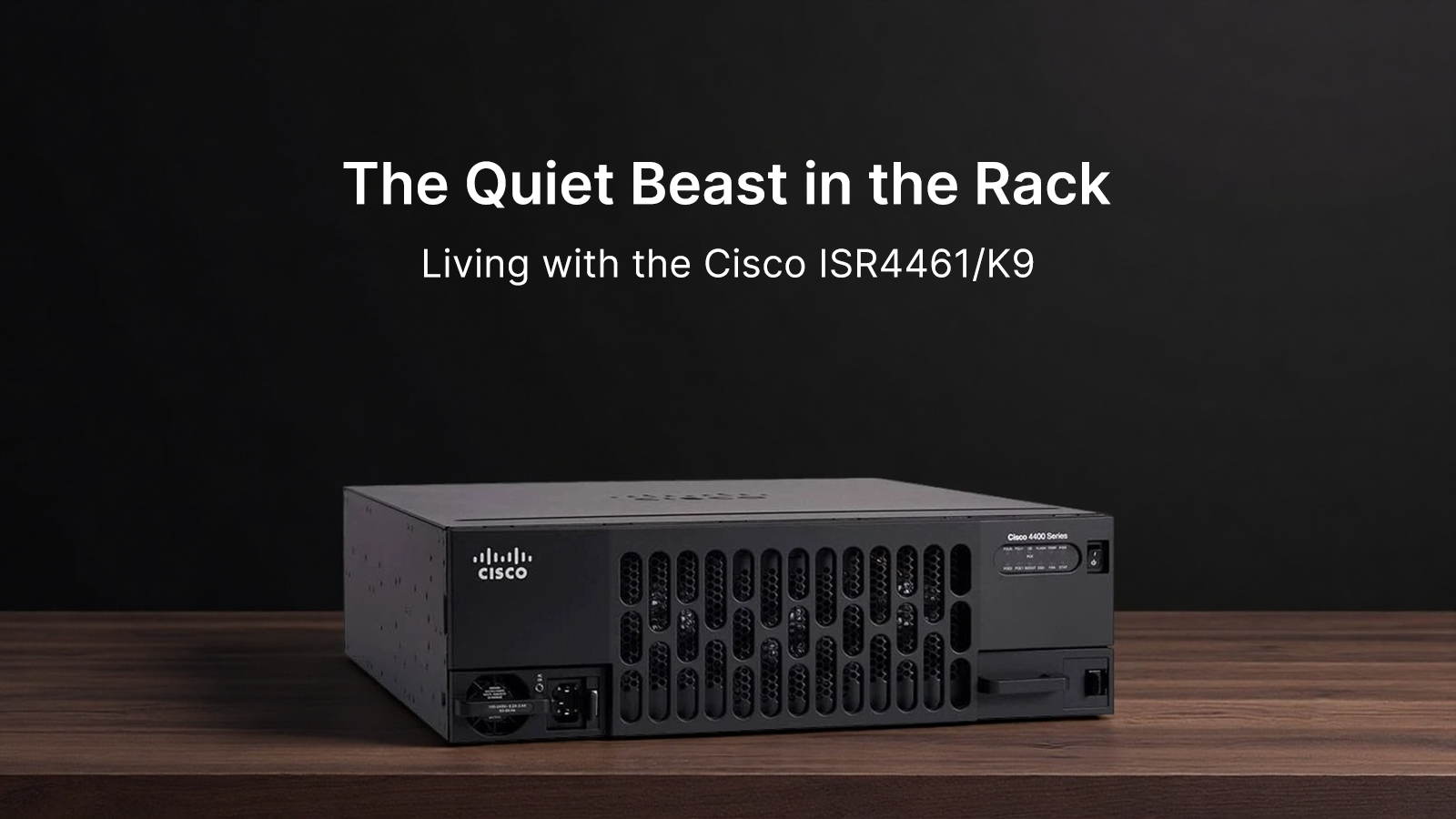
When you first lift the
4461 out of the box, the weight surprises you. This isn’t some lightweight plastic appliance; it’s dense, solid, and built like a tank. It occupies a single rack unit (1U), which is a blessing if you’re fighting for space in a crowded telco closet, but its depth means you need to watch your cabling behind it. The front face is utilitarian—a matte black grill hiding the fans, flanked by status LEDs that are bright enough to see from across the room but not so blinding that they light up the whole rack. On the right side, you’ll find the modular slots covered by blanking plates, waiting for you to decide what kind of connectivity you need. It looks serious, almost industrial, and that aesthetic carries through to the rear panel where the ports are laid out with logical precision. You get four fixed Gigabit Ethernet ports and two SFP+ slots for 10GE uplinks, plus a console port that still respects the RJ-45 standard alongside the mini-USB option. It feels like equipment designed by engineers for engineers, with no frills and no nonsense.
The real magic, however, isn’t in how it looks, but in what it can do once you plug it in. This device was built for the large branch office or the regional hub that needs to do everything. It’s not just moving packets; it’s terminating hundreds of encrypted VPN tunnels, inspecting traffic for threats, prioritizing voice calls over video streams, and even running local applications via Cisco IOx. In my experience deploying these, the 4461 shines in scenarios where you need to consolidate multiple boxes into one. Instead of having a separate router, firewall, and WAN optimizer, the 4461 eats all those roles for breakfast. The multi-core architecture separates the control plane from the data plane, which means even when you’re pushing complex security policies or running heavy QoS rules, the management interface stays responsive. It’s rare to find a box that can handle that kind of load without breaking a sweat, and the 4461 does it while keeping the fan noise surprisingly manageable for a 1U device.
Here is a breakdown of what drives this machine under the hood:
| Feature |
Specification |
| Model |
Cisco ISR 4461/K9 |
| Form Factor |
1 Rack Unit (1U) |
| Fixed Interfaces |
4 x GE RJ-45, 2 x 10GE SFP+ |
| Expansion |
3 x NIM Slots, 2 x SM Slots, 1 x ISC Slot |
| Memory (Default) |
8 GB Control Plane, 4 GB Data Plane |
| Flash Storage |
8 GB (Bootflash), expandable via USB/SSD |
| Throughput Capacity |
Up to 1 Gbps base, scalable with licenses |
| Power |
Dual redundant AC/DC power supplies |
| Operating System |
Cisco IOS XE |
| Virtualization |
Supports Cisco IOx and UCS-E modules |
| USB Ports |
2 x USB 2.0 Type-A |
| Lifecycle Status |
Mature/End-of-Sale (Active Support) |
Living with the
ISR 4461 as an administrator is a mix of frustration and deep satisfaction. The frustration comes from the sheer complexity of Cisco IOS XE. This isn’t a device you set up in five minutes with a wizard; it demands respect. You need to know your way around the command line, understand licensing tiers, and plan your memory allocation carefully. If you make a mistake in your configuration, the router won’t hold your hand. But once you get past that initial learning curve, the satisfaction kicks in. The stability is legendary. I’ve seen these routers run for years without a reboot, handling firmware upgrades and config changes with zero downtime thanks to features like In-Service Software Upgrade (ISSU). The ability to hot-swap power supplies and network modules means you can repair or upgrade the unit without disrupting the business, a feature that makes your life infinitely easier during maintenance windows.
The flexibility of the expansion slots is where the
4461 truly earns its keep. Need to add legacy T1 lines for a stubborn PBX system? Pop in a NIM. Need high-density switching? There’s a module for that. Want to run a local compute node for edge analytics? The service module slots can host UCS-E blades, turning your router into a mini-server. This modularity means the
4461 can adapt to almost any weird requirement a customer throws at you, future-proofing your investment in a way that fixed-configuration appliances just can’t match. It’s this adaptability that makes it a favorite for integrators who deal with diverse environments. You buy one chassis, and you can reconfigure it for different sites just by swapping cards, reducing the need to stockpile different SKUs.
Of course, no piece of hardware is perfect, and the
4461 has its quirks. The biggest downside is the cost of entry and operation. While the hardware itself might be accessible on the secondary market now that newer models exist, the licensing model can be a headache. To unlock the full throughput potential or advanced security features, you need to buy specific performance licenses, which can add up quickly. The power consumption is also higher than some of the newer, efficiency-focused silicon, which might matter if you’re paying by the watt in a large deployment. Additionally, the 1U form factor, while space-saving, means the fans have to spin faster to cool the dense components, making it slightly louder than its 2U siblings. If you’re placing this in a small office closet without soundproofing, the hum might become a complaint for anyone working nearby.
Despite these drawbacks, the value proposition of the ISR
4461 remains strong, especially for organizations that need proven reliability over bleeding-edge specs. It sits in a sweet spot where the technology is mature, the bugs are squashed, and the community knowledge is vast. You aren’t going to be the first person to deploy this, which means if you run into an issue, someone else has already solved it and posted the solution online. For businesses that need a robust edge platform capable of handling complex services without the premium price tag of the latest Catalyst 8000 series, the 4461 is a bargain. It offers enterprise-grade redundancy, massive expandability, and the full power of IOS XE at a fraction of the cost of new hardware.
In the end, the Cisco
ISR 4461/K9 is a workhorse. It doesn’t try to be trendy or win design awards. It’s a tool for professionals who need a network foundation that won’t crack under pressure. Whether you’re managing a distributed WAN, securing remote branches, or consolidating legacy services, this router delivers a level of performance and flexibility that few competitors can match. It asks for a bit of expertise and a decent budget for licenses, but in return, it gives you peace of mind. And in the world of networking, where downtime costs thousands of dollars a minute, that peace of mind is worth every penny. It’s the kind of device you install, configure, and then promptly forget about, knowing it will be there doing its job silently and efficiently for years to come.