
Intellectual Property
Hot selling product recommendations
View More



















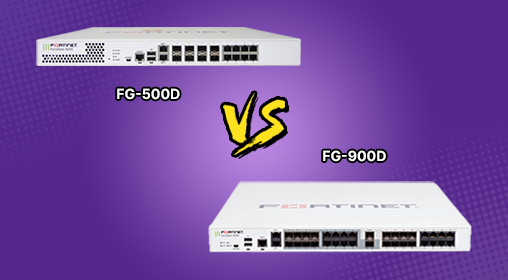
FortiGate Face-Off FG-500D vs FG-900D : Decoding the D-Series Divide
Choosing between the FG-500D and FG-900D feels less like comparing two models and more like choosing the heart for your network's circulatory system. One is a robust, capable workhorse for the enterprise core, while the other is a powerhouse designed for the relentless demands of a data center or large service provider. They run the same FortiOS software, so the experience is familiar, but the hardware tells a completely different story about scale, resilience, and raw power. Let's peel back the layers.
The most immediate difference is in their performance envelopes. The FG-500D is a solid performer with capable hardware acceleration (SPU NP6 and CP8) designed to handle enterprise-level traffic. It's the kind of device that won't break a sweat under typical corporate loads. The FG-900D, however, operates on a different plane. Think of it as the difference between a high-performance sports car and a heavy-duty transport truck; both are powerful, but one is built for speed and agility, the other for massive, sustained loads. The 900D's architecture is engineered to maintain high throughput even with every security feature—IPS, SSL inspection, advanced threat protection—turned on to the maximum. It's about having power in reserve, ensuring that a sudden traffic spike or a coordinated attack doesn't cause latency or dropped connections.
|
Core Parameter |
FortiGate FG-500D |
FortiGate FG-900D |
|---|---|---|
|
Use Case Profile |
Enterprise Core / Large Branch |
Data Center / Service Provider |
|
Hardware Acceleration |
SPU NP6, CP8
|
Advanced SPUs for massive session handling |
|
Internal Storage |
120 GB SSD
|
High-Capacity SSD (for logging & analytics) |
|
Threat Protection Throughput |
Strong for enterprise mix |
Maximum, designed for full inspection on 10G+ links |
|
High-Speed Interfaces |
1GbE/10GbE ports
|
High-density 10GbE, 40GbE, 100GbE readiness |
|
Virtual Domain (VDOM) Support |
Standard |
High-capacity, enabled for complex multi-tenancy |
|
Connection Capacity |
High (Millions) |
Very High (Tens of Millions) |
Physically, both units are rack-mountable, but their build and connectivity options reveal their purpose. The FG-500D has a practical, dense port arrangement with a mix of 1Gb and 10Gb interfaces, fitting well into a standard server rack. The FG-900D, by contrast, is a more substantial piece of hardware. It's heavier, with a more robust chassis designed for better heat dissipation under continuous full load. Its most telling external feature is the inclusion of high-density 10GbE, 40GbE, or even 100GbE ports. These aren't just for show; they are essential for connecting to the high-speed spine of a modern data center network, where the 500D's port configuration would be a bottleneck. The 900D is built for the long haul, with components rated for higher mean time between failures (MTBF), which is a key indicator of physical stability.
When it comes to features, the common ground is FortiOS. This means the vast majority of security functions—firewall policies, VPN, web filtering, intrusion prevention—are available on both. The divergence, again, is performance under load. A feature like SSL deep inspection is incredibly resource-intensive. Enabling it on the FG-500D for a significant portion of your traffic will have a measurable impact on its throughput. On the FG-900D, the hardware is specifically designed to handle this cryptographic overhead without flinching, allowing you to inspect encrypted threats across the board without compromising user experience. Furthermore, the 900D typically supports a much larger number of Virtual Domains (VDOMs), making it a logical choice for managed service providers or large enterprises that need to segment the network into many separate logical firewalls.
For the network administrator, the user experience is defined by headroom and peace of mind. Managing the FG-500D is straightforward for well-defined network segments. However, the FG-900D provides a qualitatively different feeling of control in a dynamic, high-growth environment. It's the confidence of knowing you can push the system—apply complex security policies, enable detailed logging for forensics, or onboard a new business unit—without the constant need to micro-manage performance or worry about hitting a ceiling. This operational flexibility is a huge part of its value proposition, reducing stress and administrative overhead.
The value question is intriguing. The FG-500D offers excellent capability for its class and is a cost-effective solution for organizations whose needs align with its performance profile. The FG-900D commands a higher investment, but its value is measured differently: in risk mitigation, operational scalability, and total cost of ownership over a longer period. For a growing organization, avoiding a costly "forklift" upgrade in two years because the 500D is maxed out can make the 900D the more economical choice from the start. Its ability to consolidate multiple security functions onto a single, stable platform also adds to its value.
The FG-500D's strengths are its enterprise suitability and efficient form factor. Its potential limitation is a performance ceiling that could be reached in a rapidly expanding network. Conversely, the FG-900D's primary advantage is its immense scalability and resilience for the most demanding environments. The consideration is its higher initial resource commitment. Both are built on Fortinet's stable operating system, but the 900D's superior components and thermal design give it an inherent stability advantage under sustained, extreme load, ensuring policy enforcement remains consistent even when the network is under attack or experiencing unprecedented traffic volumes.
In the end, the FG-500D is a formidable solution for securing the enterprise core where demands are substantial but predictable. The FG-900D, however, is in a league of its own, engineered for the scale, speed, and criticality of modern data centers and service provider edges. Your decision ultimately maps to your network's trajectory: one capably secures the present, while the other is built to confidently handle the unpredictable demands of the future.