
Intellectual Property
Hot selling product recommendations
View More



















FortiGate Face-Off FG-1800F vs FG-1101E : When Data Center Security Gets Serious
Picking between Fortinet's FG-1800F and the older FG-1101E isn't just about comparing specs on a sheet. It's a fundamental choice about how you want your network to breathe under pressure. One is a modern powerhouse built for the relentless traffic of today's data centers, while the other is a reliable veteran from a previous generation. The gap between them tells a story of evolving threats and the hardware needed to stop them.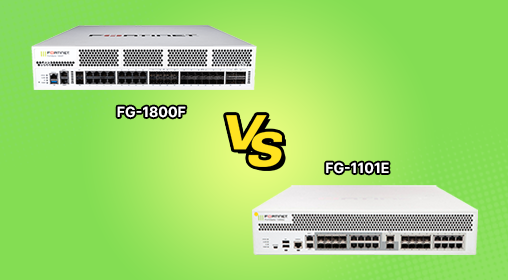
Let's talk about the raw numbers first, because they don't lie. The FG-1800F operates on a completely different level. Its Next-Generation Firewall (NGFW) throughput is a robust 11 Gbps, and it can handle a massive 750,000 new connections every second. This means it can inspect traffic deeply without becoming a bottleneck on your high-speed links. The FG-1101E, from the older E-series, was designed for its time and simply can't match this scale. The difference is most stark when you turn on advanced threat protection features. The 1800F maintains a threat protection throughput of 9.1 Gbps, allowing you to run intensive services like IPS and SSL inspection without crippling performance. For large enterprises, this is the difference between a true security gateway and a mere router.
|
Core Parameter |
FortiGate FG-1800F |
FortiGate FG-1101E (Representative) |
|---|---|---|
|
Firewall Throughput |
High (Data Center Grade) |
Moderate (Enterprise Branch Grade) |
|
NGFW Throughput |
11 Gbps
|
Significantly Lower |
|
Threat Protection Throughput |
9.1 Gbps
|
Lower |
|
IPS Throughput |
13 Gbps
|
Lower |
|
Concurrent Sessions (TCP) |
12 Million
|
Lower |
|
New Sessions/Sec (TCP) |
750,000
|
Lower |
|
High-Speed Interfaces |
40GE QSFP+, 25GE SFP28 ports
|
Standard 1GE/10GE ports |
Physically, the two units announce their different purposes through their design. The FG-1800F is built for a data center rack, with a substantial chassis that houses an impressive array of ports. It's equipped with multiple 40 Gigabit QSFP+ and 25 Gigabit SFP28 ports, ready for high-speed spine-and-leaf network cores. The FG-1101E, typically found in enterprise backbones or larger branch offices, has a more conventional set of 1GbE and 10GbE interfaces. It gets the job done, but it doesn't offer the same native connectivity for the fastest segments of a modern network. This physical disparity translates directly to expansion capabilities; the 1800F is built for growth and high-density connectivity right out of the box.
When it comes to features, both run FortiOS, providing a consistent management experience. However, the 1800F is engineered to handle those features at scale. Think of it this way: both cars have a powerful engine, but the 1800F has a much more advanced cooling system and transmission. Enabling SSL inspection on a 10 Gbps link would bring the 1101E to its knees, while the 1800F is designed to take it in stride. Its ability to maintain millions of concurrent connections and thousands of VPN tunnels makes it ideal for complex environments like multi-tenant data centers or large campuses.
For the network administrator, the user experience is defined by confidence. Managing the FG-1800F means you can deploy security policies without constantly worrying about performance overhead. Its massive headroom allows for aggressive threat protection settings and detailed logging without a performance tax. The FG-1101E requires more careful tuning; you might find yourself making compromises on inspection depth to maintain acceptable latency for critical applications. The 1800F offers a "set it and forget it" assurance, while the 1101E can feel more hands-on in a high-traffic scenario.
The value proposition is clear. The FG-1800F represents a significant investment but delivers superior long-term value for organizations with growing traffic demands or those already pushing against bandwidth limits. Its higher performance ceiling future-proofs your network and consolidates security functions that might otherwise require separate devices. The FG-1101E's advantage is its suitability for well-defined, substantial but not extreme, enterprise workloads where its lower initial cost is a perfect fit. However, its limitations in a high-growth environment could lead to an earlier, more costly upgrade cycle.
The FG-1800F's strengths are its raw power, high-speed port density, and stability under extreme load. Its potential drawback is that it might be overkill for networks that won't utilize its full capacity. Conversely, the FG-1101E's primary advantage is its proven reliability for standard enterprise duties. Both are built on Fortinet's stable operating system, but the 1800F's hardware is inherently more robust, with components designed to deliver consistent performance without faltering, even when every resource is being taxed.
In the end, the FG-1101E remains a capable unit for core enterprise routing and security where demands are predictable. But the FG-1800F is in a different league, built for the scale and speed of modern data centers. Your choice hinges on the trajectory of your network: one secures the present effectively, while the other is built to handle the unpredictable demands of the future.