
Intellectual Property
Hot selling product recommendations
View More



















F5's Load Balancing Powerhouses F5-BIG-LTM-I4600 vs F5-BIG-BT-I7800 : A Technical Face-Off
When comparing two tiers within F5 Networks' load balancing portfolio, the conversation inevitably turns to matching raw capability with operational demands. Placing the BIG-LTM-i4600 against the more advanced BIG-LTM-i7800 (represented in search results by the similar i5800/i10800 models) reveals a narrative of solid reliability versus expansive power. This isn't about declaring a single winner, but about understanding which engine is right for your data center's chassis.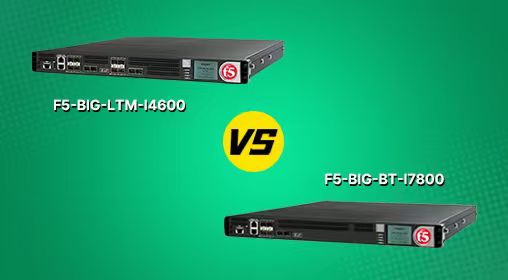
The core of the distinction lies in their performance envelopes. The i4600 is a robust workhorse, built on a 4-core Intel Xeon processor with 32GB of DDR4 memory, delivering a respectable 20Gbps of throughput. It capably handles 650,000 L7 requests per second and supports up to 28 million concurrent L4 connections. Stepping up to the i7800 class, exemplified by the i5800 with its 48GB RAM or the i10800 with a 8-core processor and 128GB RAM, performance scales significantly. We're looking at throughput leaping to 60-160Gbps, L7 request per second figures soaring to 1.8 million or more, and concurrent connections scaling to 40-100 million. The higher-end model also incorporates advanced hardware-based DDoS protection with the capacity to handle tens of millions of SYN cookies per second, a feature not present in the i4600's primarily software-based defense.
Physically, both units adhere to the standard 1U rack-mountable form factor, but differences emerge in weight, connectivity, and internal design. The i4600, weighing around 20 pounds, typically offers a configuration that includes options for 8 SFP gigabit fiber ports and 4 SFP+ 10Gb ports. The i7800-series appliances, being more densely packed, are heavier (around 26-36 pounds) and are distinguished by their inclusion of QSFP+ 40Gb fiber ports, providing critical high-speed backbone connectivity for data centers requiring immense bandwidth. This expanded physical capacity directly supports the higher virtualized guest counts, with the i7800 tier supporting up to 16 vCMP guests compared to the i4600's more limited virtualized capacity.
|
Core Parameter |
F5 BIG-LTM-i4600 |
F5 BIG-LTM-i7800 (Representative) |
|---|---|---|
|
Processor |
4-core Intel Xeon (8 threads)
|
4-core/8-core Intel Xeon (8/16 threads)
|
|
Memory |
32GB DDR4
|
48GB - 128GB DDR4
|
|
Typical Throughput |
20 Gbps
|
60 Gbps - 160 Gbps
|
|
L7 Requests/Sec |
650,000
|
1,100,000 - 3,500,000+
|
|
L4 Concurrent Connections |
28 Million
|
40 Million - 100 Million
|
|
High-Speed Ports (e.g., 40Gb) |
Not typically listed |
QSFP+ ports present
|
|
Hardware DDoS Protection |
Not listed |
25M - 130M SYN cookies/sec
|
For the network architect, the experience of managing these boxes is unified by F5's TMOS software architecture, but the day-to-day reality differs. The i4600 offers a solid, predictable environment ideal for well-defined, heavy workloads. Its value is in its proven stability and lower operational footprint. The i7800, however, is built for complexity and scale. Its ability to run numerous virtualized instances (vCMP) means it can act as a consolidated platform for multiple applications, departments, or security zones, simplifying the overall data center architecture even as it increases the capability of the individual device. Features like TurboFlex further enhance performance for specific traffic patterns, giving administrators more granular control.
Choosing between them boils down to the trajectory of your needs. The i4600's primary advantage is its exceptional suitability for core enterprise data center duties where requirements are high but predictable. It's a known quantity that delivers proven performance. The potential drawback is its lower ceiling for expansion, which could necessitate a premature upgrade in a rapidly growing environment. Conversely, the i7800-class appliance's strength is its immense headroom and advanced feature set, including hardware-level security and massive virtualization support. Its primary disadvantage is a higher initial investment, but for organizations where uptime, scalability, and consolidation are paramount, its long-term value and total cost of ownership can be significantly greater. Both are engineered for the high stability F5 is known for, with redundant power options and robust operating systems, but the higher-tier model is inherently built with more resilient components to handle its increased performance envelope.
Ultimately, the i4600 is the capable cornerstone for a demanding enterprise network, while the i7800 is the strategic engine for a scalable, consolidated, and future-proofed data center or cloud environment.