
Intellectual Property
Hot selling product recommendations
View More




















When it comes to enterprise networking hardware, the choice between Cisco's Catalyst C9200L-48P-4G-E and Juniper's QFX10002-72Q represents a fundamental decision between two different networking philosophies. These aren't merely two random switches from different manufacturers—they're designed for completely different environments and use cases. Understanding their strengths and limitations could mean the difference between a network that hums along smoothly for years and one that constantly requires workarounds and upgrades.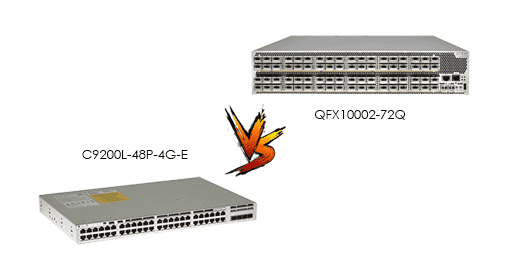
Let's break down how these two networking heavyweights compare across the critical dimensions that matter for your business.
Looking at the raw numbers reveals just how different these platforms are designed to be:
| Specification | Cisco C9200L-48P-4G-E | Juniper QFX10002-72Q |
|---|---|---|
| Port Configuration | 48x 10/100/1000Mbps PoE+ ports with 4x 1G uplinks | 72x 40GbE QSFP+ ports (24x support 100GbE) |
| Switching Capacity | 108GB backplane bandwidth | 5.76 Tbps throughput |
| Packet Forwarding Rate | 77.38 Mpps | 2 Bpps |
| Power Consumption | 1000W typical | Not specified, but optimized per 100GbE |
| Physical Dimensions | 440x445x288mm (1RU) | 2U form factor |
| Application Focus | Enterprise access layer with PoE+ support | Data center spine/leaf and core routing |
The numbers tell a clear story—the Juniper platform operates in an entirely different performance category, which makes sense given its data center focus. The Cisco switch offers more modest specifications suited to connecting end-user devices and PoE-enabled equipment like access points and phones.
The physical implementation of these switches reinforces their intended use cases. Cisco went with a compact 1RU form factor that fits standard server racks without consuming excessive vertical space. This design choice reflects the typical deployment environment where access switches need to be distributed throughout buildings, sometimes in space-constrained wiring closets. The chassis maintains a relatively lightweight profile at 4.8kg, making it manageable for a single technician to install.
Juniper's approach with the QFX10002-72Q embraces a 2U footprint to accommodate the substantial cooling and power requirements of a high-density 40/100GbE platform. This isn't a switch you'd hide in a small closet—it's built for dedicated data center environments where its 72 QSFP+ ports can form the backbone of a high-performance network. The cooling system employs three fan modules with dual counter-rotating fans that can be hot-swapped without interrupting operation, emphasizing the need for continuous availability in mission-critical deployments.
Diving deeper into capabilities, the Cisco C9200L-48P-4G-E shines in traditional enterprise environments. Its 48 Power over Ethernet Plus ports can deliver up to 30W per port to connected devices like wireless access points, IP phones, and surveillance cameras. This makes it an all-in-one solution for connecting and powering endpoint devices. The switch supports common enterprise features like VLAN segmentation with up to 1024 VLAN IDs, quality of service policies with 1000 entries, and multicast routing for 1000 groups. It's also stackable, allowing multiple physical units to be managed as a single logical device—a valuable feature for simplifying operations in distributed deployments.
Juniper's QFX10002-72Q takes a different approach, focusing on raw throughput and flexibility. Its deep buffers with Hybrid Memory Cube technology help absorb traffic bursts without packet loss, particularly important when dealing with speed mismatches between WAN and data center interfaces. The platform supports EVPN-VXLAN overlay networks for both Layer 2 and Layer 3, providing the architectural flexibility that modern cloud environments demand. Every port can be configured for 10GbE, 40GbE, or 100GbE operation, using breakout cables where needed. This flexibility allows network architects to adapt to changing requirements without replacing hardware.
Both manufacturers prioritize stability but approach it from different angles. Cisco boasts an impressive mean time between failures of 347,760 hours for the C9200L series—that's nearly 40 years of continuous operation. This reliability metric reflects the platform's suitability for environments where dedicated IT staff might not always be present to handle failures.
User reviews of similar Cisco Catalyst switches highlight their straightforward operation—one administrator noted that speeds were fast and stable right out of the box, with interfaces that worked immediately without complex configuration. The learning curve for Cisco's iOS XE is relatively gentle for those with general networking experience, and the extensive documentation and community knowledge base reduce troubleshooting time.
Juniper's reliability story centers on its redundant, hot-swappable power supplies and cooling modules, all serviceable without taking the platform offline. The Junos operating system provides a consistent experience across Juniper's switching and routing portfolio, which can significantly reduce operational overhead in networks already using other Juniper equipment. The integration with Juniper's Apstra automation system takes the platform beyond traditional management approaches, enabling intent-based networking where the system continuously validates that network behavior matches declared business objectives.
When evaluating these switches, context dramatically influences which represents the better value. The Cisco C9200L-48P-4G-E delivers an excellent price-to-performance ratio for conventional office environments, especially where Power over Ethernet requirements exist. The integrated PoE eliminates separate power injectors and cabling, resulting in both capital and operational savings. For organizations standardizing on Cisco, the consistent management experience across the Catalyst family and access to Cisco's support ecosystem provide additional value that isn't reflected in specification sheets.
The Juniper QFX10002-72Q justifies its substantially higher cost in environments that can leverage its massive throughput and port density. In a data center context, the cost per gigabit of switching capacity and the flexibility to support mixed 10/40/100GbE connections from the same platform can make it more economical than multiple lower-density alternatives. The automation capabilities through Apstra represent potentially significant operational expense reductions by simplifying configuration changes and proactive issue identification.
Choosing between these platforms comes down to honest assessment of your network's requirements:
The Cisco C9200L-48P-4G-E stands out for enterprise access layer deployments where PoE capabilities, straightforward management, and reliability matter more than raw throughput. Its limitations in port speed and scalability make it unsuitable for data center core roles, but as a device for connecting end-users and powered devices, it delivers exceptional value.
The Juniper QFX10002-72Q excels as a spine switch in data center fabric designs or for high-performance aggregation roles where 40GbE and 100GbE connectivity are non-negotiable. The substantial investment required only makes sense in environments that will actively utilize its performance headroom and architectural flexibility.
There's no universal winner here—the right choice entirely depends on where in your network the switch will operate and what performance characteristics matter most for your specific applications. Both represent competent implementations of their respective design philosophies, either of which could be the perfect solution given the right context.