
Intellectual Property
Hot selling product recommendations
View More




















Cisco Switch Showdown: C9300-48UXM-A vs. C9200L-24P-4X-E - Picking Your Network's Workhorse
Alright, let's talk about two serious contenders in the Cisco switching arena. If you're sizing up the Catalyst 9300-48UXM-A against the Catalyst 9200L-24P-4X-E, you're already looking at solid gear. But they're built for different playing fields. One's a heavyweight champion packed with every feature imaginable, and the other is a lean, mean, cost-effective machine. Choosing the right one boils down to where you plan to deploy it and what you need it to do tomorrow, not just today.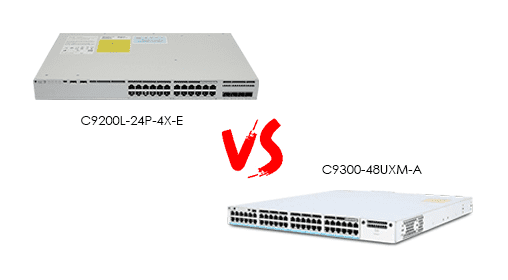
First, let's get straight to the nuts and bolts. A side-by-side look at the core specs tells you a lot about their intended roles.
|
Core Parameter |
C9300-48UXM-A |
C9200L-24P-4X-E |
|---|---|---|
|
Switch Ports |
48x Multi-Gigabit (100M/1G/2.5G/5G/10G), 12 are mGig
|
24x Gigabit (10/100/1000) PoE+ ports
|
|
Uplinks |
Modular (Supports various 1G, 10G, 25G, 40G modules)
|
4x fixed 10G SFP+
|
|
Power over Ethernet |
Universal PoE (UPoE), up to 90W per port
|
Standard PoE+
|
|
Total PoE Budget |
490W
|
370W (with 600W PSU)
|
|
Switching Capacity |
580 Gbps (1.06 Tbps with stacking)
|
128 Gbps
|
|
Forwarding Rate |
431.54 Mpps (788.69 Mpps with stacking)
|
190.4 Mpps
|
|
Memory (DRAM/Flash) |
8 GB / 16 GB
|
2 GB / 4 GB
|
|
Stacking Bandwidth |
480 Gbps (Cisco StackWise-480)
|
80 Gbps
|
|
Software |
IOS XE with Network Advantage
|
IOS XE with Network Essentials
|
Just glancing at that table, the C9300-48UXM-A clearly operates in a different performance tier. It's not just about having more ports; it's about the typeof ports. The multi-gigabit capability is a huge differentiator. As workplaces fill up with Wi-Fi 6 and Wi-Fi 6E access points that need more than 1G of uplink speed, those 2.5G/5G/10G ports on the C9300 become invaluable. It's built for the high-bandwidth, power-hungry world of today and tomorrow. The C9200L, on the other hand, is a classic and capable Gigabit switch, perfect for phones, standard wireless APs, and desktop computers, but it tops out at 1G per port.When you look at them, the C9300 feels like the more substantial piece of kit. It's a 1U form factor but weighs in at a solid 9.34 kg, giving it a dense, robust feel. The C9200L is lighter and shares a similar 1U height, but the C9300's modular uplink bay on the right is a clear visual cue to its flexibility. The fixed uplinks on the C9200L are simpler and great for a set-it-and-forget-it deployment.Feature-wise, the C9300 is a beast.That UPoE capability is a game-changer for powering things like high-end collaboration screens, building management systems, or even other network equipment directly from the switch, without a separate power source. Its modular uplinks mean you can start with 10G today and move to 40G or 100G in the future without replacing the entire chassis. Coupled with the Network Advantage license, you get full access to advanced Layer 3 routing, advanced security features like MACsec encryption, and SD-Access for software-defined networking. The C9200L with Network Essentials is no slouch, but it's designed for foundational connectivity and management, covering essential Layer 3 features and basic security.
So, which one should you pick? It's all about matching the tool to the job.
Go for the Cisco C9300-48UXM-A if:
You're running a dense, high-traffic environment like a modern enterprise office, a university lecture hall, or a high-tech hospital. You need to power advanced devices and are planning for significant growth. The investment is justified by the massive headroom, future-proof multi-gig ports, and architectural flexibility.
The Cisco C9200L-24P-4X-E is your winner if:
Your primary needs are rock-solid, reliable connectivity for a standard office, a school, or a retail branch. You have a well-defined set of devices that need PoE+ and solid 10G uplinks. You want the reliability of the Catalyst family and Cisco IOS XE but need to optimize the budget without sacrificing core performance.
Both are excellent switches; they just excel in different leagues. The C9300 is for building a network that's ready for anything you can throw at it in the next decade. The C9200L is the smart, efficient choice for nailing your connectivity needs today and for the foreseeable future.