
Intellectual Property
Hot selling product recommendations
View More




















When it comes to Cisco's switching portfolio, the Nexus 9396PX and Catalyst C9300L-48P-4G-E represent two fundamentally different philosophies aimed at distinct networking environments. One is built for raw data center performance, while the other serves as a versatile enterprise access layer solution. Let's break down how these two switches compare across the critical dimensions that matter for your network infrastructure.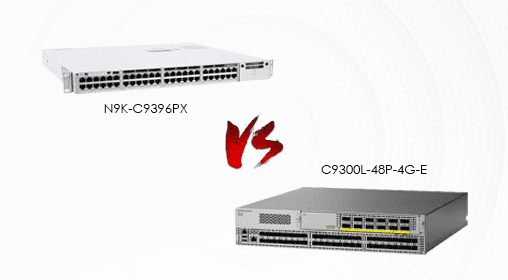
Diving straight into the technical heart of these systems reveals their divergent purposes immediately. The numbers tell a compelling story about where each switch excels.
|
Parameter |
N9K-C9396PX |
C9300L-48P-4G-E |
|---|---|---|
|
Port Configuration |
48x 10G SFP+ downlinks + 12x 40G QSFP+ uplinks (modular)
|
48x 1G PoE+ RJ-45 + 4x 1G SFP uplinks
|
|
Switching Capacity |
960 Gbps
|
104 Gbps
|
|
Forwarding Rate |
Not explicitly stated in search results, but designed for line-rate performance
|
77.38 Mpps
|
|
Power over Ethernet |
Not supported
|
740W total budget, 30W per port (PoE+)
|
|
Latency |
<1μs
|
<4μs
|
|
Stacking Technology |
Does not support stacking in traditional sense; supports Fabric Extenders (FEXs)
|
StackWise-320 (up to 8 units, 320Gbps backplane)
|
|
Typical Use Case |
Data center top-of-rack, high-performance computing
|
Enterprise access layer, IP phone and WAP connectivity
|
Looking at these foundational specifications, the Nexus 9396PX clearly targets environments where throughput and low latency are non-negotiable. With its 10G SFP+ ports and 40G uplinks, it's built for handling massive data flows between servers and storage systems. The Catalyst C9300L takes a different approach, focusing on connecting end devices with Power over Ethernet capabilities and gigabit connectivity that meets typical enterprise needs without overprovisioning.
The aesthetic and mechanical differences between these switches speak volumes about their intended homes. The Nexus model occupies a 2RU chassis with a robust steel construction designed for data center environments where airflow management is critical. It features front-to-back cooling with N+1 redundant fans that can be hot-swapped without tools, acknowledging that downtime in a server rack has serious consequences. The modular uplink design provides flexibility, allowing organizations to choose between 4-port 100G, 6-port 40G, or 12-port 40G configurations based on their aggregation needs.
Meanwhile, the Catalyst switch fits into a more compact 1RU form factor aimed at wiring closets and office environments. Its design considerations clearly prioritize different factors—particularly noise levels, since it might be deployed in spaces where people actually work. While specific noise ratings aren't provided for the C9300L, its cooling system is undoubtedly quieter than the Nexus model, which can reach up to 84.5 dB at full fan speed. The Catalyst also offers optional power redundancy, but interestingly ships with only a single power supply by default, suggesting a different expectation around uptime requirements.
When we examine what these switches actually do, the divergence in their design philosophies becomes even more apparent. The Nexus 9396PX is engineered for high-density data centers with features like VXLAN/EVPN support for network segmentation across multi-tenant environments, hardware-based IPsec encryption capable of 100Gbps throughput, and sophisticated telemetry streaming via ERSPAN. These are not enterprise features—they're solutions for service providers and large-scale cloud infrastructures where network virtualization and security are paramount.
The Catalyst C9300L-48P-4G-E focuses instead on the needs of connected workplaces. Its PoE+ capabilities can simultaneously power IP phones, wireless access points, and surveillance cameras without separate power sources. It supports Cisco's Software-Defined Access (SD-Access) for automated policy enforcement and comes with Cisco DNA Center integration for centralized management. The security features also reflect its enterprise orientation with MACsec encryption, TrustSec policy enforcement, and secure boot capabilities.
The software environment further highlights their different worlds: the Nexus runs Cisco's NX-OS, optimized for data center operations, while the Catalyst uses IOS XE, which will be familiar to enterprise network teams.
How do these switches actually perform when pushed? The Nexus 9396PX delivers consistent sub-microsecond latency even under full load, a critical requirement for financial trading applications or high-performance computing clusters where every nanosecond counts. With 960Gbps of switching capacity, it can handle massive east-west traffic flows typical in virtualized data center environments.
The Catalyst C9300L provides a different kind of performance advantage—its StackWise-320 technology allows up to eight switches to be interconnected with a 320Gbps backplane, creating a single logical switch that simplifies management and enhances resiliency. This stacking capability is far more valuable in distributed enterprise environments than raw throughput numbers. The 740W PoE budget is substantial enough to support modern power-hungry devices like Wi-Fi 6/6E access points and pan-tilt-zoom security cameras.
Both switches are built for reliability, but with different failure scenarios in mind. The Nexus incorporates full redundancy across power supplies and fans (2+1 fan configuration), recognizing that hardware failures in data centers must be resolved without service interruption. The components are hot-swappable, and the design assumes 24/7 operation under substantial loads.
The Catalyst offers power supply redundancy as an option rather than a standard feature, reflecting that occasional brief downtime for maintenance may be acceptable in enterprise settings. However, it provides stability through its stacking architecture—if one unit in a stack fails, the others continue operating, and the failed unit can be replaced with minimal disruption.
Determining which switch offers better value completely depends on your use case. The Nexus 9396PX targets organizations where performance and features justify the investment. While specific current market prices aren't detailed in the search results, the value proposition centers on its data-center-grade capabilities, including high port density at 10G speeds, flexible 40G/100G uplinks, and advanced features like VXLAN routing and hardware encryption.
The Catalyst C9300L-48P-4G-E delivers value through its versatility in enterprise environments. The integrated PoE+ eliminates separate power supplies for connected devices, reducing total cost of ownership for deployments with numerous IP phones, access points, and cameras. The stacking capability also reduces operational overhead by allowing multiple physical switches to be managed as one.
The choice between these two switches ultimately comes down to environment and application requirements. The Nexus 9396PX is unquestionably the right choice for data center deployments, high-performance computing environments, or as a core switch for large organizations moving massive data flows. Its superior throughput, low latency, and advanced data center features justify its positioning in Cisco's lineup.
The Catalyst C9300L-48P-4G-E shines as an enterprise access layer switch where Power over Ethernet, simplified management, and capital cost considerations take priority over raw throughput. It's ideal for connecting end-user devices in offices, schools, healthcare facilities, and retail environments where 1G connectivity suffices and PoE capabilities are essential.
Rather than thinking in terms of which switch is "better," the more appropriate question is which switch is better suited to your specific environment, performance requirements, and operational constraints. Both represent competent solutions for their intended domains, with the Nexus focused on uncompromising performance in the data center and the Catalyst delivering practical functionality for the enterprise edge.